How Heritage Craftsmanship Elevates Your Furniture Collections and Client Offerings
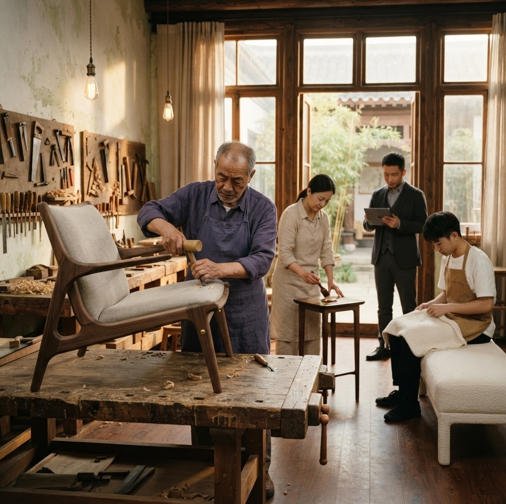
 A master artisan at work — where centuries of technique meet contemporary luxury design.
This is a comprehensive guide to understanding the artisanal processes behind Boca do Lobo’s sculptural furniture, designed specifically to help B2B partners — including furniture dealers, showroom directors, interior designers, and hospitality specifiers — communicate authentic craftsmanship value to their end clients, and differentiate their offerings in an increasingly crowded premium market.
The global luxury furniture market was valued at approximately $26.66 billion in 2026, projected to grow to $42.02 billion by 2034 (Fortune Business Insights, 2025). Yet paradoxically, as the market expands, the ability to differentiate within it is becoming harder, not easier. Every competitor claims “quality.” Every catalogue uses the word “handcrafted.” The dealers and showrooms that are pulling ahead are the ones who can tell a story that is verifiably, visually, and emotionally true — and that story starts with the people and processes behind the piece.
At Meubles Jade Ant, we work with partners who understand this. This guide is built for them.
The Heritage Foundation – Why Ancient Techniques Matter in Modern Furniture Design
Understanding the Legacy of Artisanal Furniture Making
Handcraft didn’t become a luxury signal arbitrarily. For millennia, before industrialization homogenized production, every piece of furniture was made by a specific person with a specific set of learned skills, using tools that had been refined across generations. The mortise-and-tenon joint — a woodworking technique traceable to ancient Egypt over 3,000 years ago — remains stronger under stress than most modern mechanical fasteners. Traditional dovetail joinery, developed in East Asia and refined in European cabinetmaking, distributes load across angled surfaces in ways that prevent the racking and loosening that dismantle flat-pack furniture within a decade.
These are not sentimental choices. They are structural realities. A hand-carved console using century-old joinery techniques will outlast three generations of mass-produced equivalents. When your clients invest in a piece that carries genuine heritage technique, they are not simply paying for aesthetics — they are acquiring an object built to a different standard of durability, one that will appreciate in character rather than depreciate in condition.
For B2B partners, this is the foundation of your narrative. Heritage technique isn’t nostalgia — it’s a verifiable quality claim with centuries of proof behind it.
The Evolution of Boca do Lobo’s Craft Philosophy
Boca do Lobo was founded in Porto, Portugal — a city with a woodworking and metalworking tradition stretching back to the Age of Discovery, when Portuguese shipbuilders and furniture makers were among the most technically advanced craftspeople in the world. The brand’s production philosophy draws directly from that lineage, integrating techniques like filigree (the ancient jeweler’s art of soldering twisted precious metal threads into intricate lace-like patterns), leaf gilding (applying tissue-thin gold leaf layer by layer to create depth and luminosity), metal casting (pouring molten metal into precision molds to form structural and sculptural elements), and hand-painted Azulejo tile work (the distinctive Portuguese tradition of hand-applying narrative scenes to ceramic surfaces) into furniture forms that are unmistakably contemporary in their silhouette and concept.
This is not a brand that applies “artisan” as a marketing badge. It is a production operation where the specific technical identity of each piece is inseparable from the human hand that made it.
Why B2B Clients Value Authentic Craftsmanship Narratives
Interior designers working on high-end residential projects face a challenge their clients rarely articulate directly but always feel: the difference between a room that looks expensive and a room that is expensive. Furniture with a provable artisan story closes that gap. When a designer can walk a client through the filigree process — explaining that a single side table drawer front took a master artisan 40 hours of hand-soldering — the price point transforms from an objection into an expectation.
Showroom partners who have integrated craftsmanship storytelling into their sales conversations consistently report that it reduces price resistance substantially. The conversation shifts from “why does this cost so much?” to “how long will I need to wait for mine?” That is the power of authentic heritage narrative — it creates a different buying psychology entirely.
The Master Artisans – Meet the Craftspeople Behind Your Collections
 Filigree artisans work under high-magnification conditions — precision at this level cannot be automated.
Profiles of Boca do Lobo’s Skilled Craftspeople
The artisans behind Boca do Lobo’s collections are not generalist factory workers who rotate between tasks. They are specialists — some of whom have spent 20 or more years mastering a single discipline. The filigree specialists, for example, are trained in an art form that was recognized by UNESCO as part of Portugal’s Intangible Cultural Heritage. The leaf gilding masters work with tools and application techniques that have been passed down through documented master-apprentice relationships, not manufacturing manuals.
The apprenticeship model is central to how this knowledge transfers. A new artisan joining the filigree team does not begin by handling precious metals. They spend months learning the behavior of wire, the physics of solder, the way humidity in the workshop affects adhesion — before they ever touch a production piece. This investment in knowledge transfer is what ensures that the 200th piece produced carries the same character and precision as the first.
Specialized Roles in the Production Process
The production team is organized around specific disciplines rather than generalist assembly lines. Master woodworkers oversee hand-carving and joinery, bringing decades of material knowledge — understanding how different wood species respond to different cutting angles, how grain direction affects structural integrity, how seasonal humidity changes affect wood movement. Metal artisans and finishing specialists manage casting, forging, welding, engraving, and patination, each of which requires distinct chemical and physical knowledge. Sculptural designers work at the intersection of concept and execution, translating design sketches into physical forms by solving the problems that paper cannot anticipate.
This specialization is a direct quality advantage. When a single artisan is responsible for one discipline across their entire career, they develop an intimacy with their material that produces outcomes impossible to replicate through any training program or quality control checklist.
How Artisan Expertise Translates to Product Differentiation
For your distribution channel, this specialist structure offers a specific commercial opportunity: the ability to offer limited bespoke customization that mass-market competitors simply cannot match. Boca do Lobo’s artisan teams can adjust scale, modify surface finishes, adapt material combinations, and respond to specific client briefs in ways that industrially produced furniture brands cannot, because their human expertise is the production system — not a downstream service bolted onto it.
Ancient Techniques Decoded – The Methods That Define Excellence
Woodworking Traditions and Hand-Carving Mastery
Wood carving at the level practiced in Boca do Lobo’s atelier is a physically demanding, intellectually complex discipline. The artisan begins not with the tool but with the wood — reading the grain direction, identifying the structural lines, understanding where the wood will want to split and where it will resist. Only then does the carving begin, using a sequence of chisels, gouges, and mallets that may number over 60 distinct tools for a single complex piece.
Traditional joinery — the mortise-and-tenon, the dovetail, the bridle joint — provides structural longevity that mechanical fasteners cannot match because they distribute force across larger glue surfaces and interlocking geometries. A well-executed mortise-and-tenon joint, properly made, can withstand decades of load without loosening, because the wood fibers interlock rather than simply compress against a metal screw thread.
Hand-carving creates something else entirely: sculptural dimension. The depth of a carved relief, the subtle undercutting of a decorative motif, the way a carved surface catches and redirects light — none of these effects are achievable through CNC routing, which can approximate the shape but not the surface character. The tool marks, micro-variations in depth, and subtle asymmetries of hand-carving are not imperfections. They are the visual signature of human craft.
The Art of Hand-Finishing and Surface Treatment
Surface finishing in heritage furniture making is a multi-stage process measured in weeks, not hours. Natural oil and wax finishes — linseed oil, tung oil, carnauba wax — penetrate the wood fiber and become part of the material rather than sitting on its surface. Over time, these finishes develop a patina: a depth of tone and surface character that polyurethane coatings cannot develop, because synthetic coatings age by yellowing and flaking while natural finishes age by deepening and enriching.
This aging behavior is one of the most powerful stories you can tell in a showroom setting. A client looking at a 10-year-old naturally finished walnut credenza is looking at a piece that has become more beautiful with use. A 10-year-old polyurethane-coated piece is simply older.
Sourcing and Sustainability in Heritage Craftsmanship
Artisanal furniture production carries a sustainability argument that is both authentic and commercially relevant. Heritage craft traditions prioritize material longevity — selecting materials that will last for generations rather than materials that are simply cheap to process. This reduces replacement cycles dramatically. A mass-produced hardwood substitute bedroom suite might require replacement within 8–12 years. A hand-crafted solid walnut or oak piece, properly maintained, will outlast its owner.
For your eco-conscious clients in hospitality and high-end residential design, this longevity argument directly addresses the sustainability question that increasingly drives procurement decisions. Jade Ant Furniture’s partners working in the hotel and resort sector have used this narrative effectively with clients requiring sustainability reporting — longer furniture replacement cycles mean lower material throughput and reduced carbon impact over the building’s lifecycle.
Metal and Mixed-Media Integration – Elevating Traditional Techniques
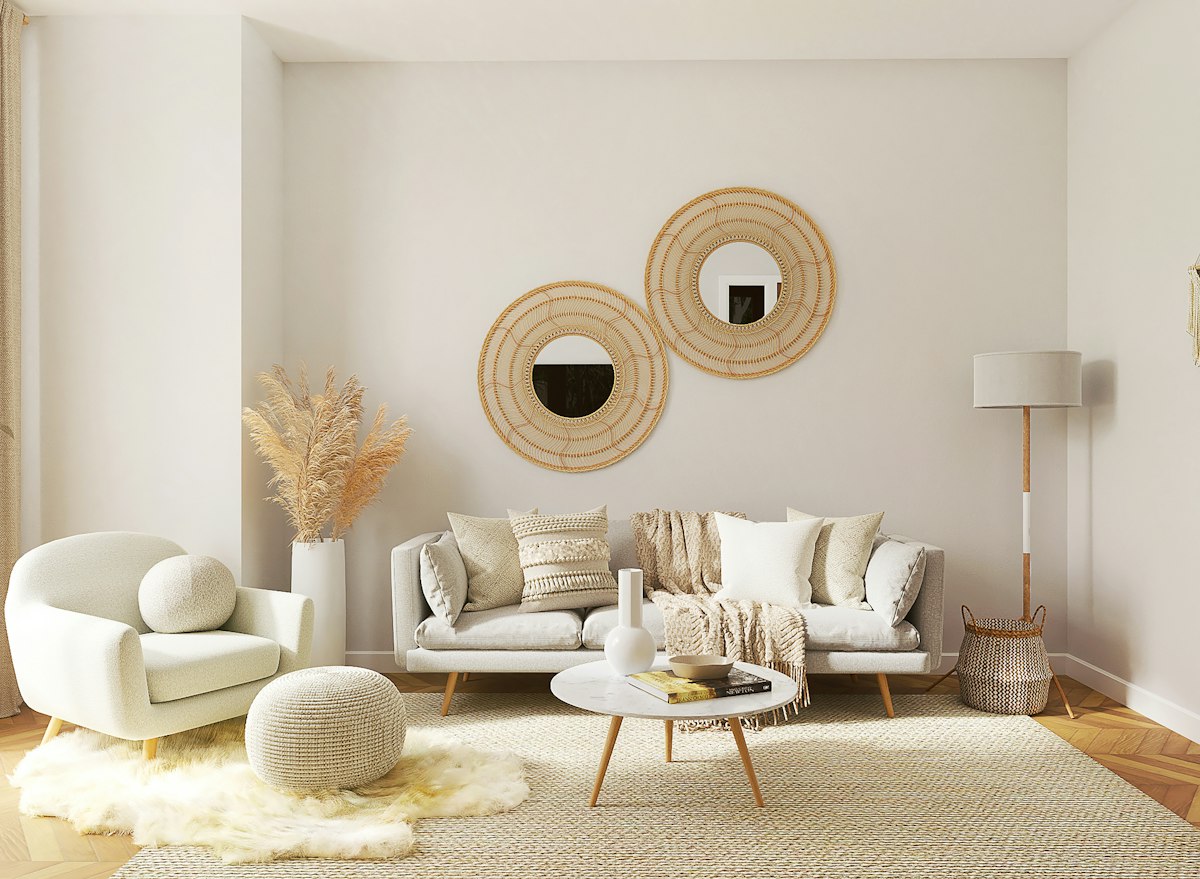 The integration of cast brass and hand-carved wood creates a material dialogue impossible to achieve through industrial production.
Metalworking Heritage and Contemporary Applications
Metal casting — the process of heating metal to its molten state and pouring it into a precision mold — is one of the oldest manufacturing techniques in human history, with documented use in furniture and decorative arts dating back over 5,000 years to Bronze Age China and Mesopotamia. Boca do Lobo’s metal casting operations honor this tradition while applying it to contemporary sculptural furniture forms that would have been technically impossible in any previous era.
The material range extends well beyond bronze and brass. Gold leaf, silver wire, patinated iron, polished stainless steel, and experimental alloys all appear in the collection, each with different visual and tactile properties. The selection of metal for a given piece is an artisan decision, not a cost decision — based on the piece’s structural requirements, its intended visual effect, and how the metal will interact with adjacent materials over time.
Inlay, Veneer, and Decorative Techniques
Marquetry — the art of arranging thin slices of wood veneer, precious stone, metal, or shell into decorative patterns — dates to Renaissance Europe and reached its technical apex in the royal workshops of 17th-century France. The precision required is extraordinary: individual veneer pieces must fit together with tolerances measured in fractions of a millimeter, or the composite surface will develop visible gaps as the materials expand and contract seasonally.
Metal inlay — routing precise channels into wood or stone surfaces and pressing fitted metal wire or sheet into them — creates visual effects of extraordinary richness: the gold line of a brass inlay set into dark ebonized oak has a contrast and tactile depth that no printed or applied decoration can replicate. These techniques require years of practice to execute at production quality levels, which is precisely why they represent a genuine competitive moat for brands that have invested in maintaining the craft tradition.
Quality Standards in Mixed-Media Production
Combining multiple craft disciplines in a single piece — say, a sideboard that integrates hand-carved solid walnut, cast brass handles, hand-applied gold leaf panels, and hand-painted ceramic tile insets — creates a quality assurance challenge that requires holistic artisan oversight. Each material expands and contracts at a different rate. Each finish interacts differently with its neighbors. Each joining technique must be selected for compatibility with adjacent materials.
The quality standards applied in this multi-discipline context go well beyond visual inspection. Pieces are evaluated for structural integrity under simulated use conditions, for finish compatibility and adhesion, and for consistency with approved design references. The documentation of this process — which technique was applied at which stage, by which artisan, using which materials — provides the technical foundation for the authenticity certification that accompanies every piece.
The Production Journey – From Raw Materials to Finished Masterpieces
Stage 1 – Material Selection and Preparation
The production journey begins before any tool touches any material. Senior artisans evaluate incoming timber for grain density, moisture content, structural integrity, and visual character. Wood that passes visual inspection is tested for moisture — lumber with too-high moisture content will shrink dramatically after installation, creating gaps at joints; too-dry lumber may crack in humid environments. Correct moisture conditioning typically requires 4–8 weeks of controlled storage before a timber is ready for production.
Metals are evaluated for purity, alloy consistency, and casting behavior. Gold leaf is tested for karatage and adhesion quality. Ceramic tile blanks are inspected for surface consistency before they go to the hand-painting team. This front-end investment in material quality is not visible in the finished piece — but it is entirely responsible for the finished piece’s longevity and stability.
| Matériau | Key Quality Criteria | Conditioning Period |
|---|---|---|
| Solid hardwood (walnut, oak, mahogany) | Grain density, moisture content (8–12%), structural integrity | 4–8 weeks |
| Precious metals (brass, bronze, gold) | Alloy purity, casting consistency, surface porosity | Batch testing |
| Ceramic tile blanks | Surface uniformity, glaze adhesion quality | Pre-firing inspection |
| Gold leaf | Karatage, leaf thickness, adhesion behavior | Per-batch testing |
| Natural stone | Veining consistency, porosity, structural soundness | Visual + percussion testing |
The Critical Role of Material Knowledge
One of the most significant differences between artisanal and industrial production is the depth of material knowledge held by the people making production decisions. An artisan who has worked with European walnut for 20 years understands how the wood responds to seasonal humidity cycles, how different cutting angles affect surface texture, and how the heartwood and sapwood of a specific log will develop different patinas over time. This knowledge directly affects production decisions: which parts of a log are used for structural components, which for decorative faces, which are set aside for complementary pieces.
For your B2B communication strategy, this depth of material knowledge is a story in itself. The idea that a single plank of wood has been evaluated by a human expert before becoming part of a piece in a client’s home is a fundamentally different proposition than a material description on a specification sheet.
Sustainability Practices in Material Management
Waste reduction in artisanal production is driven not by environmental policy but by the inherent economics of working with expensive, high-quality materials. When your raw material costs more per board-foot than a mass-producer’s finished panel, you do not waste it. Offcuts from walnut carving become handles or inlay components. Excess brass from casting operations is re-melted. This embedded efficiency is an authentic sustainability story, one grounded in craft economics rather than corporate communications.
Stage 2 – Design Translation and Artisan Interpretation
From Concept to Execution – The Designer-Artisan Collaboration
The design process at Boca do Lobo does not end when the sketch is approved. In artisanal furniture production, the drawing is a starting point — the artisan’s interpretation of that drawing in physical materials is where the design truly resolves. Wood grain does not follow drawings. Cast metal develops surface textures that rendering software cannot predict. Hand-applied patinas develop character through chemical reactions that cannot be fully specified in advance.
This means the designer-artisan collaboration is continuous and bidirectional. Artisans bring technical knowledge that shapes design decisions: a carving that looks elegant in section may require a wood thickness that affects the piece’s visual proportion. A metal casting that achieves the right sculptural effect may require a wall thickness that changes the piece’s weight and installation requirements. These conversations are part of the design process, and their outputs are what make Boca do Lobo pieces feel resolved in ways that purely drawn and then industrially manufactured furniture cannot achieve.
Customization Capabilities and Bespoke Production
For B2B partners, the designer-artisan collaboration model has a direct commercial implication: genuine customization capability. Because the artisan team works from first principles rather than from tooling constraints, modifications to scale, material, finish, and detail are achievable at the production level rather than only at the specification level. A hospitality client requiring a console scaled to a specific lobby dimension, finished in a custom lacquer that matches the project’s color palette, with hardware adapted from a reference to a different period — this is a conversation that Boca do Lobo’s artisan team can engage with. Industrial manufacturers cannot have this conversation, because their production is defined by fixed tooling, not human capability.
Managing client expectations around lead times for customized pieces requires clear communication from the outset. Standard pieces typically carry a 4–8 week production schedule. Customizations that modify material, finish, or structural elements typically add 2–4 weeks. Complex bespoke commissions — new designs or significant scale modifications — require dedicated production planning and timeline discussions on a project-by-project basis.
Quality Assurance Through Artisan Expertise
Quality assurance in artisanal production is continuous rather than terminal. Artisans evaluate their work at each stage of production — not against a checklist but against a deeply internalized standard developed through years of practice. They identify and correct issues in-process, before they become structural or aesthetic problems in the finished piece. This is fundamentally different from industrial quality control, which inspects finished products against specifications and either passes or rejects them.
The result is a much lower incidence of quality failures at the finished stage — and when issues do arise, they are typically surface-level corrections rather than structural defects, because the artisan’s continuous oversight prevents structural errors from progressing to the finishing stage.
Stage 3 – Handcrafting Techniques in Action
 Leaf gilding requires years of practice to master — the application of tissue-thin gold leaf demands perfect humidity control and an extraordinarily steady hand.
The Carving and Sculpting Process
Hand-carving a complex relief panel — the kind that appears on the facades of Boca do Lobo’s most celebrated sideboard designs — is a process that unfolds over days, not hours. The artisan begins with the bosting stage: establishing the primary masses and depths of the design using large gouges and chisels. This stage requires understanding of the finished composition in three dimensions, not just in plan — the artisan must see the finished form in the raw material.
Le modeling stage follows: refining the forms established in bosting, developing the transitions between depths, creating the smooth curves and crisp arrises that give carved relief its visual drama. Finally, the detailing stage: adding fine surface texture, undercutting elements to create shadow, and refining every surface that will be visible in the finished piece.
A senior carver working on a complex piece may spend 60–120 hours on a single panel. This time investment is the most honest answer to a client’s question about why a handcrafted piece costs what it costs — it represents the irreducible minimum of human expertise applied to an irreplaceable material.
Creating Sculptural Dimensions and Visual Interest
The visual power of hand-carved furniture comes from its behavior across different lighting conditions. Because carved surfaces are genuinely three-dimensional — not printed, applied, or routed — they respond to raking light, diffused light, and directed spotlight in completely different ways. A piece that appears elegant and restrained under diffused ambient light transforms under directional accent lighting, revealing depths and transitions that were invisible before.
This lighting responsiveness is an important showroom tool. Training your team to demonstrate pieces under different lighting conditions — and explaining why the piece responds this way — is one of the most effective ways to communicate the value of hand-carving to clients who may not have previously encountered furniture at this level.
Problem-Solving During Handcrafting
Material behavior is never entirely predictable, even for the most experienced artisan. A timber that was correctly specified and conditioned may reveal internal stress when cut — stress that was invisible at the surface. A cast metal component may develop a slightly different surface texture than expected due to trace variations in alloy composition. These situations require adaptive problem-solving within the existing design framework, a capability that is uniquely human.
Boca do Lobo’s artisan team approaches these moments as creative challenges rather than production failures. The solutions they develop — adjusting carving depth to work with rather than against internal grain, developing a new patination approach to unify slightly varied metal surfaces — frequently become production refinements that improve the piece beyond its original specification.
Stage 4 – Finishing, Refinement, and Final Details
Hand-Finishing Excellence and Surface Perfection
The finishing process is where a furniture piece transitions from a well-made object to a remarkable one. At Boca do Lobo, finishing is a multi-stage operation that begins with progressive sanding — moving from coarse grits that establish the surface plane through medium grits that remove tool marks to fine grits that create the smooth, consistent surface that finish materials require. This process is done entirely by hand on carved surfaces, where the complex three-dimensional topography makes machine sanding impossible without destroying the carved detail.
Natural finish applications — oils, waxes, and shellac-based products — are applied in multiple thin coats with hand-rubbing between each coat. This builds a finish that has depth — not the mirror-flat surface of sprayed synthetic lacquer, but the warm, nuanced surface that has absorbed its finish material and reflects light from within the material rather than from a surface coating.
Patina Development and Aging Processes
Patina development — the deliberate or natural aging of surfaces to create depth of character — is both an art and a science. Metal patinas are developed through controlled application of chemical solutions that react with the metal surface, creating oxide layers with specific colors and textures. A liver of sulfur application darkens brass or bronze through a controlled oxidation reaction; the artisan controls the depth and character of the effect by the concentration of the solution, the application method, and the buffing and sealing that follows.
Wood patinas develop over time through UV exposure, handling, and the polymerization of natural finish materials. The artisan can accelerate aspects of this process — using ammonia fuming to gray and darken oak rapidly, for example — or allow the piece to develop naturally over the client’s ownership. Either approach creates a surface character that was literally impossible to predict at the design stage and is unique to each individual piece.
Final Quality Verification and Documentation
Every piece leaving Boca do Lobo’s atelier passes through a formal multi-stage inspection process. Structural integrity is verified — joints are tested for stability, moving components for smooth operation, hardware for correct function. Surface finish is evaluated under raking light that reveals any inconsistency invisible under diffused illumination. Dimensional compliance is checked against approved specifications for pieces with installation-critical dimensions.
Documentation accompanies every finished piece: a certificate of authenticity specifying the artisan’s signature and the techniques applied; a materials specification detailing the specific timbers, metals, and finish materials used; and a care guide developed for the specific finish applied. This documentation package is a tangible asset for your showroom — it is the physical evidence of the craftsmanship story you have been telling.
Storytelling as a B2B Asset – Leveraging Craftsmanship in Your Sales Strategy
Creating Compelling Narratives Around Handmade Furniture
The most effective craftsmanship narratives are specific, not general. “Handmade by skilled artisans” closes no sale. “The drawer front on this console was hand-soldered by a filigree master over the course of 40 hours, using a technique that originated in Renaissance-era Portuguese jewelry making” changes the conversation. The specificity carries credibility, and the credibility carries value.
Your sales team does not need to be technical experts in wood carving or metalworking. They need to be fluent in three to five specific stories — the filigree process, the metal casting technique, the leaf gilding application — and able to tell those stories with confidence and visual support. The documentary content that Boca do Lobo produces is designed precisely to enable this: a two-minute video of an artisan at work is worth more than any amount of verbal description, because it shows the reality that the description asserts.
Marketing Materials and Client Education Resources
The documentary video series that Boca do Lobo has produced represents an exceptional client education resource. Full-length episodes are appropriate for showroom display screens or private client presentation environments. Shorter clips — 60 to 90 seconds — are highly effective on social channels and in email marketing. The key principle is that video content should be shown, not just mentioned. A client who watches an artisan apply gold leaf for 90 seconds understands something about the object in front of them that no specification sheet can convey.
Educational seminars and webinars designed specifically for interior designer partners are another high-value channel. Designers who understand the production process are dramatically better advocates for the collection than those who are simply familiar with the product. A designer who can explain to a client why a piece looks the way it looks — what technique created that surface, how that patina will develop over time — is a far more powerful distribution channel than one who can simply specify by model number.
Building Premium Positioning Through Heritage
The scarcity narrative in artisanal furniture is not manufactured — it is real. A filigree master who has spent 25 years developing expertise in a technique recognized by UNESCO represents a genuinely scarce production resource. The annual output of such an artisan is finite. When your clients understand that they are acquiring one of perhaps 40 or 50 pieces that will ever be produced in a specific year by this specific team, the premium price point is not a barrier — it is a feature.
This perceived scarcity is also a client retention tool. A client who has acquired a piece that their neighbors cannot simply replicate by visiting a different showroom has a different emotional relationship with that object — and with the partner who sourced it for them. Building that relationship is how Meubles Jade Ant partners develop the kind of client loyalty that produces referrals and repeat commissions rather than single transactions.
Implementing Artisan Partnerships – Practical Guidance for B2B Success
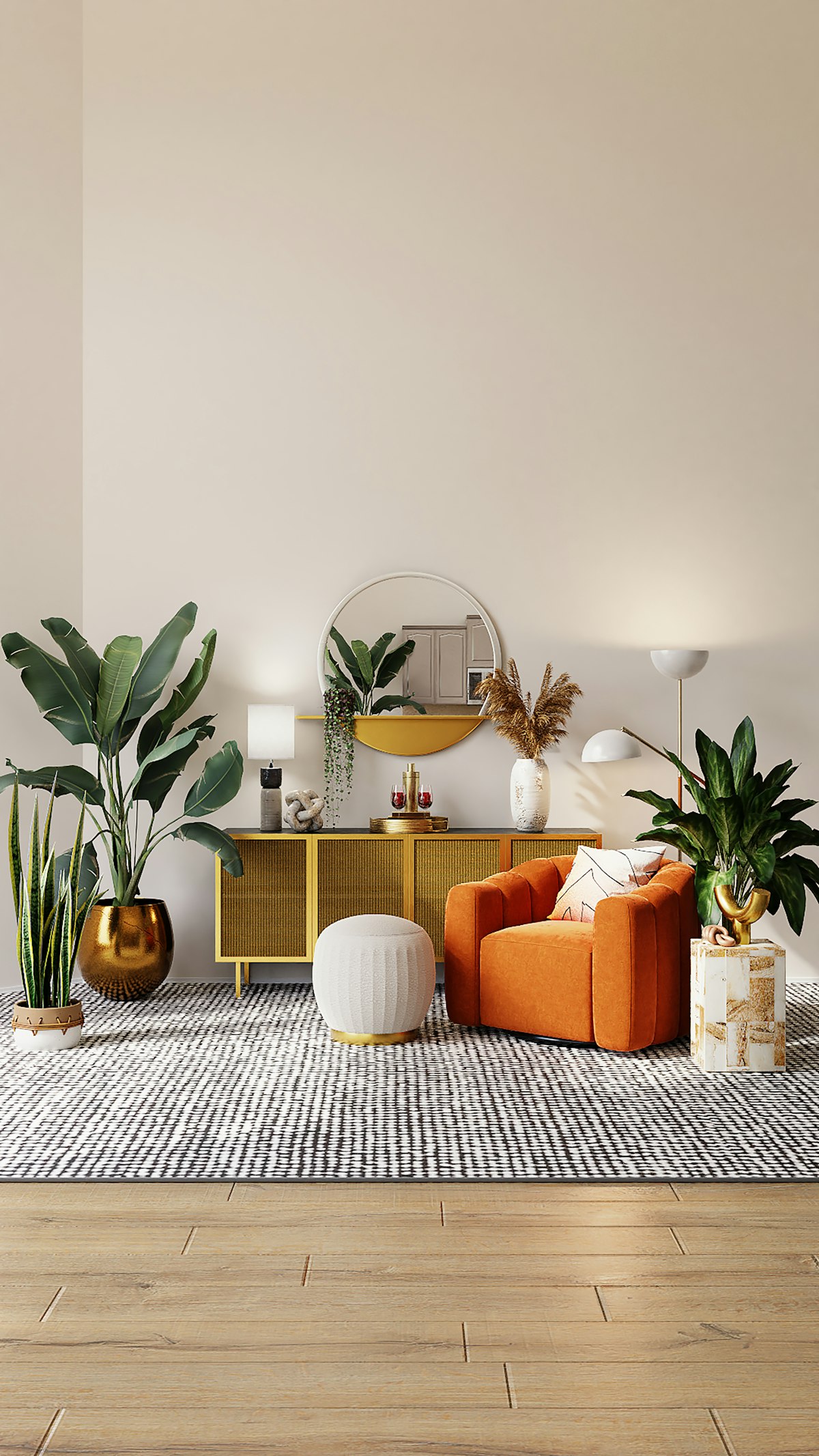 A well-curated showroom environment tells the craftsmanship story before a single word is spoken.
Collaborating with Boca do Lobo for Your Business Model
Working with handmade production requires a different inventory philosophy than working with industrial manufacturing. Lead times are longer and less compressible — you cannot simply increase line speed when a large order comes in. The solution is collaborative production planning: working with the atelier team well in advance of anticipated demand, maintaining a thoughtfully selected display inventory that demonstrates the range of techniques and materials available, and setting clear client expectations about lead times at the beginning of every sales conversation rather than as a footnote to the proposal.
The most successful B2B partners in this category operate on a showcase-plus-order model: they carry sufficient display inventory to demonstrate the full range of the collection and drive the emotional purchase decision, then manage client expectations around production lead times with transparency and confidence. Clients who understand why a piece takes 8 weeks — who have seen the documentary content and understand the filigree process — accept that timeline as evidence of the piece’s value rather than as a logistical inconvenience.
Training Your Team to Communicate Craftsmanship Value
Effective internal training for a craftsmanship-focused sales team has three components. The first is process knowledge: a working understanding of the key techniques — not at the level of technical execution, but at the level of being able to explain what the technique is, how long it takes, and what visual or tactile effect it produces. The second is material knowledge: understanding the key material properties that clients will encounter in descriptions and specifications — what makes European walnut different from American walnut, what “patinated bronze” means and how it will look in 10 years. The third is story fluency: the ability to move naturally between technical description and client-relevant narrative, connecting the production reality to the client’s emotional and aesthetic goals.
| Training Component | What It Covers | Client-Facing Application |
|---|---|---|
| Process Knowledge | Key techniques: filigree, leaf gilding, hand-carving, metal casting | “Let me show you how this surface was created…” |
| Material Knowledge | Timber species, metal alloys, natural vs. synthetic finishes | “This walnut will develop a richer tone over time because…” |
| Story Fluency | Connecting technique to value, rarity, and emotional resonance | “Only a handful of artisans in the world can do this…” |
| Objection Handling | Price point, lead time, variation responses | “The variation you see here is actually what makes it authentic…” |
| Documentary Content | Using video in presentations and showroom displays | Showing, not just telling |
Leveraging Documentary Content in Your Distribution Channel
The documentary content produced by Boca do Lobo is one of the most under-leveraged assets in the B2B partnership toolkit. Partners who have integrated video content into their showroom presentation systems — running craftsmanship documentaries on display screens near the relevant pieces, showing short clips during client consultations on tablets, incorporating behind-the-scenes footage into Instagram and website content — consistently report higher client engagement and stronger conversion rates on premium pieces.
The key to effective use of this content is contextual placement: the filigree documentary should play near the filigree piece, not in a generic brand reel. The metal casting video should accompany the cast bronze console, making the connection between the production reality and the physical object immediate and legible to the client.
Watch: The Art of Craftsmanship – A Boca do Lobo Documentary
Understanding the process is the first step to communicating its value. The following documentary provides an in-depth look at the techniques and artisans behind the collections.
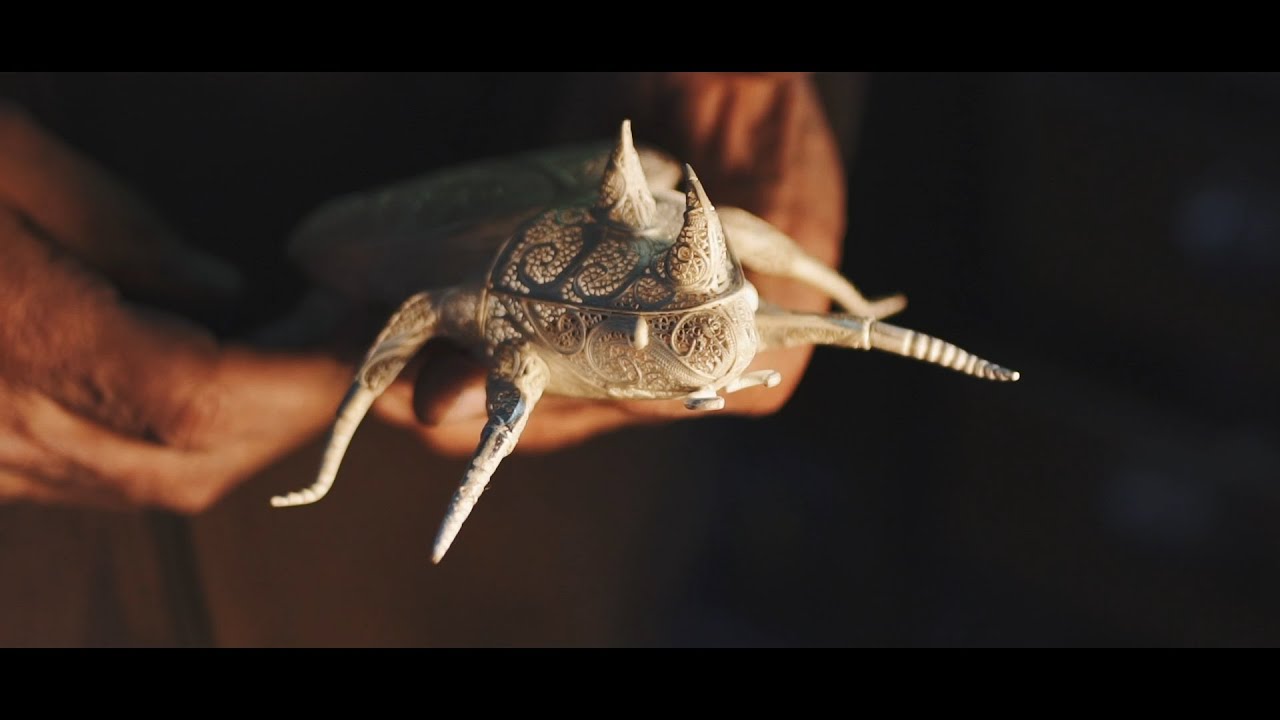
▶ Watch: “A Design and Craftsmanship Documentary by Boca do Lobo” — A testimony of ancient techniques reinterpreted in contemporary furniture form.
The Competitive Advantage of Authentic Craftsmanship
Positioning Your Business as a Premium Furniture Partner
The luxury furniture market rewards authenticity above almost all other attributes, because authenticity is the one thing that cannot be manufactured. A mass-market brand can invest in better photography, more compelling showrooms, and more sophisticated marketing — but it cannot invest its way into a genuine artisanal heritage. That heritage takes generations to build, and once built, it is the most defensible competitive position in the market.
Partners who build their positioning around authentic craftsmanship narratives — who invest in understanding the techniques, training their teams, using the documentary content, and telling specific stories with credibility and confidence — create a market position that is genuinely difficult for competitors to attack. They are not competing on price or on product breadth. They are competing on knowledge, trust, and the ability to give clients access to something that is genuinely rare.
The global luxury furniture market’s trajectory — from $26.66 billion in 2026 toward $42 billion by 2034 — tells us that demand for exceptional furniture is growing. What’s not growing at the same rate is the supply of genuinely credible luxury positioning. The partners who move now to build deep craftsmanship expertise into their brand narrative will hold that advantage for years.
Next Steps for B2B Partners
If you are a furniture dealer, showroom director, interior designer, or hospitality specifier looking to elevate your collection with authentic artisan-crafted pieces, the starting point is a conversation. Meubles Jade Ant works with B2B partners to develop tailored inventory strategies, access comprehensive training and documentary materials, and build the product knowledge foundation that makes craftsmanship selling genuinely effective.
For further reading on craftsmanship techniques, you might also explore resources such as Boca do Lobo’s official craftsmanship page, which provides technique-level detail on the specific processes covered in this guide.
Ready to Transform Your Furniture Collections with Authentic Craftsmanship Stories?
Contact our B2B Partnership Team to explore the following opportunities. Access the complete “Behind the Craft” documentary series for use in your showroom and digital marketing channels. Receive customized marketing materials developed specifically for your client segment and market position. Schedule a one-to-one consultation to develop your artisan-focused sales strategy and identify the pieces from the collection that best serve your inventory goals. Explore exclusive partnership arrangements and priority production scheduling for your key accounts.
Schedule Your Partnership Consultation Today →
Glossary of Key Craft Terms
Before the FAQ section, here is a quick reference for the technical terms used throughout this guide — terms you may encounter in client conversations or technical documentation.
Mortise-and-tenon joint: A woodworking joint in which a projecting element (tenon) fits into a corresponding cavity (mortise) to create a strong, load-distributing connection. Dates to ancient Egypt.
Filigree: A delicate jewelry technique applied to furniture, in which thin threads of precious metal (gold, silver) are soldered into intricate lace-like patterns. UNESCO-recognized as part of Portuguese Intangible Cultural Heritage.
Leaf gilding: The application of extremely thin sheets of gold (or other metal) to surfaces using specialized adhesives. Builds depth and luminosity through layered application.
Patina: The surface character developed by metal or wood over time through chemical reaction, use, and exposure. In artisanal furniture, patina is evidence of quality materials and authentic aging.
Marquetry: The art of creating decorative patterns by assembling thin pieces of veneer (wood, stone, shell, or metal) and applying them to a substrate surface.
Metal casting: The process of heating metal to its molten state, pouring it into a mold, and allowing it to solidify in the desired form. Enables complex sculptural shapes impossible to achieve through machining.
Azulejo: The traditional Portuguese hand-painted ceramic tile, applied in Boca do Lobo’s furniture as both decorative surface panels and narrative elements.
Frequently Asked Questions
1. How long does it typically take to handcraft a single Boca do Lobo piece?
Production timelines reflect the complexity and technique intensity of each design. Standard pieces typically require 4–8 weeks from material preparation through final finishing and quality certification. Designs incorporating multiple complex techniques — filigree combined with hand-carving and leaf gilding, for example — may extend to 12 weeks or more. Fully bespoke commissions involving new design development or significant scale modifications are scheduled on a project-by-project basis. At Jade Ant Furniture, we provide production schedules for all orders at the time of placement, giving you the information you need to manage client expectations with confidence.
2. What makes handcrafted furniture worth the premium pricing compared to mass-produced alternatives?
The premium is best understood across four dimensions. Structural durability: traditional joinery and solid material construction means handcrafted pieces routinely last 40–100 years, while mass-produced equivalents may require replacement within a decade. Unique character: no two handcrafted pieces are identical; variations in grain, patina, and surface texture make each piece genuinely individual. Customization: artisan production can respond to specific client requirements that industrial tooling cannot accommodate. And appreciating value: a well-made piece in quality materials becomes more beautiful with age, rather than more worn.
3. Can we customize designs for our specific client requirements, and how does this impact production time?
Customization is a core capability of artisan production, not an add-on service. Modifications to scale, material selection, finish treatment, and hardware detailing are all achievable within the production framework. Simple finish or material substitutions typically add 1–2 weeks to standard production schedules. More substantial modifications — scale changes or structural adaptations — typically add 2–4 weeks. New design commissions require dedicated production planning discussions.
4. How do we communicate the value of ancient techniques to our interior design clients and end consumers?
The most effective communication strategy combines visual evidence with specific narrative. The “Behind the Craft” documentary series provides the visual evidence — watching an artisan apply filigree or leaf gilding communicates in 90 seconds what verbal description cannot achieve in 30 minutes. Specific stories — the number of hours a particular surface took, the lineage of a specific technique, the rarity of the expertise involved — provide the narrative anchors that make the visual evidence memorable and repeatable in client conversation.
5. What documentation and certifications come with each handcrafted piece?
Every piece includes a certificate of authenticity carrying the artisan’s signature and the date of completion; a materials specification identifying the specific timber species, metal alloys, and finish materials used; a technique documentation sheet describing the production processes applied; and a care guide developed specifically for the finish treatment used in that piece. This documentation package supports your premium positioning at the point of sale and provides the client with lasting evidence of the piece’s provenance and quality.
6. How do we handle variations in handmade pieces, and what quality standards are guaranteed?
Natural variation is inherent to handcrafted production and is one of the defining characteristics that distinguishes artisan pieces from industrial ones. Grain patterns, patina tones, and subtle surface variations are evidence of authentic craftsmanship, not quality failures. However, all pieces meet strict structural and dimensional specifications, and aesthetic variations are evaluated against approved design references to ensure they fall within acceptable parameters. The most effective approach with clients is to position variation as individuality — each piece is genuinely unique, which is part of what they are acquiring.
7. What are the sustainability credentials of Boca do Lobo’s artisanal production?
The sustainability case for artisanal furniture production is rooted in longevity rather than certification. A piece designed and built to last 50–100 years has a dramatically lower material throughput impact over its lifetime than three or four mass-produced replacements. Beyond longevity, artisan production inherently minimizes waste through skilled material use, sources locally to reduce transport impact, and uses natural finish materials with lower VOC profiles than many synthetic alternatives. Detailed sustainability documentation is available for partners working with clients who have specific environmental procurement requirements.
8. How can we integrate the “Behind the Craft” documentary content into our showroom and digital marketing?
The documentary series is available in multiple formats optimized for different usage contexts. Full-length episodes (typically 8–15 minutes) are suited for showroom display screens positioned near relevant pieces or for private client presentation environments. Short-form clips (60–90 seconds) are highly effective on Instagram, LinkedIn, and email marketing, as well as in tablet-based client consultations. Usage rights and licensing terms for partner use of documentary content are defined in the B2B partnership agreement.
9. What training and support do you provide to help our sales team communicate artisan value effectively?
Partner onboarding includes comprehensive craft education covering the key techniques in the collection, material knowledge relevant to sales conversations, objection-handling guidance for the most common client questions, and video tutorials for each major production process. Ongoing support includes access to new documentary content as it is produced, regular webinars on collection developments, and a dedicated B2B support line for technical questions from your team or your clients.
10. How do we manage inventory when working with handcrafted production instead of mass-manufactured stock?
The showcase-plus-order model works most effectively for partners in this category: maintain a curated display inventory that covers the key techniques, materials, and price points of the collection, and manage client expectations around production lead times as a quality narrative rather than a logistical limitation. Collaborative production forecasting — planning orders 8–12 weeks in advance based on anticipated client demand — significantly reduces the lead time experience for clients and smooths the production schedule for the atelier. Jade Ant Furniture works with partners to develop inventory plans that balance display richness with business planning practicality.
11. What happens if a client wants to modify a design after production has begun?
The production stage at which a change is requested is decisive. Modifications raised during the design and material selection phase — before any cutting, casting, or forming has begun — can typically be accommodated with minimal schedule impact. Changes requested during the handcrafting stages are significantly more complex and may require assessment of feasibility before any commitment can be made. Changes that would require discarding completed work are generally not feasible without restarting the piece from the beginning. We maintain clear communication about production stages and key decision points to prevent this situation from arising.
12. How do we position Boca do Lobo pieces against competitors who claim handcrafted quality but use industrial production?
The documentary content is the most powerful differentiator available, because it provides visual evidence that is impossible to fake. A competitor who claims handcrafted quality but uses industrial production cannot show a master artisan at work on their specific pieces, because that artisan does not exist. Side-by-side material and joinery comparisons — showing the difference between a hand-cut dovetail and a machine-cut approximation, or between a hand-applied patina and a spray-applied faux-finish — provide technical credibility. And the authenticity documentation accompanying every piece offers a level of provenance transparency that industrial producers simply cannot match.
13. What support is available if our clients have specific questions about techniques, materials, or production processes?
Technical support is available at multiple levels. The Jade Ant Furniture B2B support team can address the majority of technical questions directly, drawing on deep product knowledge and access to production documentation. For highly specific technical questions about production processes or material behavior, we can facilitate direct communication between your client and Boca do Lobo’s production specialists. This level of transparency — a client being able to speak directly with the people who made their piece — is itself a powerful authenticity signal that mass-market competitors cannot replicate.
This article was prepared by Meubles Jade Ant for B2B partners in the luxury furniture distribution, interior design, and hospitality specification sectors. For partnership inquiries, please visit www.jadeant.co