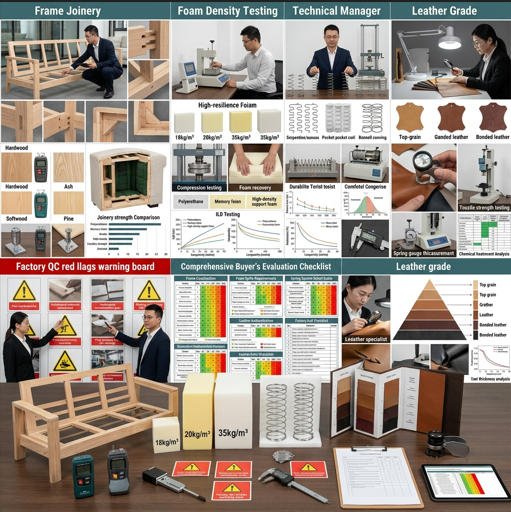
Every year, furniture importers, interior procurement firms, and hospitality operators place container-load orders for Chinese sofas — and a significant percentage arrive with problems that could have been caught at the factory gate. This guide is designed so that your sourcing team never has to find out the hard way.
China supplies roughly 37% of global furniture exports, and within that, upholstered seating — sofas, sectionals, lounge sets — represents the highest-volume, highest-complaint category. The gap between a sofa that holds up in a hotel lobby for eight years and one that sags and splits inside eighteen months is not random. It comes down to frame wood species, joint engineering, spring type, foam specification, and fabric abrasion rating — and every one of those parameters is readable before you sign a purchase order.
This guide decodes those parameters in plain language. Whether you are a hospitality procurement manager evaluating a supplier shortlist, an interior design studio specifying product for a commercial contract, or a furniture importer building a house brand, the following sections map exactly what to look for, what questions to ask, and what numbers to demand in writing.

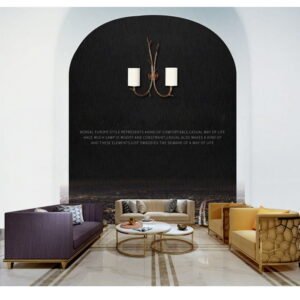
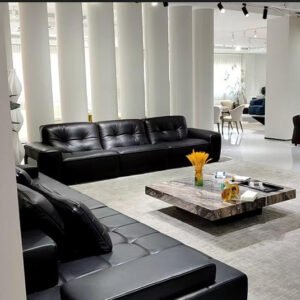
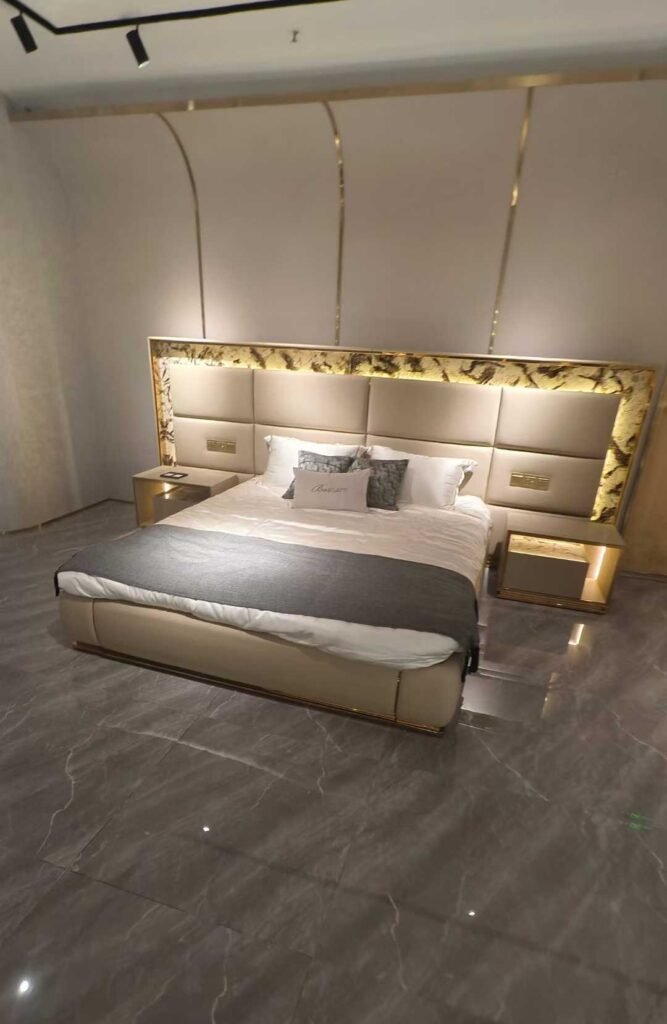
Premium upholstered sofa — separating surface aesthetics from structural quality is the core skill every B2B buyer needs.
Frame & Wood
Species, moisture content, and joint type determine whether the frame survives 50,000+ use cycles.
Suspension System
Spring type and webbing tension are the single biggest predictor of long-term seat sag — invisible from the outside.
Fabric & Leather
Double-rub count and tanning grade tell you more than colour or texture ever can.
Certificações
FSC, ISO 9001, GREENGUARD — these aren’t just compliance checkboxes; they’re proxies for factory discipline.
Material Quality and Sourcing
Solid Wood vs Plywood Foundations and Kiln-Dried Timber
The single most consequential material decision in sofa construction is the frame substrate. Solid hardwood — typically rubberwood (Hevea brasiliensis), beech, or birch for export-grade Chinese production — offers the best fastener-holding strength and resistance to cracking under load. Plywood, specifically furniture-grade multi-ply with a minimum of 9 layers, is a legitimate and widely-used alternative: its cross-grained lamination actually resists warping better than solid wood in high-humidity environments. The product to avoid is particle board or MDF framing; these materials strip their own screws under repeated stress and cannot be re-fastened after the joint loosens.
Kiln drying — the process of reducing timber moisture content to 6–8% in industrial drying chambers before cutting — is non-negotiable. Wood that enters production at 15–20% moisture content (common in air-dried or uncertified timber) will shrink, twist, and open its joints inside the first year of use. Ask your supplier for the timber moisture certificate. A factory running at volume with proper QC will have this document available; a factory that cannot produce it is telling you something important.
Sourced vs Reclaimed Materials and Environmental Certifications
Since 2026, the EU Deforestation Regulation (EUDR) requires full timber chain-of-custody traceability for furniture entering the European market. This shifts FSC (Forest Stewardship Council) or PEFC certification from a marketing advantage to a legal requirement for European-bound orders. For North American markets, California Air Resources Board (CARB) Phase 2 compliance governs formaldehyde emissions from composite wood panels — a standard that any factory supplying US hospitality or commercial contracts must already meet.
Reclaimed or recycled materials can appear in budget frames without disclosure. A quick field test: the formaldehyde smell test (a strong chemical odour from a freshly opened carton suggests non-compliant composite board) and a moisture meter on corner samples during factory inspection will confirm material consistency.
Finish Integrity of Veneers and Surface Treatments
Where exposed wood elements are present — legs, arm caps, trim rails — the veneer bond and surface lacquer quality determine the visual lifespan of the piece. A properly bonded veneer will not delaminate when you flex the panel by hand at the edge. The lacquer should be catalysed polyurethane (PU) with a minimum of three coats: sealer, undercoat, and topcoat. Water-based acrylic lacquers are acceptable for budget tiers but will show micro-cracking within two to three years in commercial environments with regular cleaning.

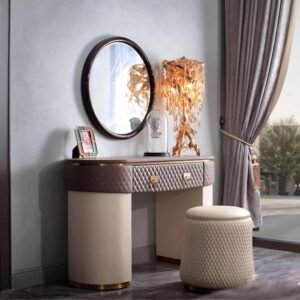
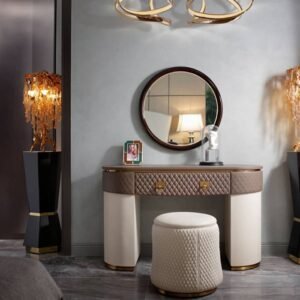
Frame details and wood finish quality are visible before a single cushion is placed — know what you are looking at.
Frame Construction and Wood Types
Grade of Lumber and Density Implications
Rubberwood is the dominant species in Chinese sofa production, and for good reason: it is a plantation crop (lower environmental cost), grows fast, and achieves a Janka hardness rating of approximately 950 lbf — comparable to black walnut. Beech, used in higher-grade production, runs around 1,300 lbf and is the preferred species for visible leg components and front rail elements that take direct impact. Poplar and pine appear in low-cost frames; both are acceptable for interior non-structural elements but should not be used for seat rails or arm frames under commercial-use specifications.
Density directly correlates with fastener holding strength. Ask suppliers to state the timber species in writing on the product specification sheet. “Solid wood” is a permitted description for mixed-species frames in Chinese export documentation, which means you may receive poplar seat rails and rubberwood legs in the same frame without being told.
Corner Blocking and Reinforcement Techniques
Corner blocking (also called corner bracing) refers to triangular or L-shaped wood blocks glued and screwed into the interior corners of the frame where rails meet. A frame without corner blocking at all four seat-rail corners will begin to rack — develop a diagonal flex — within 12 to 18 months of commercial use. In a 200-room hotel with sofas receiving 8–12 guest contacts per day, that translates to visible structural failure within the first service period.
During factory inspection, request that one completed frame be left without upholstery. Turn it upside down, look into the interior through the underside, and verify that solid corner blocks are present and that each is both glued (you should see squeeze-out residue) and fastened with at minimum two screws per face. A factory that objects to this inspection is not a factory you want to work with at volume.
Anterior Versus Rear Frame Joinery Visible Indicators
The front (anterior) face of the frame — the seat rail and front leg assembly — takes the highest load concentration in use. Rear frame joinery tolerances are typically looser in budget production because they are hidden. A quality frame will show consistent joinery precision throughout: mortise-and-tenon joints at the leg-to-rail connection, dowel reinforcement at seat-rail butt joints, and no visible daylight in any glued joint. If you can rock the frame by applying lateral pressure at the arm tops, the frame has already failed its basic structural test before any foam or fabric is applied.
Joinery and Frame Stability
Dowels, Screws, and Glued Joints — What to Look For
The three fastening methods used in sofa frames each have appropriate applications. Dowel joints use cylindrical wood pins pressed into pre-drilled aligned holes; they provide shear resistance and are appropriate at butt joints throughout the frame. Screws (ideally #10 or #12 wood screws with coarse thread for wood substrates) provide pull-out resistance and should be used alongside glue at all leg attachments and rail connections. Glued joints alone — without mechanical fasteners — are the hallmark of a production shortcut: PVA wood glue cures to excellent strength in lab conditions, but any joint that sees even moderate peel stress (as all sofa joints do) will fail without mechanical backup.
The combination to specify: kiln-dried hardwood frame, minimum two 50mm dowels per butt joint, minimum two #10 screws per rail-to-leg connection, corner block at each seat-rail corner, and all joints pre-fitted before glue application. A factory producing to this specification will not hesitate to write it into the purchase order.
Through-Tenon and Finger-Joint Examples
Through-tenon joinery — where the tenon (the protruding tongue of one member) passes completely through the mortise (the receiving socket) of the other and is visible from the outside — is the strongest mechanical joint available in wood construction. It is primarily used in exposed-leg designs where the joint becomes a decorative feature. Finger joints (interlocking rectangular profiles at timber ends) are used to extend short timber runs and, when well-executed with properly mated profiles and gap-free glue lines, produce a joint stronger than the wood itself. Poorly executed finger joints — visible gaps, misaligned fingers, glue squeeze-out without mechanical interlock — are a reliable signal of low production precision throughout the facility.
📊 Frame Timber Species — Janka Hardness & Commercial Suitability for B2B Sofa Procurement
Janka hardness (lbf) — higher = more resistant to denting and joint failure under load
Suspension System: Springs and Webbing
Type of Springs — Innerspring, Zigzag, Sinuous — and Their Durability
The suspension system is the component buyers most frequently overlook during product review, and the one that most reliably differentiates a sofa that lasts from one that doesn’t. There are three dominant systems in Chinese production:
Eight-way hand-tied coil springs (also called drop-in coil systems in their cheaper variant) use individual coil springs tied at eight points to adjacent springs and to the frame rail. Genuine eight-way hand-tied construction, where an upholsterer manually ties each spring with jute twine in eight directions, is labour-intensive and appears almost exclusively in premium and custom production. It delivers an adaptive, multi-directional support response that is particularly valued in hospitality and contract furniture where diverse occupant weights and postures must be accommodated. Expect to pay a 15–25% premium over sinuous spring equivalents; the lifespan advantage — typically 12+ years of commercial use versus 5–7 for sinuous — more than justifies this for high-traffic applications.
Sinuous (zigzag) springs are S-shaped steel wire springs running front-to-back across the seat frame, attached at each end with spring clips. They are the industry standard in mid-range Chinese export production. A properly specified sinuous system — 9-gauge wire, spacing no greater than 76mm between springs, with cross-ties connecting adjacent springs at mid-point — will perform adequately for residential and light-commercial use. The failure mode to watch for is under-gauge wire (11 or 12 gauge) and absent cross-ties, which allows individual springs to shift laterally over time, creating the characteristic “trench” sag that makes a sofa uncomfortable within two to three years.
Webbing-only systems (jute, polypropylene, or elastic webbing) are the lowest-cost suspension option. Elastic webbing (Pirelli or equivalent synthetic rubber strips) can perform well when interlaced at 50mm spacing and tensioned to 10–15% stretch. Jute webbing alone, without spring support, is acceptable only for back support — never for seat suspension in commercial applications.
Webbing Quality and Tension Consistency
Where webbing forms part or all of the suspension system, the installed tension must be consistent across the seat from left to right and front to back. Press the seat platform with both palms, side by side. You should feel uniform resistance. Any soft spot indicates a webbing strip installed at insufficient tension or an elastic strip that has already fatigued. On new product, this should never occur.
Edge Supports to Prevent Sag Over Time
The front seat rail is the highest-stress area of any sofa. A hardwood edge rail — a full-length piece of solid timber running the width of the front seat edge, through which the front spring attachment clips are fastened — prevents the front edge of the seating platform from collapsing forward under occupant load. Without it, the front lip of the seat compresses faster than the centre, creating the permanent forward pitch that characterises end-of-life commercial sofas. Confirm front-edge rail presence in your product specification.

Premium sofa interiors in contract hospitality environments — suspension system failure is the primary cause of early replacement cycles.
Cushion Filling and Comfort
Core Materials: Foam Grade, Density, and Layering
Foam specification is one of the most commonly misrepresented elements in sofa quotations. Two numbers matter above all others: density (the weight of foam per cubic foot, expressed as lb/ft³ or kg/m³) and ILD (Indentation Load Deflection, the force in pounds required to compress a 4-inch foam sample by 25% — the industry-standard measure of firmness).
For commercial-grade seating, the following benchmarks apply: seat cushion core foam should be minimum 1.8 lb/ft³ for residential specification and 2.2–2.8 lb/ft³ for commercial contract. High-density foam (2.5 lb/ft³ and above) can hold its dimensional shape for 10+ years of regular use; low-density foam (below 1.5 lb/ft³) will compress by 15–20% within two years, creating cushions that look substantially thinner than at point of purchase. ILD for a comfortable seat cushion typically falls in the 28–35 range — firm enough for postural support, soft enough to not feel rigid.
Layered construction — a firm-density base core with a softer comfort layer bonded on top — is the premium approach, allowing the cushion to combine long-term dimensional stability with initial touch comfort. Request that your supplier state both the density and ILD of each foam layer in the product specification sheet, along with the foam manufacturer name. Reputable suppliers source from established foam manufacturers (e.g. Foshan Foshan Ruiyuan, Jihua, or imported Leggett & Platt foam derivatives) and will identify their source without hesitation.
| Foam Grade | Density (lb/ft³) | ILD Range | Tempo de vida esperado | Recommended Use | Rating |
|---|---|---|---|---|---|
| High Density Premium | 2.5 – 2.8 | 30–40 lbs | 10 a 15 anos | Contract / Hospitality | ✔ Recommended |
| High Density Standard | 2.0 – 2.4 | 25–35 lbs | 7–10 years | Commercial / Mid-tier | ✔ Acceptable |
| Medium Density | 1.6 – 1.9 | 20–28 lbs | 3 a 5 anos | Residential Light Use | ⚠ Caution |
| Low Density Budget | < 1.5 | 10–18 lbs | 1–2 anos | Not for B2B / Contract | ✘ Avoid |
Down/Feather vs Synthetic Alternatives and Blend Quality
Down and feather fill — whether pure goose down, duck down, or blended fibre — is specified in luxury hospitality and high-end residential contract work for its unmatched softness and immediate recovery. The performance metric to request is fill power: a fill power of 600+ indicates a quality down cluster that will maintain loft over time. However, down fill without an inner foam core produces cushions that require constant reshaping — operationally impractical in a hotel lobby or commercial lounge context. The premium solution is a down-wrapped foam core: a high-density foam slab encased in a sewn down/feather envelope, delivering both structural integrity and luxurious surface feel.
Synthetic fibre alternatives — hollow-fibre polyester and conjugated polyester — are the standard in mid-range production. Quality here is measured by the denier (fibre thickness) and whether the fibre is a virgin or recycled blend. Premium synthetic fills use a 7-denier hollow conjugated fibre that maintains loft substantially better than flat-fibre or non-conjugated alternatives.
Maintenance Implications and Long-Term Recovery
Cushion fill choice directly affects the maintenance requirements your clients will face post-purchase. Down-filled cushions require daily fluffing in commercial environments and are inappropriate for applications where regular housekeeping cannot be guaranteed. High-density foam without down wrapping is the most maintenance-stable option for B2B procurement — it requires no reshaping, holds its profile, and its performance degradation is predictable and documentable over a service life.
🥧 Cushion Fill Composition in Chinese Export Sofa Production (2025 Industry Data)
Upholstery Fabrics and Leathers
Fabric Weight, Weave, and Abrasion Resistance
Fabric durability in commercial upholstery is measured by two industry-standard abrasion tests. The Teste de Wyzenbeek (dominant in North America) runs fabric against cotton duck material with a back-and-forth motion; each pass is one “double rub.” The Martindale test (dominant in Europe and the UK) uses a figure-eight motion against worsted wool. The two tests are not directly equivalent, but general industry benchmarks are: residential light-use fabrics should achieve a minimum 15,000 double rubs (Wyzenbeek) or 20,000 cycles (Martindale); commercial/contract specification requires 30,000–50,000 double rubs or 30,000+ Martindale cycles; heavy-duty hospitality or healthcare upholstery should exceed 100,000 double rubs.
Chinese export fabrics frequently appear in quotations described as “heavy-duty polyester” or “premium linen blend” without abrasion test data attached. Demand the test report. Any mill supplying contract-specification fabric will have it; fabric sold without test data is almost certainly below commercial specification.
Fabric weight is an ancillary indicator: contract upholstery fabric typically runs at 400–600 g/m² for woven textiles and 320–450 g/m² for performance velvets. Fabric below 280 g/m² in a seat application is a warning sign.
Leather Tanning, Grain Consistency, and Finish Durability
Leather is the most frequently misrepresented upholstery material in B2B furniture procurement. The hierarchy — and the honest definitions — are as follows. Couro de flor integral retains the complete outer layer of the hide with all natural grain markings present; it develops patina over time and is the most durable and breathable option. Top-grain leather has the outer surface lightly sanded to remove natural imperfections, then a protective pigment coat is applied — it is uniform in appearance, easier to clean, and slightly less breathable than full-grain. Couro de grão corrigido has been heavily processed, embossed with an artificial grain pattern, and coated with a thick polyurethane film — it looks uniform and clean in showroom conditions but delaminating and cracking within 3–5 years of heavy use is common. Bonded leather (sometimes labelled “regenerated leather” or “PU leather” in Chinese supplier quotes) is a composite of leather shavings and fibres bonded with polyurethane; it has essentially no durability in commercial applications and should be specified out of any B2B contract.
The tanning process matters beyond grain grade. Chrome-tanned leather (the most common in Chinese production) is supple, uniform in colour take-up, and cost-effective. Vegetable-tanned leather, produced using plant-based tannins, is stiffer at purchase but develops superior character over years of use; it is appropriate for premium hospitality and is the material behind most Italian furniture leather’s reputation. Semi-aniline tanning — applying a light pigment coat over aniline-dyed leather — offers a middle position: natural feel with slightly improved stain resistance.
| Leather Type | Construction | Durability | Manutenção | B2B Application Fit |
|---|---|---|---|---|
| Full-Grain Aniline | Untouched outer hide, aniline dye only | 15–25 yrs | Conditioning 2x/year | Premium Hospitality |
| Top-Grain Semi-Aniline | Light sanding + pigment coat | 10–15 yrs | Damp wipe, annual condition | Contract / Commercial |
| Corrected Grain | Heavy sanding + emboss + PU coat | 3–6 yrs | Easy wipe but cracks at seams | Budget Residential Only |
| Bonded / PU Leather | Leather fibre composite + film | 1–3 yrs | Delamination risk | Not Recommended |
Stitch Quality and Fabric Securing Techniques
Fabric installation is not just about the textile itself — the method of attaching it to the frame determines how long the surface remains taut and wrinkle-free. Stapling (pneumatic staple gun at 6–8mm spacing for perimeter and corner tucks) is standard; on a quality product the staple lines are uniform, corner pleats are folded rather than gathered, and the fabric tension is consistent to hand-pressure from every seat position. Hot-glue bonding along visible edge returns is acceptable for back and arm panels but should never be the primary fixing method on seat or front-arm surfaces where mechanical stress is highest.

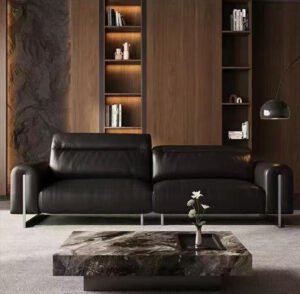
Upholstery material and surface finish communicate quality at the point of sale — but the specifications behind them determine long-term performance.
Seam Work and Stitching Precision
Stitch Density, Uniformity, and Seam Alignment
Stitching is one of the most reliable visible proxies for overall production precision in a sofa. The measurable standard: a quality upholstery seam should run at 8–10 stitches per inch (SPI). Below 6 SPI, the seam has insufficient mechanical resistance to fabric pull; above 12 SPI, the needle perforations weaken the fabric at the seam line. Both failures manifest as seam separation in use. Thread specification matters equally: upholstery-grade nylon or polyester thread at ticket number 40 (approximately 0.4mm diameter) for structural seams, ticket 60 for decorative topstitching.
Seam alignment at corners, cushion joins, and piping transitions is where production precision becomes immediately visible. Hold a cushion at arm’s length and look at the welting (the cord-filled piping that defines the cushion edge). On a quality product it is taut, forms a clean geometric line, and the seam where it meets each corner is a single mitered junction — not a gathered fold. Puckering, waviness, or misalignment at corners of more than 3mm is a QC failure.
French Seams, Piping, and Reinforcement Details
French seams — where the raw seam allowance is folded inside a second stitching line, encasing the raw edge — are used on exposed fabric panels and areas subject to abrasion from contact. They prevent fraying without the need for serging, and their presence in a design is a signal that the pattern-cutter and upholsterer are working to tailoring rather than budget production standards. Piped cushion edges (cord-filled fabric welting sewn into the cushion seam) are both decorative and structural: they reinforce the highest-stress seam on the cushion and define the silhouette of the piece. Both elements appear in mid-to-premium production and are visible quality signals that B2B buyers can assess at the sample stage.
Finishes, Hardware, and Details
Hardware Quality: Screws, Brackets, Corner Blocks, and Corrosion Resistance
Frame hardware — the screws, hanger bolts, barrel nuts, and metal brackets used to assemble modular sofa components — is almost never specified in standard quotations from Chinese suppliers, and this is where subtle quality differences hide. Zinc-plated or yellow passivated steel fasteners are the minimum acceptable standard for interior furniture. Bright steel fasteners without surface treatment will begin to oxidise within 18 months in normal indoor humidity ranges, and the resulting surface rust can transfer to fabric through the frame material. For coastal or humid-climate installations — a relevant concern for hospitality furniture in Southeast Asia, the Middle East, or beachfront properties — stainless steel or dacromet-coated fasteners should be specified.
Leg-leveller glides (the adjustable foot hardware on leg bases) are a small detail that your clients will notice. Felt or nylon glides of insufficient diameter will indent soft flooring; a minimum 40mm diameter nylon glide with felt underside is the professional specification for hard flooring, and metal swivel glides should never be used on timber or LVT surfaces.
Finishing Touches: Edges, Corners, and Exposed Trim Quality
The finish quality of exposed non-upholstered elements — leg bases, arm-end panels, back-rail skirts — is one of the most reliable on-site inspection indicators. Run your finger along the leg taper on a sample: the lacquer should be smooth, without sand-through marks, brush drags, or dust inclusion in the film. The leg-to-floor profile should be square or uniformly chamfered, not splintered. Decorative nailheads (where specified) should be spaced at consistent intervals using a tape or spacing tool — not hand-estimated, which produces visible rhythm inconsistencies across the length of a sofa run.
Craftsmanship and Production Process in Chinese Workshops
Workshop Scale, QC Processes, and Batch Consistency
One of the most persistent challenges in B2B sourcing from China is the gap between sample quality and production-run quality. A manufacturer producing 200 pieces per day on a semi-automated line will deliver more consistent quality than one producing 20 pieces per day in a craft workshop — not because craft workshops lack skill, but because documented, repeated process control is what produces batch consistency. ISO 9001:2015 certification is the internationally recognised standard for quality management system discipline; a factory with this certification has documented its production processes, conducts internal audits, and has had its QC system independently verified.
The Chinese furniture manufacturing cluster in Foshan (Guangdong Province) is the dominant export-production hub for upholstered furniture. Within Foshan, factory tiers range from OEM export manufacturers running dedicated quality departments and BSCI social compliance audits, to sub-contract assembly workshops with no formal QC programme. The price difference between them can be as little as 8–12% on FOB quotation — but the performance difference in batch consistency over a 500-piece hotel contract order can be the difference between a profitable project and a costly replacement cycle.
Working with a manufacturer-partner like Móveis Jade Ant, which provides built-in QC coordination across its production facilities, significantly reduces the remote management burden for international B2B buyers who cannot maintain permanent in-factory presence.
Finishing Time vs Result Quality and Hand-Finishing Cues
Hand-finishing — the final manual detailing applied before packaging — is the most labour-intensive and most frequently value-engineered step in mass production. The signs of adequate hand-finishing: all loose threads trimmed (no thread tails visible at seam ends), cushion corners square and filled to the seam profile, fabric panels free from puckering under arm and back attachment points, and all decorative elements (buttons, nailheads, welt cord ends) cleanly terminated. A simple protocol for sample inspection: white-glove the entire surface of the sample. Any fibre contamination, adhesive residue, or lacquer overspray transferred to the glove indicates the finishing step was truncated.

Premium hospitality and commercial lounge specifications demand batch-consistent quality across full production runs — not just sample-perfect prototypes.
Watch: How Luxury Sofas Are Made
The following video from LuxDeco walks through the hands-on production process of a high-specification upholstered sofa — from frame assembly to final upholstery. It provides useful visual reference for the joinery, suspension, and padding stages described in this guide, and is particularly helpful for sourcing managers who have not conducted a Chinese factory visit.
Buying Tips: Signs of Quality and Common Pitfalls
Price Ranges, Warranties, and After-Sales Service Expectations
In the Chinese export market (FOB Foshan/Shanghai, 2025–2026 pricing), upholstered sofa frames for B2B buyers broadly stratify as follows: entry-level production runs USD 180–350 per seat for fabric sofas; mid-range export-quality production runs USD 350–700 per seat; premium contract-specification production with documented foam, spring, and leather specifications runs USD 700–1,500+ per seat. These are indicative ranges — configuration, material selection, customisation, and volume all affect final pricing significantly. The relevant point for procurement teams is that a quotation substantially below the mid-range figure for a contract-specification requirement is not a bargain; it is an undisclosed material specification downgrade.
Warranty terms are a useful quality signal. A manufacturer confident in their production quality will offer 2–3 years on frame and suspension, 1–2 years on foam and fabric. Factories offering only 12 months on everything, or whose warranty terms are vague and untested, are communicating something about their expected failure rates. Critically for B2B buyers: confirm the warranty covers the commercial-use context, as many Chinese furniture warranties are voided for “commercial use” in their terms.
Post-sale service infrastructure for international B2B buyers typically means: a named account manager with direct communication availability, documented spare parts availability (particularly for modular sofa connector hardware and replacement cushion fills), and a clear replacement/refund process for DOA (dead-on-arrival) or in-transit-damaged pieces in the first container delivery. These service parameters should be agreed in writing before the purchase order is signed, not discovered after the first claim.
How to Verify Authenticity of Materials and Workmanship In-Store or At Factory
The most reliable verification happens at factory level, not showroom level. A structured factory inspection protocol should include: a physical frame inspection on at least three in-production units (not pre-selected samples); foam density verification using a postal scale and a measured sample cut — calculate weight divided by volume in cubic feet, compare to stated specification; spring count and gauge verification by inserting a wire gauge tool through the dust cover on an inspection unit; and a fabric abrasion test certificate reviewed against the approved sample swatch. Third-party inspection agencies (SGS, Bureau Veritas, QIMA) offer pre-shipment inspection services starting at approximately USD 250–300 per visit and provide independent documentation that protects B2B buyers in dispute situations.
At showroom or trade fair level: the nail-scratch test on leather (genuine leather shows a slight surface compression that recovers; PU coating shows a permanent white scratch line), the fold test on cushions (fold a seat cushion in half and release — high-density foam returns to shape within 2–3 seconds; low-density foam stays deformed for 5–8 seconds or more), and the racking test on frame (apply lateral pressure at the arm tops while the sofa is on its feet — there should be zero flex). These tests take under three minutes and will differentiate a well-built product from a poorly built one more reliably than any marketing material.
Red Flags to Avoid
Several patterns in supplier behaviour consistently correlate with quality problems in the delivered product. Aggressive pressure to move from sample approval to bulk order without a pre-production sample (PP sample) stage — where a production-process unit is made and approved before the full run starts — is the highest-risk scenario in Chinese furniture procurement. A PP sample requirement is standard practice among professional export manufacturers and adds typically two to three weeks to the production schedule; a supplier who resists this step is one whose production-run quality diverges from their sample quality.
Inconsistent finish across a showroom display — variation in fabric tension, seam alignment, or surface finish between pieces of the same model — tells you that their QC process is not catching in-process defects. If the showroom pieces vary, the container-load pieces will vary more. Other signals worth noting: an inability to state timber species or foam density from memory (an experienced production manager knows their materials without looking them up), a warranty document that cannot be produced in English, and any resistance to an independent third-party inspection before shipment.
📊 Quality Factor Impact on Commercial Sofa Lifespan (Industry Benchmark Data)
Estimated % contribution to early failure in commercial B2B sofas (combined multi-factory data)
Key Terms Glossary
- ILD (Indentation Load Deflection)
- The force (in pounds) required to compress a 4-inch foam sample by 25%. Higher ILD = firmer foam. Residential comfort: 25–35 lbs. Contract seating: 30–40 lbs.
- Dureza Janka
- A measure of wood resistance to denting, expressed in lbf. Used to compare timber species suitability for load-bearing furniture frames.
- Double Rub (Wyzenbeek)
- One back-and-forth abrasion pass in the Wyzenbeek fabric test. A fabric rated at 30,000+ double rubs is suitable for commercial upholstery applications.
- Sinuous Spring
- An S-shaped steel wire spring running front-to-back across the seat frame. Standard in export Chinese production. Quality gauge: 9-gauge wire, maximum 76mm spacing.
- Corner Blocking
- Wood or metal blocks glued and screwed into the internal corners of a sofa frame to prevent racking (diagonal flex). Non-negotiable in commercial specification.
- Full-Grain Leather
- Leather retaining the complete outer hide surface. The most durable and breathable grade; develops natural patina over years of use.
- CARB Fase 2
- California Air Resources Board standard governing formaldehyde emissions from composite wood panels. Required for US market furniture using MDF, plywood, or particle board.
- Certificação FSC
- Forest Stewardship Council chain-of-custody certification confirming timber was sourced from responsibly managed forests. Required for EU market compliance post-EUDR 2026.
- Pre-Production Sample (PP Sample)
- A production-process unit manufactured under factory conditions before the full run begins, submitted for approval to the buyer. The most important quality control checkpoint in Chinese furniture procurement.
Quality in a Chinese sofa is not a vague characteristic — it is a set of measurable, documentable parameters that any professional B2B buyer can evaluate before placing an order. The frame construction tells you whether the piece will still be structurally sound in five years. The suspension system tells you whether it will still be comfortable. The foam specification tells you whether the cushions will still look like cushions. The fabric or leather grade tells you whether the surface will still be intact. And the supplier’s willingness to put all of these specifications in writing tells you whether they are confident in their own product.
The most significant industry shift for B2B buyers in the current period is the formalisation of material traceability requirements — EUDR timber documentation, CARB compliance for US-market composite panels, and the tightening of commercial warranty disclosure standards. Suppliers who have invested in compliance infrastructure for these requirements are, almost without exception, the same suppliers who have invested in production quality. The two things come from the same institutional discipline.
The best approach remains a combination of: detailed written specifications in the purchase order, a mandatory PP sample stage before production release, third-party pre-shipment inspection on the first container of any new supplier relationship, and a structured comparison across a minimum of three supplier quotations at equivalent specifications. Reputable brands and manufacturers like Móveis Jade Ant make this process significantly more manageable by bringing QC processes and material documentation to the table as standard practice — because at volume B2B procurement, the cost of one failed container order far exceeds any price saving from cutting corners on the specification process.
For further guidance on navigating the Chinese furniture supply chain, including detailed guides on custom Chinese furniture factory ordering, identifying quality Chinese furniture, e evaluating Chinese contract furniture manufacturers, the Jade Ant resource library is a recommended starting point for procurement teams building or auditing their China sourcing programme.
For broader industry reference, the Business of Furniture industry data, American Leather’s fabric test explainer, e FSC certification guidance are authoritative external references used in the preparation of this guide.