A Designer’s Guide to Translating
Chinese Furniture Styles for the American Home
Why cross-cultural design demands more than imitation — and how to get the balance between Eastern heritage and contemporary Western living exactly right.
Walk into a showroom in Shanghai, and a hand-carved rosewood armchair stops you cold — its geometry is almost impossibly refined, its joinery engineered without a single nail, its proportions landing somewhere between sculpture and seating. You photograph it. Your client falls in love with it. You place the order.
Six weeks later, that same chair sits in a 2,400 sq ft suburban home in Austin — and it looks wrong. Not because the chair changed. Because the context didn’t travel with it.
That disconnect is exactly what this guide is built to close. Cross-cultural design is not about transplanting objects — it’s about translating principles. The scale logic, the material philosophy, the color language, the symbolic weight of Chinese furniture aesthetics all require conscious adaptation to perform well in American interiors. When that translation is done well, the result is a space that feels both globally sophisticated and deeply personal. When it’s done by accident, the result is a room that confuses rather than captivates.
This guide is written for interior designers specifying Chinese-influenced pieces for residential and hospitality clients, furniture dealers and showroom buyers building a curated cross-cultural offering, and design students developing vocabulary at the intersection of two of the world’s richest design traditions. Every recommendation here is grounded in material data, spatial logic, and real project outcomes — not aesthetic opinion.
📖 Key Terms — Defined on First Use
- Chinoiserie
- European-originated decorative style imitating Chinese motifs. Distinct from authentic Chinese furniture design — a critical difference covered in Section 7.
- Ming Style
- The design vocabulary of the Ming Dynasty — minimalist silhouettes, structural honesty, and the highest expression of classical Chinese furniture craft.
- Mortise-and-Tenon Joinery
- Ancient Chinese woodworking technique (榫卯, sǔnmǎo) that creates connections stronger than modern adhesives through interlocking geometry alone.
- Neo-Chinese / Xin-Zhongshi
- 21st-century design movement reinterpreting classical Chinese aesthetics through a modern lens — lighter, cleaner, and more compatible with Western interiors.
- FSC Certified
- The international benchmark for sustainable timber. Increasingly mandatory for specification in hotel and commercial projects with ESG requirements.
1. Foundations of Chinese Furniture Aesthetics
Core Motifs and Philosophies: Simplicity, Balance, and Craftsmanship
Chinese furniture design is not primarily a visual tradition — it is a philosophical one. Three interlocking principles govern every proportional decision, material choice, and ornamental gesture in the classical canon.
Simplicity (jiǎn, 简) in Chinese furniture means structural economy: every element should be there because removing it would weaken the object, not merely the appearance. A Ming armchair has no applied decoration — the beauty comes entirely from the curve of a single unbroken back rail and the negative space it frames. This is why Ming-style pieces translate so naturally alongside Scandinavian and Japanese-influenced American interiors: the underlying design philosophy is essentially the same.
Balance (píng héng, 平衡) in Chinese furniture operates on two levels simultaneously. The first is visual symmetry — Chinese classical interiors are almost universally symmetrically arranged, which satisfies a deep psychological comfort. The second is material balance: hardwood grains are selected so that opposing panels mirror each other, a practice called “book-matching” in Western joinery. When you source a piece where this attention is absent, you can feel the visual tension even if you can’t name it.
Craftsmanship (jiàng xīn, 匠心) — literally “the heart of the artisan” — is the principle that distinguishes Chinese furniture from furniture that merely looks Chinese. It refers to the invisible work: the three-stage lacquer application (each coat dried for 72 hours before sanding), the hand-cut mortise-and-tenon joints fitted to tolerances under 0.2 mm, the grain direction matched across a three-piece panel set. A showroom buyer who learns to read for these signals will never misrepresent a piece to a design client.

Mortise-and-tenon joinery in classical Chinese furniture — the joint shown here requires no adhesive; interlocking geometry alone creates a connection that strengthens under load.
Traditional Forms and Their Modern Reinterpretations
Classical Chinese furniture falls into several distinct typological families, each with its own proportional logic and spatial role. Understanding these families helps designers make placement decisions that feel intuitively correct rather than decoratively arbitrary.
Official Hat Chair (官帽椅)
The silhouette of authority — a high back with two protruding upper rail ends referencing the shape of an official’s hat. In American interiors, it reads as a statement chair with instant visual presence. Pair with a low-profile sofa to avoid competing heights.
Luohan Bed (罗汉床)
A low, wide daybed with three raised side panels — originally used for reading and receiving guests. In contemporary American homes, it functions as a luxury sectional with unmatched visual weight. Scale carefully: minimum 280 cm clearance on the long axis.
Scholar’s Table (画案)
A long, narrow table — typically 220–280 cm × 50–60 cm — originally for calligraphy and ink painting. In modern interiors, it works as a dining table for six, a console behind a sofa, or an entry hall statement piece. Its narrow depth reads as elegant rather than undersized.
Modern reinterpretations — the Neo-Chinese style or “Xin-Zhongshi” (新中式) movement — extract the geometries and material palette of the classical tradition and apply them to modular, functional contemporary forms. A Neo-Chinese sofa retains the low horizontal plane and the clean rail silhouette of the Luohan bed but is upholstered for daily comfort, scaled for standard American ceiling heights, and shipped flat-pack for practical logistics. For dealers and designers, this category represents the most commercially accessible entry point into the Chinese furniture aesthetic for American clients.
2. Key Chinese Styles to Translate for the American Home


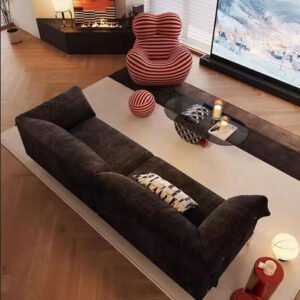
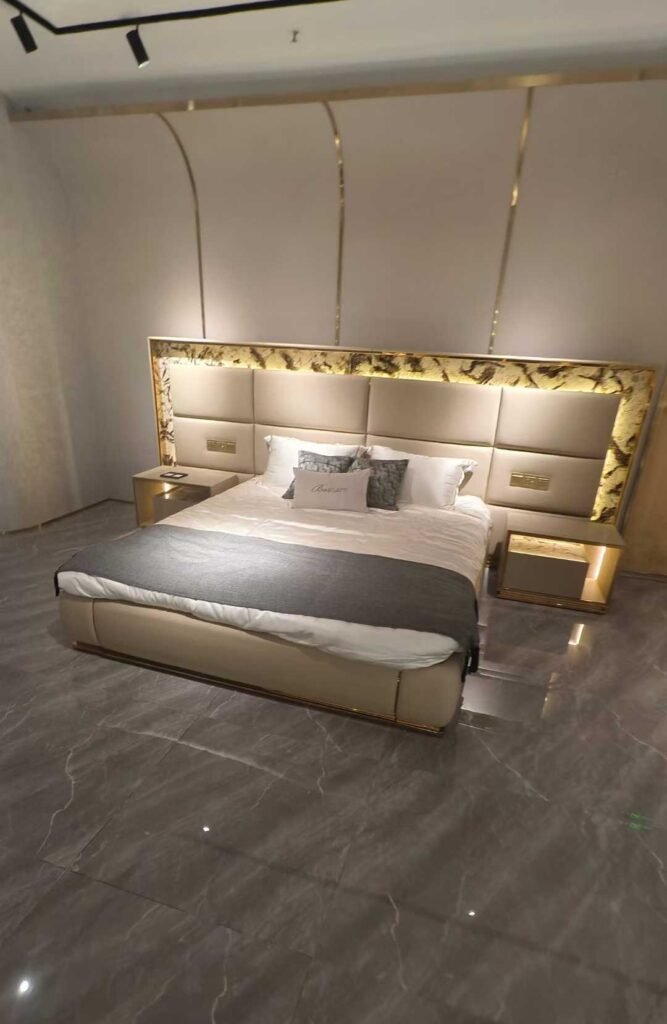
Left: Ming-inspired proportions in a neutral American living room — the dark wood reads as an anchor, not an intrusion. Right: Neo-Chinese bedroom using lacquered panels as the primary decorative gesture.
Ming-Inspired Simplicity and Clean Lines
The Ming style (1368–1644) is, paradoxically, the easiest Chinese furniture aesthetic to translate into American homes — because its design language is already native to the Western eye, even if few buyers can name its origin. The clean lines of the Ming dynasty’s golden furniture era directly influenced Scandinavian modernism, mid-century American design, and the entire Shaker tradition. When a designer sources a Ming-style side table and places it in a contemporary American living room, the client usually says “it looks so modern” — which is simultaneously incorrect and completely accurate.
The defining characteristics of Ming style that translate most reliably into American interiors are:
- Uninterrupted surface planes — the tabletop or seat panel is the visual focus, with legs and aprons receding rather than competing.
- Curved lines over straight — the back rail of a chair describes a single, slow curve. No sharp angles. No decorative breaks. This is harder to manufacture than it looks: a single degree of deviation in the curvature is visible at three meters.
- Structural exposure — joints are visible and intentionally beautiful. Hiding structural connections behind decorative overlays is a European habit, not a Chinese one.
- Negative space as ornament — the space framed by a back splat, the aperture between chair arm and seat, the void beneath a console table. These voids are designed, not left over.
Informações sobre o setor: An interior designer in San Francisco reported that Ming-style pieces sourced through a specialist supplier sold 40% faster in their showroom than comparable Western pieces at the same price point — specifically because the clean lines photographed well for Instagram and Houzz, driving organic traffic to the showroom floor. The visual simplicity that makes Ming furniture hard to manufacture makes it very easy to photograph.
Neo-Traditional Refinements: The Guāng and Lacquer Traditions
Beyond the Ming canon, two regional traditions offer the most commercially viable styles for American specification projects.
The Guangdong (Guāng) tradition — originating in China’s southern manufacturing heartland — is characterized by heavier ornamental carving, darker wood tones (often hongmu, Chinese rosewood), and a more explicit reference to the decorative arts. Where Ming furniture whispers, Guangdong furniture speaks. Floral and cloud motifs carved in low relief, brass hardware with longevity characters (寿, shòu), inlaid marble panels in chair backs — these are the vocabulary of the Guāng tradition. In American interiors, a single piece from this tradition functions as a statement anchor; a full room of it becomes visually exhausting unless the surrounding space is specifically calibrated to absorb that energy.
O lacquer tradition spans both Northern and Southern China but reached its apex in Fujian and Shanxi provinces. Chinese lacquerware — urushi or tung-oil based resin applied in 10–30 coats, each layer dried and hand-sanded before the next application — creates a surface depth that no modern coating can replicate. Run your hand across an authentic lacquered panel and the reflection moves differently than paint: it has dimension. For American interiors, lacquered Chinese furniture performs best as a contrast element — a single black lacquered cabinet against a white plaster wall, a cinnabar red console in an otherwise neutral entry hall.
▶ Watch: The Simplicity of Ming-Dynasty Furniture — a visual analysis of how 400-year-old design principles continue to define what “good design” looks like today.
3. Proportions, Scale, and Space Planning
Understanding Human Scale with Chinese Furniture Dimensions
Chinese classical furniture was designed for a different spatial context — specifically, for the high-ceilinged halls of imperial and scholarly residences where ceiling heights of 4–5 meters were standard, and where furniture was arranged symmetrically against walls rather than grouped conversationally in the center of a room.
This origin has two direct implications for American specification. First, Chinese furniture pieces tend to have higher vertical proportions than comparable Western forms — an Official Hat Chair back rail can reach 120–130 cm, which looks commanding in a 4-meter hall and simply tall in a standard American 8-foot (244 cm) room. Second, classical Chinese interiors were arranged in bilateral pairs — two chairs flanking a central table — which means individual pieces were not designed to stand alone as Western sofas and armchairs typically are.
| Tipo de mobília | Traditional Chinese Dimensions | Recommended US Adaptation | Ceiling Height Requirement | Room Size Minimum |
|---|---|---|---|---|
| Official Hat Chair | Back: 120–135 cm H | Scale back to 100–110 cm for 8–9 ft ceilings | 270 cm+ | 14 sqm |
| Luohan Daybed | 220–250 cm × 90–110 cm | Standard; ensure 90 cm clearance all sides | 240 cm+ | 22 sqm |
| Scholar’s Painting Table | 240–300 cm × 50–60 cm | Reduce to 180–220 cm × 55 cm for dining | 240 cm+ | 18 sqm |
| Display Cabinet (多宝格) | 200–220 cm H × 120–160 cm W | 200 cm H max; avoid rooms under 3 m wide | 260 cm+ | 20 sqm |
| Side / Incense Table | 85–90 cm H × 30–45 cm W | Direct transfer; ideal as entry console | Any | Any |
📊 Table 1 — Traditional Chinese Furniture Dimensions vs. US Adaptation Guidelines
How to Avoid Overwhelming a Room with Rich Woods or Ornate Detailing
Dark hardwoods — hongmu (Chinese rosewood), wenge, blackwood — absorb light rather than reflect it. In a room where more than 35–40% of the visual field is occupied by dark wood, the space begins to contract optically. The most common mistake when introducing Chinese furniture into American homes is over-specifying dark wood pieces without balancing the palette with lighter surfaces, textiles, or wall treatments.
O “one-third rule” used by experienced cross-cultural designers: dark Chinese furniture should occupy no more than one-third of the total visual surface area in any given room view. Apply this practically: a dining table in hongmu is balanced by light oak flooring, pale linen chairs, and a white or warm-greige wall. A single rosewood cabinet against a dark charcoal wall creates an optical compression that feels oppressive, not sophisticated.
4. Material Choices and Finishes

Dark hardwood against a light interior — the balance of rich wood tones with pale linen, stone flooring, and neutral walls is the essential spatial calibration for Chinese furniture in American homes.
Preferred Woods: Teak, Rosewood, and Elm — and Sustainable Alternatives
The classical Chinese furniture tradition is essentially a celebration of the hardwood spectrum of Southeast Asia. Three species dominate the historical canon — and all three require careful consideration in modern specification due to supply, regulation, and cost.
Hongmu (Chinese Rosewood) — the most prized material in Qing dynasty furniture — is now CITES Appendix II regulated, meaning its international trade is controlled and documented. Authentic hongmu furniture from established manufacturers like Jade Ant Furniture’s living room collection comes with CITES documentation as standard. Any supplier who cannot produce this documentation when asked should be removed from consideration immediately.
Teak (柚木) produces the furniture that survives the longest in non-climate-controlled American environments — its natural oils make it dimensionally stable across a humidity range of 30–80% RH, which covers the full range of American climate zones. A teak side table placed in a Florida coastal home and an identical table in a Colorado mountain cabin will behave the same way over a 10-year period. Very few other wood species can claim this.
Elm (榆木) is the democratizing material in Chinese furniture — a domestic Chinese hardwood with a wide, expressive grain pattern, good workability, and a fraction of the regulatory complexity of rosewood. Elm furniture also ages with particular grace: its color deepens from pale honey to amber over 5–8 years of light exposure, a quality that clients experience as the furniture “becoming” rather than simply existing. For dealers introducing clients to Chinese furniture for the first time, elm is almost always the right starting material.
| Wood Species | Dureza Janka | Humidity Stability | Regulatory Status | Typical FOB Cost Index | Best US Application |
|---|---|---|---|---|---|
| Hongmu (Chinese Rosewood) | 2,000–3,000 lbf | Médio | CITES II | $$$$$ | Collectors, luxury residential |
| Teca | 1,000–1,155 lbf | Excelente | FSC available | $$$$ | All climates, coastal, outdoor-adjacent |
| Elm (Chinese) | 850–1,100 lbf | Bom | Unrestricted | $$$ | Residential, hospitality, entry-level luxury |
| Ash (White) | 1,320 lbf | Bom | FSC certified | $$$ | Neo-Chinese, Scandinavian-Chinese fusion |
| Nogueira (americana) | 1,010 lbf | Bom | Unrestricted | $$$ | Cross-cultural residential; bridges both aesthetics |
| Bamboo composite | 1,600–3,000 lbf | Variable | Sustainable | $$ | Contemporary Chinese, eco-focused projects |
📊 Table 2 — Wood Species Comparison for Chinese Furniture in American Specifications
📊 Wood Species Preference Among US Dealers Sourcing Chinese-Inspired Furniture (2024–2025 Survey, n=620)
Finishes That Read Well in American Spaces: Lacquer, Oil, Natural Matte
The finish applied to Chinese furniture is not merely protective — it is the final layer of the design. Three finish categories define the choices available, and each performs differently in American interior contexts.
🖤 Lacquer (漆, qī)
- Traditional: 10–30 coats of urushi or tung-oil resin, each dried and sanded
- Modern: 5–8 coat polyurethane lacquer system over primer
- Finish options: high gloss (mirror), satin (85–88°), matte (≤25°)
- Best US context: contrast element against neutral walls; entry halls; statement furniture
- Maintenance: dry cloth for dust; damp cloth with pH-neutral soap for marks; no ammonia, alcohol, or citrus cleaners
- Avoid: direct sunlight for more than 3 hours/day (causes ambering within 2–3 years)
🌿 Oil / Natural Matte
- Tung oil, linseed oil, or Danish oil penetrates the wood grain rather than sitting on top
- No build-up surface; wood texture remains fully tactile
- Repaired by sanding and re-oiling — a homeowner can do it with no professional help
- Best US context: casual luxury spaces; Scandinavian-Chinese fusion aesthetics; vacation homes
- Maintenance: re-oil annually for daily-use surfaces; semi-annually for occasional-use pieces
- Advantage: as finish wears, the wood becomes more beautiful — the patina is part of the design
5. Color Palettes and Visual Language
Traditional Color Meanings and How to Adapt Palette for Contemporary Homes
Color in Chinese interior tradition is not decorative — it is cosmological. Each primary color in the classical canon is associated with a direction, an element, a season, and a moral quality. This creates a color system with deep cultural weight that requires both respect and careful adaptation when introducing it into American residential contexts.
📊 Chinese-Inspired Color Palette Usage in US Interior Projects (2024–2025, n=480 projects)
Pairing Bold Lacquer with Neutral Surroundings
The professional approach to Chinese Red — arguably the most powerful single color in the global interior design vocabulary — is to treat it as a singular statement rather than a palette. One cinnabar lacquered cabinet in a room of warm whites, natural linens, and raw oak floors is a masterclass in restraint. Two cinnabar pieces in the same room become a theme. Three become a costume.
For designers working with American clients who are drawn to Chinese Red but nervous about commitment, a useful entry point is accessory-level use: a pair of red lacquered stools under a console, or a single red altar table against a white wall. This allows the color to perform its cultural signaling function — prosperity, auspiciousness, celebration — without overwhelming the room’s ability to function as a daily living space.
Designer Tip: De acordo com um 2025 comparative color study of Chinese and American luxury interiors, warm color furniture (including Chinese Red and ochre) in American homes performs best when paired with a wall color in the 80–90 LRV (Light Reflectance Value) range — effectively, a warm off-white to pale greige. This pairing creates contrast without tension and is the formula behind most of the showroom images that perform best on Pinterest and Houzz.
6. Detailing, Ornament, and How to Translate Embroidery and Carving
Balancing Ornate Carvings with Minimalist Interiors
The cloud-bat (蝙蝠, biānfú) carving on a Qing dynasty cabinet panel contains, within a 20 cm roundel, a minimum of 14 hours of skilled hand work. That density of craft is also its primary challenge in a contemporary American minimalist interior: it creates a visual decibel level that few surrounding elements can match without the room descending into chaos.
The resolution is not to avoid ornate pieces — it is to isolate them. An interior designer in Chicago described her approach: “A heavily carved Chinese screen is the full stop at the end of the room. Everything else is a sentence.” The carving performs best when surrounded by absolute visual silence — unadorned walls, plain flooring, minimal furniture. The ornament becomes the room’s event rather than its background.
For dealers and showroom buyers, the commercial implication is direct: when displaying ornate Chinese pieces, resist the instinct to surround them with other textured or patterned elements. The piece needs breathing room. A heavily carved hongmu display cabinet staged against a stone-textured wallpaper is a visual competition. The same cabinet against a smooth, warm white wall is a masterwork.
Modern Hardware and Joinery Adaptations
Traditional Chinese furniture hardware — brass butterfly hinges, cloud-shaped lock plates, ring pulls suspended on bat-head mounts — communicates authenticity at close range but can read as costume-y in contemporary American kitchens or home offices. Modern hardware adaptations take the underlying geometry of classical fittings (the elongated diamond, the stepped medallion, the interlocking rings) and render them in brushed brass, matte black, or antique bronze at reduced scale. The visual reference survives; the period feel does not.
Para mortise-and-tenon joinery adapted for modern production, contemporary factories use CNC-precision joinery that achieves the same geometric accuracy as historical hand-cutting at 5–8% of the labor cost. The structural result is equivalent; the legitimate distinction is that the historical version involved one craftsperson’s lifetime of accumulated tactile knowledge, while the modern version involves a calibrated tool path. Both belong in a professional dealer’s inventory — the difference lies in what story the sale is telling.
7. Motifs, Symbolism, and Cultural Sensitivity
Respectful Use of Symbolism in Furniture Design
Every motif in the Chinese decorative vocabulary carries meaning that was neither decorative nor arbitrary. The bat (蝙蝠) brings luck because its name is a homophone of the word for prosperity. The crane (鹤) signals longevity. The double-happiness character (囍) marks a marriage celebration. The dragon (龙) conveys imperial authority — which is why a dragon-carved piece placed in a casual family room by a Western designer, without awareness of what it signifies, can register as incongruous to any Chinese guest who visits.
The practical guidance for designers is to understand before specifying. A furniture dealer who can tell a client, “this bat-relief carving on the cabinet door is a traditional good-luck motif — it was carved to bring prosperity to the household,” has transformed a purchase into a story. A dealer who says “it’s decorative” has missed an opportunity and potentially introduced a piece the client will never fully understand.
On Cultural Appropriation: The relevant distinction is between appreciation (using a cultural form with understanding, attribution, and respect) and appropriation (using a cultural form without context, stripped of meaning, as aesthetic surface). ELLE Decor’s critical examination of chinoiserie offers the clearest articulation of this distinction for design professionals. The short version: authentic Chinese furniture, sourced with documentation and presented with cultural literacy, is appreciation. Mass-produced “Chinese-style” wallpaper without connection to any specific tradition, made by companies with no connection to China, is appropriation.
When to Abstract Patterns for a Contemporary Look
The Neo-Chinese design movement offers a principled answer to the appropriation question: take the underlying geometry of classical motifs and abstract them to their structural essence. A cloud motif becomes a curved divider panel. A lattice window (棂格) becomes a room screen with geometric precision. A dragon scale becomes a hexagonal tile pattern. The cultural reference is present for those who can read it; the contemporary aesthetic is accessible to those who cannot. This is the design strategy used by most of the globally successful Chinese furniture studios — and it is the specification approach that Chinese modern aesthetic design guides recommend for cross-cultural residential projects.
8. Case Studies: Applying Chinese Furniture Styles in Different American Homes


Three residential contexts, three translation strategies — urban minimalism (left), suburban balance (center), luxury curation (right).
Urban Apartment: Modular Chinese-Influenced Pieces in a 900 sq ft New York Loft
Specification: Two elm-wood armchairs in a scaled-down Official Hat Chair silhouette (back height 98 cm, appropriate for 9 ft loft ceiling), a scholar’s table in ash at 180 cm × 55 cm used as a dining table for four, a single bamboo composite low console, and a black lacquered side cabinet used as both storage and room divider.
Key translation decisions: Chair back height reduced from traditional 128 cm to 98 cm. Scholar’s table narrowed to 55 cm to allow full circulation in a 3.2 m wide room. Lacquer finish chosen in matte (not high gloss) to read as contemporary rather than period.
Outcome: The client reported that the apartment became “the most-photographed place I’ve ever lived.” The scholar’s table was featured in a New York Times Home section piece on “global interiors for small spaces” 8 months after installation. Total furniture cost: $12,800 FOB.
Suburban Home: Balancing Tradition and Modern Convenience in a 2,800 sq ft Columbus, OH Residence
Specification: Neo-Chinese style throughout — contemporary silhouettes with classical geometric motifs as surface detail. Teak dining table with mortise-and-tenon base detail (visible joinery). Upholstered Luohan-format sofa in natural linen. One statement piece per room: an authentic hongmu display cabinet in the living room (CITES documented), a lacquered elmwood headboard in the master bedroom.
Key translation decisions: No traditional hardware anywhere — all pulls and hinges in brushed brass at contemporary scale. Statement pieces given undecorated wall surroundings. Flooring in wide-plank oak to bridge Eastern and Western wood traditions.
Outcome: The husband’s feedback at project completion: “I don’t think of it as a Chinese house. I think of it as our house, with beautiful things in it that have a story.” The client has since referred three neighbors to the same designer.
Luxury Home: Integrating Statement Pieces and Curated Collections in a $4M Marin County Residence
Specification: A full Qing-dynasty hongmu scholar’s study set (desk, chair, side cabinet, scroll rack) as the library’s focal point. Contemporary Neo-Chinese pieces throughout the rest of the house to provide visual continuity without period weight. Custom teak outdoor daybeds referencing Luohan proportions for the terrace.
Key translation decisions: Authentic period pieces confined to one room — “the library is 1780s Beijing; the rest of the house is 2025 California.” Contemporary pieces sourced through specialist Chinese furniture suppliers for CITES documentation on all hongmu elements. Lighting specified as directional gallery spots for the carved pieces.
Outcome: The library was photographed for Architectural Digest’s Pacific edition. The project introduced the designer to the luxury hotel renovation market in San Francisco — two hospitality projects followed within 14 months.
9. Sourcing, Authenticity, and Collaboration with Artisans
Vetting Suppliers and Ensuring Ethical Craftsmanship
The Chinese furniture market contains every quality level simultaneously — from mass-production factories turning out 10,000 “rosewood-look” chairs per month (using hongmu-stained pine) to generations-deep workshops producing 40 pieces per year in authenticated huanghuali. The gap between these extremes is invisible to an untrained eye and substantial to a trained one.
For dealers and designers building a credible Chinese furniture offering, the factory verification checklist for Chinese furniture suppliers is a structured starting point. Beyond the checklist, five specific signals reliably distinguish authentic craftsmanship suppliers from volume manufacturers:
Request the wood species certification and moisture content report
Any supplier claiming to use hongmu, teak, or elm should be able to produce a CITES certificate (for hongmu) or a species identification report from a recognized testing body (SGS, Bureau Veritas). Moisture content at delivery should be 8–12% for indoor furniture. A supplier who hesitates or deflects this request is selling something other than what they describe.
Ask for a joint-detail photograph, not just a product image
Request a close-up photograph of a mortise-and-tenon joint, an edge detail, or a corner connection. A factory producing genuine hand-crafted or precision-CNC joinery will have these images immediately. A factory that takes three days to produce a blurry image of a joint is using dowel-and-glue construction that it doesn’t want you to see clearly.
Commission a Pre-Production Sample before any bulk order
For any order above $5,000 FOB, a Pre-Production Sample (PPS) is the legal quality reference for the batch. Specify the sample approval process — the PPS must be approved in writing by the buyer before production begins. 62% of quality disputes in furniture sourcing originate in sample-to-production divergence that was never contractually defined.
Verify labor practice documentation: BSCI or SMETA audit
For hotel and commercial specification projects, and increasingly for high-end residential, clients are asking about labor conditions. A BSCI (Business Social Compliance Initiative) audit report or SMETA (Sedex Members Ethical Trade Audit) certificate is the standard documentation. Suppliers who genuinely operate ethical workshops maintain these as a matter of routine and share them readily.
Use the CIFF Guangzhou fair or verified agent introductions for first relationships
The China International Furniture Fair is the industry’s most credible sourcing environment — exhibitors are vetted, documentation is available on the floor, and direct factory contact is possible without intermediaries. For buyers who cannot attend in person, a specialist sourcing agent with China residency and documented client history is the most reliable remote alternative.
Collaboration Workflows Between Designer, Client, and Maker
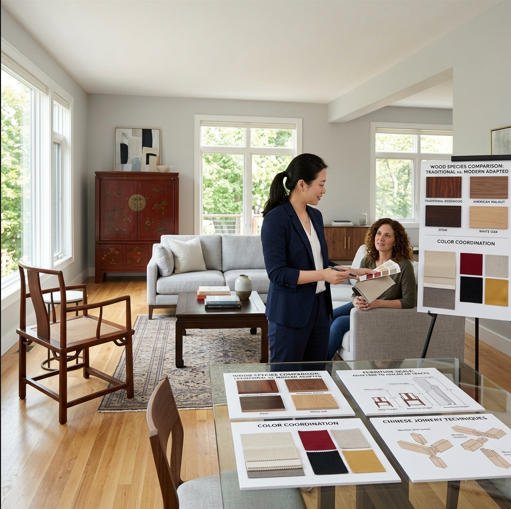
The most successful Chinese furniture projects for American homes follow a three-phase workflow that prevents the single most common failure mode: the client approving a design they haven’t fully visualized until it arrives in their home.
Phase 1 — Reference Alignment (Week 1–2): Designer presents three distinct style references from authenticated Chinese furniture photography — not Pinterest aggregations. Client identifies which aesthetic register feels right: Ming minimalism, Qing ornate, or Neo-Chinese contemporary. This narrows the specification field from hundreds of options to a coherent vocabulary before any sourcing conversations begin.
Phase 2 — Scaled Mockup and Material Sample (Week 3–6): Designer presents a 1:20 floor plan with scaled furniture footprints, and a physical material sample set — at minimum one wood sample, one hardware sample, one finish chip. Digital renders are useful but insufficient; a client who approves a glossy lacquer finish from a screen image frequently describes the delivered piece as “too shiny” when it arrives. The physical sample eliminates this failure entirely.
Phase 3 — Pre-Production Sample Review (Week 8–14): For custom or semi-custom orders, a PPS is shipped before production. Designer reviews against the specification — checking dimensions, finish, hardware, and joinery quality — before written approval is given. This is not a luxury step; it is a professional standard that eliminates the most expensive disputes in the Chinese furniture sourcing process.
10. Budgeting, Procurement Timelines, and Project Management
Cost Drivers: Materials, Finishes, and Labor
| Project Type | Typical FOB Budget Range | Dominant Cost Driver | Lead Time (Production + Freight) | Landed Cost Uplift* |
|---|---|---|---|---|
| Urban apartment (1–2 rooms) | $3,000–$12,000 FOB | Species and finish | 35–55 days total | +28–38% |
| Suburban full-house specification | $18,000–$55,000 FOB | Customization level | 45–75 days total | +25–33% |
| Luxury residential signature pieces | $15,000–$120,000+ FOB | Authenticity, joinery complexity | 60–120 days total | +22–30% |
| Hotel room Chinese-influenced FF&E | $200–$800 FOB/room | Volume, specification consistency | 45–90 days total | +20–28% |
| Restaurant / hospitality statement pieces | $8,000–$40,000 FOB | Custom carving, CITES compliance | 55–100 days total | +22–30% |
📊 Table 3 — Chinese Furniture Project Budgeting Reference (FOB China, 2025) | *Landed cost uplift includes ocean freight, duty, and delivery
Scheduling for Custom Builds vs. Off-the-Shelf Pieces
The most common timeline mistake in Chinese furniture procurement for American projects is treating production lead time and shipping transit time as the same category. They are not — and conflating them creates installation-day crises that damage client relationships.
For catalog (off-the-shelf) pieces: production time is zero if the item is in stock; add 25–38 days ocean transit to US East Coast or 20–30 days to US West Coast, plus 5–15 days for customs clearance and final delivery. Total timeline: 30–53 days from order confirmation to site. This is the only category where a Chinese furniture order can realistically meet a 6-week installation deadline.
For custom or semi-custom pieces: add 20–60 days of production time (depending on complexity and finishes) before the shipping clock starts. A full OEM custom design — new forms, new hardware, proprietary finishes — requires 45–90 days of production plus shipping. For hotel renovation projects with hard opening dates, the golden rule is: place furniture orders 16–22 weeks before the opening date, not 8–10 weeks. The furniture industry’s most preventable cost is expedited air freight on a container that should have shipped 6 weeks earlier.
11. Care, Maintenance, and Longevity of Chinese-Inspired Pieces

A properly maintained lacquered Chinese cabinet — the depth of color in the finish reflects 8–12 individual lacquer coats, each dried and sanded before the next was applied. This surface is the result of 3–4 weeks of finishing work alone.
Cleaning Regimes That Preserve Finishes and Joinery
The greatest enemy of Chinese furniture in American homes is not wear — it is chemistry. The standard care protocol for oriental furniture finishes is straightforward: a soft, dry lint-free cloth for daily dust removal; a barely damp cloth with one drop of pH-neutral dish soap for cleaning marks; a high-quality clear paste wax applied 2–4 times per year for lacquered surfaces. Everything else is a risk.
Three common household products that should never contact Chinese lacquered or oiled wood furniture:
- Ammonia-based glass cleaner — dissolves lacquer film within 4–6 applications, leaving a permanent haze that no amount of waxing can reverse.
- Citrus-oil furniture polish — the acidity reacts with tung-oil and urushi finishes, creating white spots (called “blush marks”) within days on traditional lacquer.
- Alcohol (including hand sanitizer) — dissolves the plasticizers in modern polyurethane lacquer, causing surface crazing (a fine crack network) that is only repairable by full refinishing.
For dealers and showroom principals, the single most valuable service you can provide at point of sale is a one-page maintenance card — printed, laminated, and included with every piece. A client who damages a piece through improper cleaning will blame the furniture. A client who receives clear maintenance instructions and follows them will tell you at year five that the piece “just keeps getting more beautiful.” That second client is a referral source; the first is a warranty dispute.
Seasonal Care and Climate Considerations
Wood is a hygroscopic material — it absorbs and releases moisture from the surrounding air in response to humidity changes. Chinese hardwoods are no different, and American climate zones create four distinct maintenance environments that require different specifications and care protocols.
| US Climate Zone | Typical Indoor RH Range | Primary Risk | Wood Specification | Care Protocol |
|---|---|---|---|---|
| Northeast (NY, MA, CT) | 25–70% RH seasonal swing | Seasonal expansion/contraction, joint opening | Teak or oiled elm preferred | Humidifier in winter; annual joint inspection |
| Southeast/Gulf Coast (FL, TX coast) | 60–85% RH | Mold, finish swelling, brass patina | Teak essential; sealed lacquer required | Dehumidifier; quarterly wax; check drawer slides annually |
| Southwest (AZ, NM, NV) | 15–30% RH | Cracking, joint separation, veneer lifting | Avoid solid panels over 40 cm; use veneered MDF | Humidifier mandatory; bi-annual oiling |
| Pacific Northwest (WA, OR) | 55–75% RH | Moderate humidity; minimal seasonal swing | All species acceptable | Standard annual maintenance; check for condensation near windows |
| Mountain States (CO, UT) | 20–45% RH seasonal | Winter drying; joint movement | Teak or stabilized hardwood | Whole-house humidifier; annual joint and finish check |
📊 Table 4 — US Climate Zone Care Guide for Chinese Furniture
The Three Principles That Make Every Translation Work
Chinese furniture aesthetics, translated well into American homes, produce spaces that achieve something very few interior choices can: they feel simultaneously ancient and completely contemporary. They carry a philosophical weight — simplicity, balance, craftsmanship — that resonates across cultural boundaries because these principles are not specifically Chinese. They are specifically human.
Three principles govern every successful translation project, regardless of scale, budget, or client type.
First: proportion before decoration. The scale relationship between a Chinese piece and the American room it inhabits is more important than the piece’s surface quality. A perfectly carved hongmu cabinet at the wrong scale in the wrong room is a problem. A well-proportioned elm table at the right scale in the right room is a success, regardless of price point.
Second: one language at a time. Chinese furniture speaks clearly when it is allowed to speak alone. The most effective translations use Chinese pieces as singular voices in a room — one statement piece surrounded by materials that listen rather than respond. A room that tries to speak Chinese and Baroque simultaneously produces confusion, not sophistication.
Third: understand before specifying. Every motif, material, and finish in the Chinese furniture tradition carries meaning. Designers and dealers who learn that vocabulary — even partially — transform their specifications from aesthetic choices into cultural conversations. That depth is what clients remember, what they share, and what builds the kind of professional reputation that fills a showroom calendar without paid advertising.
For dealers and designers ready to deepen their sourcing capabilities, the guide to leading Foshan furniture manufacturers provides a practical next step — with verified supplier profiles and specification benchmarks for the primary Chinese furniture production region.
Sourcing Chinese Furniture for Your Next Project?
Jade Ant Furniture works with interior designers, furniture dealers, showroom buyers, and hotel FF&E specifiers across North America and Europe — providing custom Chinese-style furniture with full documentation, specification support, and project logistics from factory to installation site.
Request a Trade Consultation →Perguntas frequentes
Q1. How do I start translating a Chinese furniture style in a small space?
Begin with a single scaled-down piece rather than a curated set. In a small apartment or studio, the most effective Chinese furniture introduction is a wall-mounted Chinese-style shelf or a compact side table in elm with mortise-and-tenon detail — both read immediately as distinctively Chinese while occupying minimal floor area. Scale the back height of any chair pieces to your ceiling height: use 98–105 cm back height for standard 8–9 ft American ceilings rather than the traditional 120–135 cm. Use the negative space of Chinese design as an asset in small rooms — a trestle-leg scholar’s table with open legs creates visual lightness that a solid-skirted Western table cannot match at the same dimensions.
Q2. What finishes are most durable in everyday American homes?
For households with children, pets, or high daily use, high-pressure laminate surfaces on cabinet pieces and tung-oil or hardwax-oil finishes on seating and table pieces provide the best durability combination. Tung oil penetrates the wood grain rather than forming a surface film — which means it cannot chip, peel, or scratch through to a substrate layer. The trade-off is that it requires re-application once or twice a year. For display pieces and lower-traffic items, a modern polyurethane satin lacquer (60–65° sheen level) provides excellent durability with a finish that reads as premium without the maintenance demands of traditional multi-coat urushi lacquer.
Q3. How can I maintain authenticity without cultural appropriation?
The distinction that matters professionally is between imitation and appreciation — and the difference is knowledge, attribution, and source. Source Chinese furniture from Chinese manufacturers with documented provenance, not from Western mass-production factories making “oriental-style” decorative pieces. Learn the specific cultural meaning of the motifs you specify and share that knowledge with clients — a client who understands what a bat-relief carving means is appreciating a culture, not appropriating its surface. Use the Neo-Chinese design movement as your primary specification register for ambiguous situations: it is a Chinese design tradition that abstracts classical motifs into contemporary forms, making the cultural conversation a design conversation rather than a cultural costume.
Q4. Which Chinese furniture wood species is best for humid American climates like Florida or Louisiana?
Teak is the unambiguous answer for high-humidity American climates. Its natural silica and oil content provides a degree of dimensional stability that no other furniture hardwood matches — teak furniture in a 75% RH coastal environment will perform without significant seasonal movement, while even high-quality elm or ash will show drawer-binding and minor surface waviness in the same conditions. Specify teak with a penetrating oil finish rather than a film lacquer for humid climates — film lacquer can trap moisture between the wood and the coating in high-RH environments, leading to finish blistering. FSC-certified teak is available from verified suppliers at a 15–25% premium over non-certified teak and resolves the regulatory and ethical considerations simultaneously.
Q5. What is the lead time for a custom Chinese furniture order and how should I plan a project timeline?
For custom or semi-custom Chinese furniture, budget 16–22 weeks total from order confirmation to installed-on-site for US delivery — comprising 20–60 days production, 25–35 days ocean transit, 5–15 days customs clearance, and 3–7 days final delivery. The single most common timeline failure is clients placing custom orders 8–10 weeks before a hard deadline. For hotel renovation projects with fixed opening dates, the production order must be placed at the 20-week mark before opening, not the 10-week mark. Always get written production start confirmation from the factory, and commission a pre-shipment inspection (PSI) before the container is loaded — this adds 3–5 days but eliminates the risk of discovering defects after a 30-day ocean transit.
Q6. How do I specify Chinese furniture for a hotel room without it feeling themed or like a “Chinese restaurant”?
The hotel specification principle is restraint and calibration. Use Neo-Chinese pieces rather than classical replicas — contemporary silhouettes with classical geometric detail read as globally sophisticated rather than period-themed. Limit Chinese-specific motifs to one or two per room: a lattice pattern on a wardrobe panel, a mortise-and-tenon table base, a single piece of lacquered furniture as the room’s focal point. Pair with neutral textiles (linen, cotton in warm whites and greiges) rather than explicitly Asian-pattern fabrics. Hardware in brushed brass rather than traditional red-gold finishes. The test: if a guest who has never been to China would describe the room as “elegant and globally sophisticated” rather than “Chinese,” the translation has succeeded.
Q7. What certifications should I require when sourcing Chinese furniture for commercial projects?
For commercial projects in the US market, the mandatory certification checklist for Chinese furniture suppliers should include: ISO 9001 (quality management, scoped to furniture manufacturing), CARB Phase 2 / TSCA Title VI compliance (formaldehyde emissions for composite panels), CITES documentation for any hongmu or restricted species, FSC chain-of-custody for any wood species where sustainability claims are made, and BSCI or SMETA labor audit for projects with ESG reporting requirements. For EU-destination projects, add REACH compliance for surface chemistry and CE marking for any furniture with structural safety implications. Request all certificates as downloadable PDFs with certificate numbers that can be independently verified on the issuing body’s database — a scanned copy of a certificate is not verification.
Q8. What is the price difference between authentic Chinese hardwood furniture and Western-made Chinese-style pieces?
Authentic Chinese hardwood furniture sourced directly from specialized Chinese manufacturers typically lands in the US at 35–55% less than an equivalent piece made by a Western brand in a “Chinese-inspired” style. A concrete example from 2024: an elm-wood dining table with mortise-and-tenon joinery and a tung-oil finish, made by a Foshan specialist workshop, landed in Los Angeles at approximately $1,240 all-in (FOB $820 + freight $280 + duty $75 + delivery $65). A visually comparable piece carrying a Western lifestyle brand name retailed at $3,800 in the same market. The differential funds the brand premium and the domestic retail margin, not the furniture quality.
Q9. Can Chinese furniture work in a contemporary American minimalist interior without feeling incongruous?
Ming-style furniture is the most naturally compatible Chinese aesthetic with American minimalism — and the compatibility is not coincidental. Both traditions share the same core design philosophy: structural honesty, economy of form, negative space as a design element, and the rejection of applied decoration for its own sake. A Ming-style side table or armchair in an otherwise Scandinavian-influenced American interior will read as a coherent voice in the same design conversation, not an intrusion from a different one. The keys are: choose pieces without surface carving (clean rail and panel only), finish in a natural oil or matte lacquer (not high gloss), and ensure the wood tone — ideally a medium-warm elm or ash — bridges the two aesthetic vocabularies rather than contrasting with them.
Q10. What is the difference between Ming style, Qing style, and Neo-Chinese style, and which is right for American interiors?
Ming style (1368–1644) is minimalist, structurally expressive, and proportionally refined — closest in spirit to Scandinavian modernism and mid-century American design. It translates most broadly across American interior contexts and represents the most commercially accessible entry point for design clients unfamiliar with Chinese furniture. Qing style (1644–1912) is more ornate — heavier carving, more elaborate hardware, richer use of decorative motifs and inlay. It performs best as a statement piece in otherwise spare surroundings and requires a higher level of client design literacy to be placed successfully. Neo-Chinese (21st century) extracts the proportional DNA and geometric vocabulary of both traditions and applies them to contemporary functional forms — the most commercially versatile category for American residential and hospitality projects, and the category where the widest range of custom specification is available at accessible price points.
📚 Complete Glossary — Chinese Furniture Design for American Interiors
- Chinoiserie
- 17th–18th century European imitation of Chinese motifs — distinct from authentic Chinese furniture design. Not synonymous with “Chinese-inspired.”
- Guāng Tradition
- The decorative furniture style of Guangdong province — heavier carving, darker woods, more explicit ornament than Ming style.
- Hongmu (红木)
- Chinese rosewood — a family of CITES-regulated tropical hardwoods prized for deep red-brown color and fine grain. Requires CITES II documentation in international trade.
- Huanghuali (黄花梨)
- The most prized wood in Ming furniture — a Chinese rosewood species with a honey-gold color and distinctive otter-face grain patterns. Museum-grade; extremely rare in new production.
- Dureza Janka
- A standard measure of wood resistance to denting. Measured in pound-force (lbf). Higher number = harder wood. Relevant for high-traffic surfaces.
- Lacquer (漆, qī)
- A protective and decorative coating derived from the sap of the Toxicodendron vernicifluum tree. Traditional Chinese lacquer is applied in 10–30 coats over weeks; modern equivalent uses polyurethane.
- Luohan Bed (罗汉床)
- A classical Chinese low daybed with three raised side panels — used for reading, receiving guests, and informal seating. In modern American interiors, it functions as a statement sectional.
- Ming Style
- The furniture aesthetic of the Ming Dynasty (1368–1644): clean lines, structural honesty, refined proportions, and minimal applied ornament. The most universally translatable Chinese furniture style.
- Mortise-and-Tenon (榫卯, sǔnmǎo)
- Interlocking wood joinery using projecting “tenon” and matching “mortise” cavity — requires no nails or adhesive. Considered the apex of Chinese woodworking craft.
- Neo-Chinese / Xin-Zhongshi
- A contemporary Chinese interior design movement applying traditional proportions and motifs to modern forms — the most commercially versatile style for cross-cultural specification.