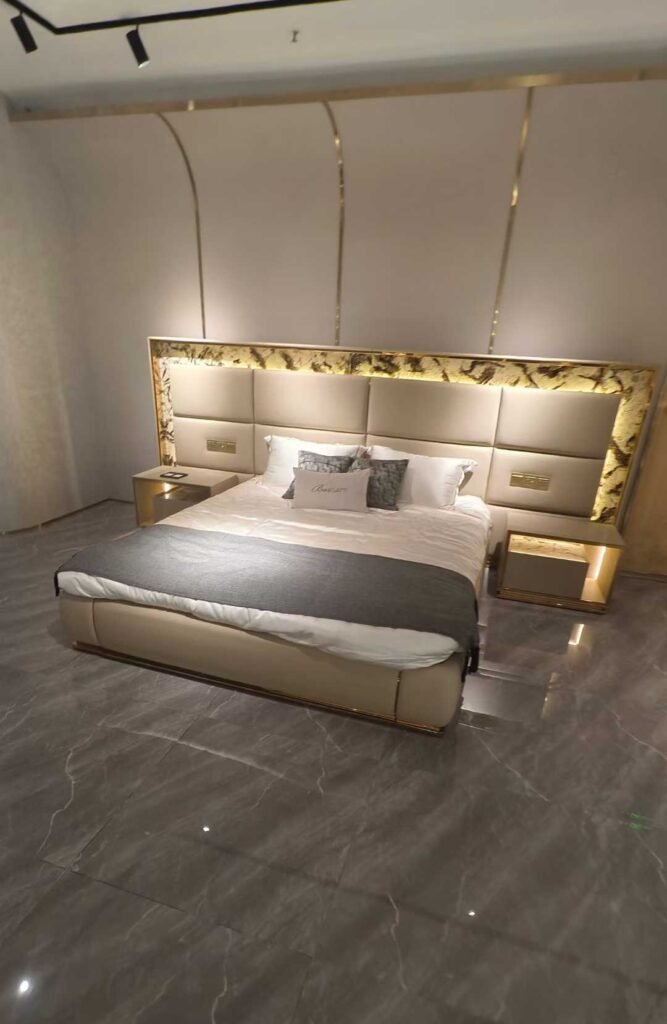

Luxury Furniture Ordering Strategy: How to Work With Your Distributor for Faster Reorders, Predictable Lead Times, and Consistent Quality
For high-end furniture importers, distributors, villa owners, interior designers, private label brands, FF&E buyers, architecture firms, developers, and hotel operators

I. The High-Stakes Nature of Luxury Procurement
Here’s a common situation. A hotel group reorders 40 nightstands for its second property. The first batch was approved 18 months ago. The new batch arrives a shade warmer, because the factory mixed the stain from memory instead of from a recorded formula.
Now the two properties don’t match. The brand standards team rejects the order. The opening date is six weeks away, and nobody can say exactly what went wrong.
In luxury FF&E and high-end residential work, small errors cost a lot. A stain variance on one piece is a touch-up. Across 200 rooms, it can turn into a remake, a missed opening, and a hard conversation with an owner.
Quick definition: FF&E stands for Furniture, Fixtures & Equipment. It covers the movable items in a hotel, villa, or commercial space, such as beds, sofas, tables, lighting, and décor.
The Shift from Transactional to Strategic Partnerships
A “vendor mindset” treats every order as a fresh negotiation: get a quote, push the price down, place the order, hope for the best.
That approach works fine for commodity products. It breaks down in luxury, where:
- Finishes are mixed by hand
- Materials vary by batch (leather hides, marble slabs, wood logs)
- Production slots fill months ahead
- One misunderstanding can mean a full remake
A strategic partnership flips this around. The distributor knows your standards, keeps your records, reserves capacity for your pipeline, and flags risks before they turn into delays.
Overview of the Efficiency Framework
This guide covers three connected areas:
- Streamlining reorders: Specification libraries, gold samples, and template ordering
- Managing timelines: Buffers, critical path mapping, and milestone alerts
- Optimizing collaboration: Approval gates, QC coordination, financial terms, and long-term alliances
Glosario de términos clave
| Término | Plain-English Meaning | Example |
|---|---|---|
| SKU | A unique product code for one specific item and configuration | NS-204-WAL-BRS = walnut nightstand with brass pulls |
| Finish Code | A recorded formula or reference for a color or surface treatment | “SW-12 Smoked Walnut, 20% sheen” |
| Gold Standard Sample | The physical, signed reference piece that all production must match | A sealed chair kept at the factory and at your office |
| Plazo de entrega | Total time from order confirmation to delivery on site | 20 weeks from deposit to installation |
| Critical Path | The chain of tasks that sets your earliest possible finish date | Marble slab selection → cutting → finishing → shipping |
| Long-Lead Item | A product or material that takes much longer than average to source | Book-matched Calacatta marble, rare veneers |
| Scope Creep | Changes that keep piling up after the design was agreed | Adding a drawer, then changing the leg, then the fabric |
| AQL | Acceptable Quality Limit: the maximum share of defects allowed in an inspection sample | AQL 1.5 for major defects |
| JIT (Just-in-Time) | Delivering goods only when the site is ready to use them | Bedroom furniture arrives the week painting finishes |
| COM | Customer’s Own Material: fabric or leather you supply for upholstery | A designer sends 60 meters of their own velvet |
II. Establishing a Standardized Specification Library
Reducing friction in repeat orders begins with the elimination of ambiguity in product specifications.
Most reorder problems don’t happen on the factory floor. They start with missing information. If the spec only says “walnut, satin finish,” two different finishers will give you two different results.
Implementation of Digital Asset Folders
Create one digital folder for every SKU. Each folder should hold:
| Folder Content | Por qué es importante |
|---|---|
| Final approved shop drawing (with revision letter) | Prevents building from an outdated version |
| Finish code + formula reference | Lets the factory recreate the exact color |
| Fabric/leather supplier, pattern, color, and lot number | Batch matching for reorders |
| Hardware model numbers and finish codes | “Brushed brass” is not a specification, but a part number is |
| Foam density and firmness rating | Keeps seat comfort the same across batches |
| Material certifications (FSC, CARB, fire ratings) | Ready for customs and project compliance |
| Photos of the approved sample under daylight and warm light | Visual reference for inspectors |
| Packaging specification | Prevents damage on repeat shipments |
Real-world scenario: A boutique hotel group with three properties kept every SKU in one shared cloud folder. When they reordered 60 lounge chairs, the distributor confirmed the price and lead time in two days. Their first order had taken three weeks of emails to pin down.

Illustrative figures based on typical patterns in repeat FF&E ordering. Actual results depend on order size and complexity.
The Role of Gold Standard Samples
A photo can’t show you sheen, texture, or how a finish changes under warm light. A physical sample can.
Keep a physical reference library:
- One sealed, signed sample stays at the factory, next to the production line.
- A matching finish panel or swatch stays with you or your designer.
- Each sample is labeled with the SKU, finish code, approval date, and who signed it.
Análisis del sector: Natural materials change over time. Oak darkens, walnut lightens, and leather picks up a patina. Most experienced factories keep finish panels wrapped and stored away from light, so they don’t drift over the 2–3 years a hotel program might run. Ask your distributor how they store reference samples.
Creating a Pre-Approved Material Matrix
A pre-approved material matrix is a short list of materials your team has already tested and accepted. Designers can choose from it without starting a new approval cycle.
| Categoría | Pre-Approved Options | Approved For | Notas |
|---|---|---|---|
| Wood species | White oak, American walnut, ash | Residential + hotel | FSC available |
| Finishes | 6 stain colors, matte or satin | All projects | Formula codes on file |
| Upholstery | 12 performance fabrics, 50,000+ rubs | Hotel guestrooms, lobbies | Fire-rated for US/UK |
| Leather | 2 full-grain lines, 8 colors | Residential, suites | Lot-matched |
| Stone | 4 marble types, 2 sintered stones | Tabletops | Slab photos required |
| Hardware | Brushed brass, bronze, black nickel | All | Part numbers on file |
The time savings add up fast. A new fabric can take 3–5 weeks to source, test, and approve. A pre-approved one can go straight into the order.
III. Optimizing the Repeat Order Workflow
Streamlining the reordering process prevents project delays and reduces administrative overhead.
Implementing Template Ordering
For recurring packages, such as a standard king guestroom or a villa master suite, create a template order form that lists every item, quantity, and spec reference for that room type.
| Template: Standard King Guestroom | SKU | Qty per Room | Spec Folder Rev. |
|---|---|---|---|
| King bed with upholstered headboard | BD-KG-01 | 1 | E |
| Nightstand, 2 drawers | NS-204 | 2 | C |
| Dresser / TV console | DR-310 | 1 | B |
| Lounge chair | LC-115 | 1 | D |
| Desk + chair | DK-220 / CH-221 | 1 each | B |
| Luggage bench | LB-090 | 1 | A |
To reorder for 50 rooms, multiply by 50, confirm the revision letters, and send. There’s no need to rebuild the list from scratch each time.
Establishing a Dedicated Account Liaison
General sales support is set up to handle new inquiries. Your reorder needs someone who already knows your file.
A dedicated liaison should:
- Know your SKUs, finish codes, and past issues without having to look them up
- Be your single point of contact for quotes, production updates, and claims
- Have the authority to escalate problems inside the factory
At Jade Ant furniture, repeat clients work with the same project contact from quotation through shipment. That person keeps the client’s spec history. When a reorder comes in, they can flag issues like “your last batch used fabric lot 4471, which is now discontinued” before production starts, not after.
Utilizing Forecast-Based Ordering
Luxury factories plan production slots weeks or months ahead. If you share a rolling forecast, even a rough one, your distributor can hold capacity and pre-order long-lead materials.
A simple quarterly forecast might look like this:
| Quarter | Project | Estimated Units | Confidence | Key Long-Lead Items |
|---|---|---|---|---|
| Q1 2027 | Resort Phase 2 (80 keys) | 560 pieces | Alto | Teak, outdoor fabric |
| Q2 2027 | Private villa, Dubai | 85 pieces | Medio | Book-matched marble |
| Q3 2027 | Show apartments (6 units) | 120 pieces | Bajo | Custom leather |
Análisis del sector: Chinese New Year 2027 falls on February 6. Most furniture factories in China slow down 2–3 weeks before the holiday and take 3–4 weeks to reach full speed again afterward. Orders placed in December often lose six weeks or more. Forecasting lets you place those orders in October or November instead.
IV. Strategic Lead Time Management
Proactive timeline management mitigates the risks associated with artisanal production and global logistics.
The Buffer Integration Strategy
A factory quote of “45 days” usually covers production only. It doesn’t include approvals, inspection, freight, customs, or delivery.
Illustrative split for a custom order shipped from China to a US or EU project site.
Production is less than half the timeline. That’s why you need to build a realistic lead time:
| Stage | Duración habitual | Recommended Buffer |
|---|---|---|
| Drawing approval | 1–2 weeks | +1 week |
| Sampling and approval | 3–5 weeks | +1–2 weeks |
| Production | 6–10 weeks | +1–2 weeks |
| QC inspection and packing | 1–2 weeks | +3–5 days (allow for re-inspection) |
| Ocean freight | 2–5 weeks | +1 week |
| Customs clearance | 3–10 days | +1 week |
| Last-mile delivery and installation | 1–2 weeks | +3–5 days |
| Total | 16–26 weeks | +5–8 weeks |
Critical Path Mapping
El critical path method is a planning technique that finds the longest chain of dependent tasks in a project. Any delay on that chain delays the whole project.
In luxury furniture, the critical path is usually set by long-lead items, so identify them during the design phase:
| Long-Lead Item | Why It Takes Longer | Typical Extra Time |
|---|---|---|
| Book-matched marble tops | Slab selection, matching, and reserving the slabs | +3–6 weeks |
| Exotic or figured veneers | Limited log supply, permits for some species | +4–8 weeks |
| Imported designer fabrics | Mill production runs, international shipping | +3–6 weeks |
| Custom-cast metal bases | Mold making and casting | +4–6 weeks |
| Full-grain leather in custom colors | Tannery dye lots | +3–5 weeks |
Here’s what that means in practice: if the dining table needs a book-matched Calacatta slab, select the slab first, even before the chairs are finalized.
Implementing Milestone Alerts
Agree on a fixed update rhythm, with photos at each stage:
- Raw materials received: Photos of timber, fabric rolls, and stone slabs, labeled by order
- Assembly: Frames built, joinery visible
- Finishing: Stain and lacquer applied, compared against the finish panel
- Upholstery and final assembly: Fabric applied, hardware fitted
- Packing and shipping: Crates labeled by room or zone, container loaded
A weekly update is standard. Ask for an immediate alert if any milestone slips by more than three days. The earlier you hear about a problem, the more options you have to fix it.

V. Mastering the Approval Process
A structured approval hierarchy prevents costly mid-production changes and ensures design fidelity.
The Three-Stage Approval Gate
Each gate has to be signed off before work moves to the next stage:
| Gate | What Is Approved | Who Signs | What Happens If Skipped |
|---|---|---|---|
| Gate 1: Concept | Design intent, dimensions, materials, budget | Designer + client | Factory guesses the intent |
| Gate 2: Prototype / Sample | Physical sample: comfort, finish, proportions | Designer + buyer | Bulk order doesn’t match expectations |
| Gate 3: Pre-Shipment Inspection | Finished goods vs. gold sample and AQL criteria | Buyer or QC agent | Defects found on site, not at the factory |
Tip: Gate 2 is where most money is saved. Changing a sample costs a few hundred dollars. The same change on 200 finished pieces can cost tens of thousands.
Digital Sign-Off Protocols
Verbal approvals (“looks good on WhatsApp”) don’t hold up when there’s a dispute. Use a cloud tool or shared document where each approval records:
- The SKU and revision letter
- Photos of what was approved
- Name, role, and date
- Any conditions (for example, “approved, but reduce arm height by 10 mm”)
This protects both sides. It also stops scope creep: if a change isn’t in the signed record, it goes through a change order, with its cost and time impact attached.
Managing Client Expectations
Your end client doesn’t need the factory schedule. What they need is a timeline they can trust.
Turn the distributor’s lead times into a client-facing schedule with buffers already built in:
| Distributor Timeline | Client-Facing Promise |
|---|---|
| Production complete: Week 12 | “Furniture ships in Week 14” |
| Arrival at port: Week 17 | “Arrives in your city in Week 19” |
| Installation: Week 19 | “Installation in Week 20–21” |
Análisis del sector: Designers who promise a conservative date and deliver early end up with far happier clients than designers who promise the factory’s best-case date and then explain a delay. Under-promising here is good project management.
VI. Advanced Quality Control (QC) Coordination
Maintaining luxury standards requires a rigorous, collaborative inspection framework.
Coordinating Third-Party Inspections
An independent inspector gives you eyes on the factory floor. Agencies such as QIMA y SGS offer furniture-specific inspections across Asia.
| Inspection Type | Cuando | Qué atrapa |
|---|---|---|
| Pre-production check | Before cutting | Wrong materials, wrong foam, wrong fabric lot |
| During production (DUPRO) | 20–40% complete | Joinery shortcuts, finish drift, dimension errors |
| Pre-shipment inspection (PSI) | 80–100% packed | Final workmanship, quantity, packaging |
| Container loading check | During loading | Crate handling, correct quantities, labeling |
Most inspections use the acceptable quality limit (AQL) sampling system. For luxury furniture, a common standard is:
- Critical defects: 0 allowed (structural failure, safety risks)
- Major defects: AQL 1.5 (visible finish problems, wrong dimensions)
- Minor defects: AQL 2.5 (small marks on hidden surfaces)
This video shows how a structured QC system keeps furniture production consistent:
https://www.youtube.com/watch?v=oOCbLWUL-7I
The Defect Resolution Protocol
Agree on what happens when something goes wrong before anything does. Put it in the contract:
| Defect Type | Example | Agreed Resolution | Timeframe |
|---|---|---|---|
| Minor, fixable on site | Light scuff, loose handle | Touch-up kit or local technician | 3 a 5 días |
| Major, fixable on site | Drawer misaligned, seam pulling | Factory-supplied parts + local repair | 1–3 weeks |
| Major, not fixable | Wrong finish, cracked stone | Replacement shipped at supplier cost | 6–10 weeks |
| Transit damage | Crushed crate, broken leg | Insurance claim + replacement | Per policy |
Always photograph crates before you open them, and note any damage on the delivery receipt before signing. Without that record, transit claims are very hard to win.
Final Fit-and-Finish Audits
On large orders, the risk isn’t one bad piece. It’s slow drift across the batch. For example, the 1st and the 150th nightstand may each look fine on their own but differ when they’re side by side.
To catch this:
- Line up 5–10 pieces from different points in the production run.
- Compare them in the same light against the gold sample.
- Check color, sheen, grain direction, stitching, and hardware alignment.
For multi-villa developments, run this check for each villa’s batch, so every property is consistent with the others.

VII. Logistics and White-Glove Delivery Integration
The luxury experience ends only when the furniture is perfectly installed in the final space.
Coordinating Just-in-Time (JIT) Delivery
Furniture that arrives too early has to go somewhere. That usually means a warehouse at $15–40 per pallet per month, or a dusty site corridor where it gets damaged.
JIT delivery ties each shipment to site readiness:
- Ship floor by floor or villa by villa, not all at once
- Confirm painting, flooring, and HVAC are complete before releasing each wave
- Share site-ready dates with your distributor at least 8 weeks ahead
Specialized Handling Requirements
Agree on a packaging standard for each product type:
| Item Type | Recommended Packaging |
|---|---|
| Lacquered casegoods | Soft foam wrap, corner guards, plywood crate |
| Marble or stone tops | Separate A-frame crate, edges padded, shipped upright |
| Upholstered pieces | Breathable covers, cardboard frames, no plastic directly on fabric |
| Glass and mirrors | Custom crate with foam inserts, “FRAGILE – THIS SIDE UP” markings |
| Metal finishes | Anti-tarnish paper, individual wrapping |
All solid wood crates must meet ISPM 15, the international standard for treating wood packaging. Non-compliant crates can be held or destroyed at customs.
Integrated Installation Coordination
The delivery team and the design team need a shared plan:
- Placement plan: A floor plan for each room showing where every SKU goes
- Crate labeling: Every crate marked with room number and SKU
- Site walk-through: Designer and installer check access routes, elevators, and door widths
- Installation day: Floors protected, pieces placed, packaging removed
- Snag list: Any defects logged with photos and assigned for fixing
VIII. Financial Optimization and Terms Management
Strategic financial coordination improves cash flow and strengthens the distributor relationship.
Negotiating Volume-Based Incentives
Long-term loyalty is worth something to a factory, because it makes their planning easier. Some structures you could propose:
| Incentive Type | Cómo funciona | Typical Range |
|---|---|---|
| Annual volume tier | Lower price once yearly spend passes a threshold | 3–8% discount |
| Program pricing | Fixed price for repeat SKUs across multiple projects | Price locked 6–12 months |
| Free samples on repeat SKUs | Sample costs waived for loyal accounts | Saves $200–1,500 per sample |
| Priority production slots | Guaranteed capacity during peak season | Fewer delays |
Optimizing Payment Milestones
Tie payments to verified progress. A common structure in luxury furniture trade is:
- Ingreso 30% at order confirmation (pays for materials)
- 40% after pre-shipment inspection passes (pays for completed production)
- 30% against shipping documents (released when the goods ship)
This protects you, because you don’t pay the bulk until quality is verified. It also protects the factory’s cash flow. Make sure the Incoterms are clear too. The ICC’s Incoterms rules define exactly who pays for freight and insurance, and who carries the risk, at each stage.
Managing Currency Fluctuations
If you pay in USD and sell in EUR, GBP, or AED, exchange rate swings can eat your margin. A 5% currency move on a $200,000 order is $10,000.
Ways to manage this:
- Forward contracts: A forward contract is an agreement to exchange currency at a fixed rate on a future date. Lock in the rate when you confirm the order.
- Price validity windows: Agree that quotes stay valid for 30–60 days, so neither side carries open-ended risk.
- Matched currencies: Where possible, price client contracts in the same currency you pay suppliers.
This is general information, not financial advice. Talk to your bank or a currency specialist before setting up a hedging strategy.
IX. Cultivating Long-Term Supplier Collaboration
Moving from a buyer-seller dynamic to a strategic alliance yields superior product exclusivity and priority.
The Feedback Loop
Hold a short quarterly review with your distributor. Cover:
| Topic | Questions to Ask |
|---|---|
| Product performance | Which pieces are getting complaints? Which fabrics are wearing? |
| Delivery performance | Did shipments arrive on the promised dates? |
| Quality trends | Any repeated defects in the last quarter? |
| Upcoming pipeline | What projects are coming, and what will they need? |
| Process improvements | Where did we lose time? What can we fix? |
Análisis del sector: Hotel housekeeping logs are a goldmine. If the same drawer runner keeps showing up in maintenance tickets across one property, share that data with your distributor. A good partner will upgrade the hardware on your next order, sometimes at no extra cost.
Co-Developing Exclusive Ranges
The strongest partnerships end up making products together. Private label collections let you own a design no competitor can buy. For a full walk-through of how this works, see our guide to private labeling modern luxury furniture.
Protect your designs early. The World Intellectual Property Organization explains how design registration works internationally. You should also sign an NNN (Non-Disclosure, Non-Use, Non-Circumvention) agreement before you share drawings with any factory.
Transparency and Trust
Sharing your project pipeline can feel risky, but it gives you priority. A distributor who knows a 120-key resort is coming in Q3 can:
- Reserve production slots
- Pre-order long-lead materials
- Assign experienced craftsmen to your work
Distributors who are kept in the dark can only react once your order arrives, along with every other order in their queue.
X. Summary of the Strategic Ordering Framework
Efficient luxury ordering comes from three things working together:
| Pillar | Key Tools |
|---|---|
| Specification | Digital asset folders, gold samples, pre-approved material matrix |
| Timing | Buffer integration, critical path mapping, milestone alerts, JIT delivery |
| Collaboration | Approval gates, QC coordination, fair payment terms, quarterly reviews |
The Competitive Advantage
When your reorders take days instead of weeks, your deliveries land on promised dates, and your second batch matches the first, clients notice. Designers bring you their next project, and hotel groups roll your specs out to new properties. That consistency is what lets you charge premium prices and protect your margin.
Start small. On your next order:
- Build a spec folder for every SKU.
- Keep a sealed gold sample at the factory and one at your office.
- Share a rough 6-month forecast with your distributor.
To understand the manufacturing side better, our overview of the China furniture manufacturing landscape in 2026 explains how top-tier factories plan capacity. Importers can also read our guide to importing and distributing high-end furniture for landed-cost and compliance details. If you’re still choosing a partner, our checklist for comparing hospitality furniture manufacturers covers the right questions to ask.
Jade Ant furniture works with importers, designers, and hotel buyers who want a partner that keeps their specifications on file and reorders with confidence. You can read more about our team and story, explore our custom furniture manufacturing program, o start a conversation with Jade Ant about your next project.
Related FAQs for High-End Procurement Professionals
1. How do I handle significant lead-time delays without compromising my relationship with the end client? Tell the client early, explain why, and give them a new date that you trust. Offer options where you can, such as installing finished rooms first or providing temporary pieces. Clients usually accept a delay they hear about weeks ahead. What damages trust is hearing about it the week of delivery.
2. What is the best way to ensure color consistency across multiple batches of luxury fabrics or leathers? Order the full quantity from one dye lot whenever you can, and record the lot number in your spec folder. For reorders, ask the mill or tannery for a “strike-off” (a test sample from the new lot) and approve it against your original swatch before production starts.
3. How should I structure a “Private Label” agreement to ensure exclusivity in my region? The agreement should name the exact designs, the territory, and the time period covered. Include an NNN clause, state that you own the designs, and set penalties for breaches. For China-based manufacturing, have it drafted under Chinese law and in Chinese, with help from a lawyer who specializes in China IP. This is not legal advice.
4. What documentation is required to ensure seamless customs clearance for high-value furniture imports? You’ll typically need a commercial invoice, packing list, bill of lading, and certificate of origin. Depending on the materials, you may also need ISPM 15 crate certification, FSC or CITES papers for certain woods, and formaldehyde compliance (TSCA Title VI) for the US. US importers can find duty rates in the Harmonized Tariff Schedule and general rules in CBP’s import guidance.
5. How do I manage “Change Orders” mid-production without incurring prohibitive costs? Ask for every change in writing, and get the cost and time impact before you approve it. Changes are cheapest before cutting starts, and very expensive once finishing has begun. A clear design freeze date, agreed at Gate 2, prevents most late changes.
6. What are the industry standards for “Acceptable Quality Levels” (AQL) in luxury furniture? A common luxury standard is zero critical defects, AQL 1.5 for major defects, and AQL 2.5 for minor defects. Some high-end buyers inspect 100% of pieces on bespoke orders, or on orders under about 50 units.
7. How can I incentivize my distributor to prioritize my project during peak production seasons? Share forecasts early, pay on time, and approve samples quickly. Factories prioritize clients who make their planning easy. Volume commitments or program pricing agreements can also secure reserved production slots.
8. What is the most effective way to coordinate “White Glove” delivery for multi-villa developments? Deliver villa by villa, in the order each one becomes site-ready. Label every crate with its villa and room number, and have a placement plan for each property. If you can, use the same installation crew throughout, so they learn the standards and the site.
9. How do I reconcile the gap between an architect’s vision and a distributor’s manufacturing capabilities? Bring the distributor in early, at the concept stage. A good manufacturing partner will suggest small engineering changes, such as hidden reinforcements, split tops for shipping, or alternative joinery. These keep the look while making the piece buildable and durable.
10. Which digital tools are most effective for tracking FF&E orders across multiple global projects? Many teams start with a shared cloud spreadsheet or project database, with one row per SKU. Larger portfolios often move to dedicated FF&E specification and procurement platforms. Whatever you choose, make sure there’s one live file that both you and the distributor update.
11. How should I handle disputes regarding “natural variations” in luxury materials (e.g., marble veining or wood grain)? Agree on what counts as acceptable variation before production starts. For stone, approve the actual slab photos, or visit the yard. The Natural Stone Institute has guidance on how natural stone varies. For wood, approve a range sample that shows the lightest and darkest acceptable grain. Variation inside the agreed range is normal. Anything outside it is a defect.
12. What are the risks and benefits of using a consolidated shipping hub versus direct-from-factory delivery? A consolidation hub combines goods from several factories into fewer containers. That lowers freight cost, simplifies customs, and allows one inspection point. The downsides are extra handling and a few more days of transit. Direct-from-factory shipping suits single-supplier orders. Hubs work better when one project sources from three or more factories.