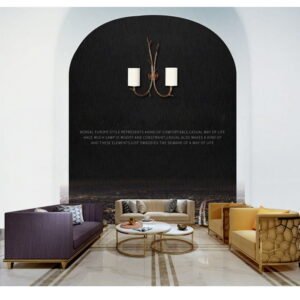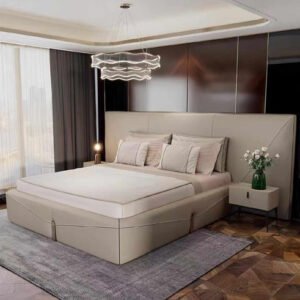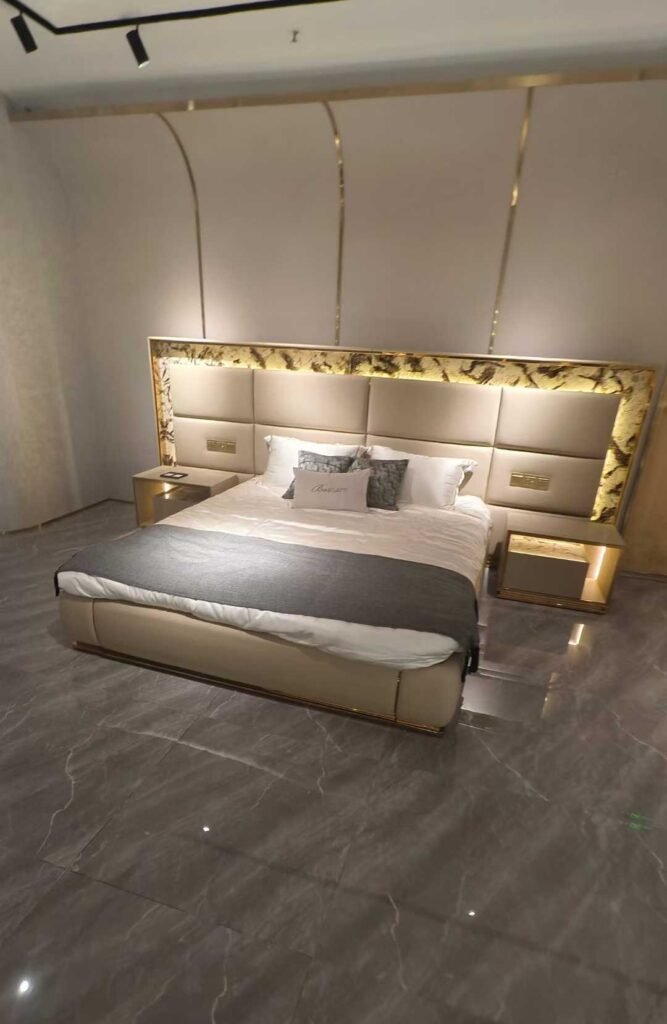
In Q3 2024, a procurement manager at a mid-size UK hospitality group placed a USD 127,000 order for hotel room furniture through a Gold Supplier on Alibaba. The listing had 4.8-star reviews, a verified badge, and a product catalog that looked indistinguishable from a legitimate manufacturer’s website. Twelve weeks later, 420 nightstands arrived at the Rotterdam port — delaminated veneers, jammed drawer slides, and formaldehyde odors strong enough to trigger guest complaints in nine rooms. Rework bill: USD 34,600. The factory turned out to be a trading company with no production capability of its own.
That outcome was not inevitable. It was the product of a sourcing model mismatch — using a self-service marketplace for a project that needed expert-level factory verification, material specification control, and in-process quality oversight.
China remains the world’s dominant furniture manufacturing base: cumulative export value reached USD 67.81 billion in 2025, supplying hospitality projects, commercial fit-outs, and residential developments on every continent. But the market’s scale creates its own complexity. With over 50,000 registered furniture manufacturers and dozens of B2B platforms listing millions of SKUs, the sourcing decision is no longer “where do I find a supplier?” — it is “what infrastructure do I need between me and the factory?”
This article answers that question for B2B buyers: importers, hospitality procurement teams, furniture distributors, interior design firms, and real estate developers sourcing at volume. It compares two fundamentally different infrastructure choices — full-service sourcing agents et online B2B marketplaces — across every dimension that determines whether your order arrives on spec, on time, and without a rework bill that erases your margin.
Key Terms Defined:
Full-service sourcing agent — A China-based professional or firm that acts as the buyer’s representative: finding factories, verifying credentials, managing quality inspections, coordinating logistics, and protecting IP on the buyer’s behalf. Fee: typically 5–10% commission on FOB value, or a monthly retainer of USD 1,500–3,000.
Online B2B marketplace — A digital platform (Alibaba, Global Sources, Made-in-China, etc.) where buyers search supplier listings, request quotes, and place orders without an intermediary. The platform provides tools (payment protection, dispute resolution, verification badges) but does not manage production or quality on the buyer’s behalf.
Furniture sourcing specifics — Unlike consumer electronics or apparel, furniture is bulky, material-intensive, and technically complex. A foam density deviation of 5 kg/m³, a veneer thickness reduction of 0.3mm, or a lacquer film thickness below spec produces defects that are invisible in a product photo but catastrophic in a hospitality room or high-end residential project.
Overview of Sourcing Furniture from China
China’s furniture manufacturing ecosystem is not a single, uniform market — it is a geography of deep specializations, each cluster optimized for a specific product category, price tier, and export destination. Understanding this landscape is the foundation of any sourcing decision, because the right infrastructure (agent vs. marketplace) depends entirely on where in this ecosystem your product category sits.
Market Landscape and Typical Buyer Profiles
Foshan’s Longjiang district dominates global production of upholstered residential and hotel seating. Anji, Zhejiang, produces roughly 60% of the world’s office chairs. Dongguan handles high-end contract and commercial-grade case goods. Fujian leads in FSC-certified solid hardwood outdoor furniture. Linyi, Shandong, is the world’s flat-pack and MDF panel furniture capital. An agent with genuine specialization in your product category has factory relationships and material-grade knowledge built across years in the right cluster. A marketplace search aggregates listings from all these regions simultaneously — useful for discovery, but blind to these geographic quality distinctions.
B2B buyers sourcing from China fall into four distinct profiles, each with different risk tolerances and infrastructure needs:
| Profil de l'acheteur | Typical Order Size | Primary Risk | Sourcing Infrastructure Need |
|---|---|---|---|
| Hospitality FF&E Procurement | USD 50K–500K per project | Material non-compliance, delayed delivery, design inconsistency | Full-service agent or direct manufacturer-partner |
| Furniture Importer / Distributor | USD 20K–200K per order | Material substitution, quality consistency across repeat orders | Agent with ongoing quality oversight + marketplace for new style discovery |
| Interior Design Firm (Commercial) | USD 10K–100K per project | Custom spec execution, IP leakage, coordination complexity | Agent or manufacturer-partner with custom production capability |
| Real Estate Developer (Residential) | USD 30K–300K per development phase | Volume consistency, phased delivery, cost control | Direct factory relationship with agent oversight on first order |
Key Players and Platforms
The major online B2B marketplaces in furniture sourcing are: Alibaba (largest global inventory, greatest variance in supplier quality), Global Sources (stronger verification standards, more manufacturing-focused), Made-in-China (domestic Chinese market orientation, strong for standard products), and 1688.com (Alibaba’s domestic wholesale platform — factory prices, no English interface, requires a China-based agent to navigate effectively).
On the agent side, the market ranges from independent freelance agents operating from a single city, to boutique sourcing firms specializing in one product category, to vertically integrated manufacturers like Meubles Jade Ant that combine direct factory production with full sourcing-agent services — eliminating the commission layer while providing the same oversight and specification management.

Full-Service Sourcing Agent Explained
A full-service sourcing agent is not a middleman who marks up the factory price — at least, not a legitimate one. The correct model is a buyer’s representative: a professional with on-the-ground presence, factory relationships, and operational infrastructure in China, acting exclusively in the buyer’s interests throughout the sourcing lifecycle.
Roles and Responsibilities
The scope of a full-service furniture sourcing agent covers seven operational domains. Factory identification and verification — shortlisting factories against the buyer’s specification, auditing production capability, and verifying legal and compliance credentials (business license on NECIPS, ISO 9001 certificates on issuing-body databases, BSCI audit status). Specification translation — converting the buyer’s design intent into production-ready documentation in both English and Mandarin, including material specs, construction tolerances, and finish parameters. Price negotiation — leveraging ongoing factory relationships to negotiate on inputs (material grade, hardware brand, packaging specification) rather than just headline price. Quality management — running the three-checkpoint inspection protocol (Pre-Production Inspection, During-Production inspection at 30–40% completion, Pre-Shipment Inspection using AQL 2.5 for major defects). Logistics coordination — advising on Incoterms, booking freight, managing export documentation, and flagging ISF filing requirements. IP protection — executing NNN agreements with factories before specifications are shared, advising on design registration. And post-delivery support — managing defect claims, warranty enforcement, and corrective-action follow-up.
When a Full-Service Agent Adds Genuine Value vs. DIY
The agent model adds disproportionate value in four specific scenarios. When the product requires custom specifications that cannot be adequately communicated through a marketplace listing — custom dimensions, project-specific finishes, proprietary construction details. When compliance requirements are non-negotiable — CARB Phase 2 for US composite wood, BIFMA X5 for commercial furniture structural safety, EN 1021 for EU hospitality upholstery fire resistance — and verification requires physical certificate cross-checking, not just accepting a PDF. When order scale creates significant financial exposure — at USD 50,000+, the cost of a failed container (rework, replacement production, delayed project handover) typically exceeds the agent’s entire service fee. And when the buyer lacks China-based operational presence — without the ability to physically visit factories, conduct video inspections in Mandarin, or resolve production issues in real time, the buyer is flying blind through the most risk-concentrated phase of the order.
Where agents do not add value: small test orders of standard, off-catalog products where the specification is fully defined by the factory’s listing and the buyer is using platform payment protection with third-party inspection. In this scenario, the agent layer adds cost without adding proportionate control.
Online Marketplaces Explained
Online B2B marketplaces are optimized for one thing: reducing the friction of finding a supplier. They aggregate enormous inventory, compress the time from “I need this product” to “I have a quote” from weeks to hours, and provide built-in tools — payment protection, dispute resolution, supplier ratings — that create a floor of commercial safety. For certain buying scenarios, that is exactly the right tool.
What Marketplaces Offer
Alibaba’s 2025 active supplier base exceeds 200,000 furniture and home goods manufacturers and trading companies. Global Sources positions itself as a more verification-intensive alternative, with in-person factory audits and stricter listing requirements for its Verified Manufacturer badge. Both platforms offer: Trade Assurance (Alibaba) or similar escrow-based payment protection, dispute resolution processes with platform mediation, Verified Supplier or Gold Supplier badges (which confirm the company has paid for the verification package, not necessarily that they are a factory), and sampling options.
Marketplace platforms provide useful starting points for market intelligence — understanding the price range for a product category, identifying design styles available for a given segment, and benchmarking against multiple suppliers simultaneously. A 2025 survey by China Checkup found that nearly 23% of B2B buyers who sourced through online platforms reported experiencing fraud or receiving materially non-compliant goods — but also found that buyers who used Trade Assurance, third-party inspection, and verified-badge suppliers together reduced that rate significantly. The platform is a tool, not a guarantee.
Typical Seller Profiles and Risk Considerations
The fundamental challenge on any Chinese furniture marketplace is that the listing interface looks nearly identical whether the seller is a Tier 1 integrated manufacturer with 800 workers and ISO 9001 certification, or a three-person trading company forwarding inquiries to a subcontracted workshop. A 2025 audit found that approximately 23% of “Verified Supplier” or “Gold Supplier” listings in the furniture category on major platforms were trading companies presenting themselves as factories. Trading companies are not inherently problematic — but when a buyer needs production traceability, QC access, or enforceable material specifications, a trading company intermediary structurally cannot provide them. Verifying whether a listing represents an actual manufacturer requires steps that go beyond the platform interface: checking the business license scope on NECIPS, reviewing US export shipping records on ImportYeti, and requesting a live video walkthrough of the production floor.

Cost Structure Comparison
Price comparison between a sourcing agent model and a marketplace model is only meaningful at the coût à l'arrivée level — the total cost per unit when the furniture arrives at your destination warehouse, inclusive of all fees, freight, duties, and risk provisions. Comparing a marketplace FOB unit price against an agent-managed FOB unit price without accounting for inspection costs, defect-risk provisions, and tariff structures is like comparing the sticker price of two cars without looking at fuel, insurance, and maintenance.
Direct Costs vs. Intermediary Costs
The agent’s commission (typically 5–10% of FOB value for orders under USD 100,000, dropping to 3–4% for larger programs) is the visible cost of the agent model. What is less visible is the cost structure on the marketplace side: platform membership fees embedded in supplier pricing, trading company margins of 10–25% above factory price (invisible because the buyer does not know the factory price), and the risk-adjusted cost of quality failures.
For a USD 50,000 furniture order, an agent charging 7% costs USD 3,500. If that agent’s QC program reduces the defect rate from a marketplace-typical 8% to 1.5%, and the average cost to rework or replace a defective unit is USD 80, the saving on 32.5 units (6.5% × 500 units at USD 80 each) is USD 2,600 — making the agent’s net cost approximately USD 900, before accounting for material substitution prevention, logistics savings from optimized packaging, and avoidance of a container delay.
Hidden Costs, Fees, and Total Cost of Ownership
The hidden costs on both sides are where procurement budgets erode invisibly. On the marketplace side: sample remake fees when the listing photo does not match the product specification, upgraded packaging (standard export cartons are routinely inadequate for furniture transit — a Jade Ant Furniture analysis of 1,200 container shipments found that upgrading to reinforced double-wall corrugated with corner protectors reduced transit damage from 6.8% to 0.9% at a cost of just USD 4–5 per unit), customs clearance complications from ambiguous product documentation, and rework costs post-delivery. On the agent side: hidden factory-side referral fees (where the agent is compensated by both the buyer and the factory, creating incentive to recommend factories that pay the highest referral rate rather than those best suited to the project) are the primary risk — and the reason to explicitly ask any agent whether they receive factory-side payments.
Landed Cost Comparison — 500 Upholstered Dining Chairs, FOB Guangzhou to US Warehouse
| Cost Element | Marketplace Route (USD) | Sourcing Agent Route (USD) | Notes |
|---|---|---|---|
| FOB Unit Price × 500 | $42,500 ($85/unit) | $39,000 ($78/unit) | Agent negotiates 8–12% below marketplace listed price via direct factory access |
| Sourcing Agent Fee | $0 | $2,730 (7% of FOB) | Commission-based; drops to 4% on orders over $100K |
| 3rd-Party QC Inspections | $600 (PSI only) | $1,200 (PPI + PSI) | Agent manages booking; 2-day inspection at $300–600/day |
| Ocean Freight (20′ FCL) | $2,800 | $2,400 | Agent’s freight network yields 10–15% better rates |
| US Import Duty (~3.5% MFN) | $1,488 | $1,365 | Based on FOB value; HS code 9401.69 |
| Tarif au titre de l'article 301 (25%) | $10,625 | $9,750 | Applied to FOB value; rising to 30% Jan 2027 |
| Dédouanement + ISF | $450 | $450 | Similar regardless of sourcing route |
| Defect Rework Provision (est.) | $2,720 (8% defect rate × $68 avg rework) | $408 (1.5% defect rate × $68 avg rework) | Industry benchmark defect rates: marketplace 6–10%, agent-managed 1–2.5% |
| Total Estimated Landed Cost | $61,183 | $57,303 | Agent route saves ~$3,880 net on this order despite the commission |
| Cost Per Unit (Landed) | $122.37 | $114.61 | 6.3% lower landed cost via agent route |
Illustrative example based on 2025 market benchmarks. Tariff rates, freight, and defect provisions vary by order, product category, and destination. Use as a framework for your own landed-cost analysis.
Landed cost component comparison — Marketplace route vs. Sourcing Agent route for a 500-unit upholstered chair order. Agent commission is offset by negotiated FOB savings, lower defect provisions, and better freight rates.
Quality Control and Supplier Verification
Quality control is the domain where the structural difference between an agent and a marketplace is most consequential — and most visible in the outcomes data. An agent who operates a genuine three-checkpoint QC program (Pre-Production, During-Production, Pre-Shipment) reduces the defect rate on furniture orders from an industry-average 6–10% on unmanaged marketplace orders to 1–2.5%. That difference does not show up in a product listing. It shows up in what arrives at the destination warehouse.
QC Processes, Factory Audits, and Sampling
Pre-Production Inspection (PPI) — conducted before a single unit is cut — verifies that raw materials on-site match the specification: wood species (confirmed by grain pattern and weight, not just the factory’s word), foam density (weighed against volume), fabric lot numbers (matched to the approved sample), hardware brand and model number (checked against packaging labels), and panel certification documents (CARB Phase 2 certificate numbers verified with the issuing laboratory). A marketplace buyer who skips the PPI does not discover that rubberwood was substituted for specified ash until the container is unpacked.
During Production (DUPRO) at 30–40% completion is where systematic errors are caught at the lowest possible cost. A re-adjusted CNC program costs nothing. Reworking 400 finished and lacquered units costs USD 15,000–30,000. DUPRO catches misaligned assembly jigs, incorrect foam cut dimensions, and finish-color drift before the entire production run is committed to the wrong specification.
Pre-Shipment Inspection (PSI) applies AQL sampling (typically AQL 2.5 for major defects, AQL 0 for critical safety defects) to finished, packed goods — the final gate before the balance payment is released. On marketplace orders without an agent, PSI can still be commissioned through third-party firms (QIMA, SGS, Bureau Veritas at USD 300–600 per day) — and doing so is strongly recommended for any order above USD 10,000.
Root causes of documented quality defects in B2B furniture orders sourced from China, 2024–2025. N = 450 quality dispute records. Source: Procurement consultant analysis, Jade Ant supplier network data, published industry QC reports.
How Agents vs. Marketplaces Handle Quality Assurance
The key structural difference is accountability. When an agent arranges QC, any defects discovered during inspection create a direct tension between the agent and the factory — the agent’s reputation and client relationship depend on resolution. When a marketplace platform arranges dispute resolution after delivery, the buyer is navigating a process designed to achieve a commercial settlement, not prevent the defect from recurring in the next order.
A survey of 85 China furniture sourcing agents (2024–2025) found that while 91% verify business licenses, only 44% check export records through shipping databases, and just 22% maintain an ongoing compliance calendar for certificate renewals and labor audit scheduling. This means even within the agent category, verification depth varies enormously — reinforcing the importance of the due diligence questions covered in the decision criteria section below.
Lead Times and Logistics
Lead time is where marketplaces create an illusion of speed and agents create actual predictability. The distinction matters when a project delivery date is contractually binding — as it almost always is in hospitality, real estate, and commercial fit-out procurement.
Production Lead Times and Variability
Marketplace suppliers respond to RFQs (Request for Quotation) within hours — creating a perception of agility that has nothing to do with actual production timelines. The quoted production time on a marketplace listing is the factory’s optimistic estimate under ideal conditions: no material procurement delay, no peak-season capacity squeeze, no quality rework. A 2025 analysis of hospitality furniture orders found that marketplace-sourced orders experienced schedule slippage on 38% of first-time orders, versus 14% for agent-managed orders where production capacity was verified before PO placement and milestone timelines were contractually defined.
The critical production variables an agent manages and a marketplace buyer cannot see: whether the factory is operating at 60% or 95% capacity during your production window; whether peak-season demand (pre-Golden Week October, pre-Chinese New Year January/February) will compress your order’s priority; and whether the quoted timeline accounts for the actual material procurement lead time (solid oak from North America: 4–6 weeks; Italian leather: 6–8 weeks) rather than assuming everything is already in stock.
Shipping Options, Incoterms, and Logistics Considerations
Incoterms (International Commercial Terms) define who pays for each logistics stage and at what point risk transfers from seller to buyer. In Chinese furniture exports, three terms dominate:
| Incoterm | Who Pays Freight | Risk Transfer Point | Meilleur pour | Watch Out For |
|---|---|---|---|---|
| EXW (Ex Works) | Buyer pays everything from factory gate | Factory gate | Buyers with own freight agent in China | Buyer must manage Chinese inland transport, export customs — requires China presence |
| FOB (Free On Board) | Seller covers to vessel; buyer from loading | Vessel loading at origin port | Most experienced B2B buyers — best cost control | Buyer must book freight; risk starts at loading, before container arrives at your port |
| CIF (Cost, Insurance & Freight) | Seller covers to destination port | Destination port | Buyers who want seller to manage freight | Seller chooses freight forwarder; buyer loses freight cost transparency |
| DDP (Delivered Duty Paid) | Seller covers all, including duties | Your warehouse | First-time importers; highest convenience | Most expensive; seller controls all cost variables; duty payment opacity |
A professional sourcing agent defaults to quoting FOB, then providing a full landed-cost calculation using current freight rates and applicable duty codes. Any marketplace or agent who quotes only the FOB unit price without context for the total landed cost is giving you an incomplete picture that cannot be used for accurate project budgeting.
Packaging is the most underestimated logistics variable in furniture importing. Furniture transit damage — corner impacts, veneer scratching, glass-top cracking — concentrates in the gap between the product and the carton wall. Specifying reinforced double-wall corrugated cartons with polyfoam corner inserts and wooden pallet bases in the purchase order (not leaving it to factory standard practice) reduces transit damage by 60–80%. An agent who writes packaging specifications into the PO routinely achieves this. A marketplace buyer who does not specify packaging receives whatever the factory considers standard.
Risk Management and Legal Considerations
Risk in China furniture sourcing concentrates at three points: before production starts (wrong factory, unchecked compliance), during production (material substitution, specification drift), and in the contractual framework (unenforceable agreements, no dispute recourse). Agents and marketplaces address these differently — and the gap is most visible when something goes wrong.
Intellectual Property, Contracts, and Compliance
IP protection is a domain where marketplaces offer structurally no help, and the difference with a professional agent is significant. When a buyer shares proprietary furniture designs, custom construction specifications, or branded colorways with a Chinese factory — whether through a marketplace RFQ or an agent introduction — the IP is at risk of unauthorized replication unless protected by a China-specific legal agreement and registered rights.
A standard Western NDA is not enforceable in Chinese courts. The correct instrument is a Accord NNN (Non-Use, Non-Disclosure, Non-Circumvention) — drafted in Mandarin, governed by Chinese law, with RMB-denominated penalties that create real deterrence against a Chinese counterparty. A professional sourcing agent executes NNN agreements with factories before any design documentation is shared. On a marketplace, the buyer shares specifications directly through the platform’s messaging system — with no NNN in place, and no practical recourse if designs appear in a competitor’s catalog six months later.
For buyers with genuinely distinctive designs, registering design patents with China’s National Intellectual Property Administration (CNIPA) before factory introductions is the most effective defensive step. China’s IP enforcement through its specialized IP courts has improved considerably since 2020 — but only for rights that are formally registered in China. The US Commercial Service IP protection guide for China provides a practical overview of the registration process and enforcement options.
Dispute Resolution and Recourse Mechanisms
When a quality dispute arises on a marketplace order, the buyer’s primary recourse is the platform’s dispute resolution system. Alibaba’s Trade Assurance covers shortfalls in quality or delivery when the buyer can document the breach relative to the original listing specification — a standard that is difficult to apply to custom furniture where the “specification” was communicated through messages, photos, and verbal agreements rather than a formal quality agreement.
An agent-managed order has a different recourse structure. The purchase agreement includes explicit quality specifications, AQL thresholds, and a penalty clause (typically: factory pays 2× replacement cost for lots exceeding AQL 2.5). The pre-shipment inspection report is the legal documentation. And dispute resolution is specified in the contract — typically CIETAC (China International Economic and Trade Arbitration Commission) arbitration, which is enforceable in China’s courts and neutral relative to foreign courts. As Harris Sliwoski LLP’s China law practice notes, a dispute resolution clause in Chinese, governed by Chinese law, and referencing a Chinese arbitration body is the structure most likely to produce an enforceable outcome against a Chinese manufacturer.
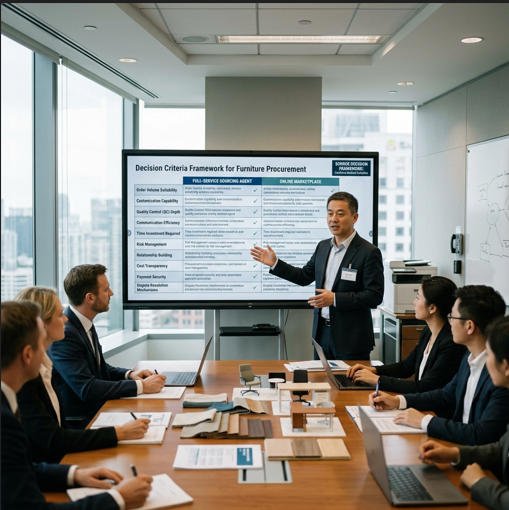
Decision Criteria for Choosing Your Sourcing Approach
The agent-versus-marketplace decision is not a universal recommendation — it is a context-dependent calculation based on order size, product complexity, risk tolerance, and project consequences. The framework below is designed to make that calculation explicit.
Scenarios Favoring a Full-Service Agent
Use a full-service agent when: your order is above USD 30,000 (at this scale, the agent’s commission is easily recovered through FOB negotiation, QC savings, and logistics optimization); your product requires custom specifications that cannot be fully conveyed through a marketplace listing; your destination market has non-negotiable compliance requirements (CARB Phase 2, BIFMA X5, EN 1021) that require verified, third-party-checked certification; your project has a contractually fixed delivery date where a production delay creates cascading cost consequences; you are commissioning proprietary designs that require IP protection before factory introduction; or you are establishing a long-term supply relationship that will span multiple production cycles and needs consistent quality baseline documentation.
Scenarios Favoring Online Marketplaces
Use a marketplace when: you need to discover and compare a broad range of product styles quickly and cost-effectively; your order is a small test purchase of standard, off-catalog products below USD 10,000; you are benchmarking prices across a product category before engaging a sourcing partner; your specification is fully defined by the factory’s catalog listing with no customization; or you are augmenting an established supply program with a small volume of supplementary items where your existing quality standards are already documented and third-party inspection is commissioned independently.
Hybrid Models and Blended Approaches
The most sophisticated B2B buyers use both tools in sequence: marketplaces for discovery and initial supplier screening, agents (or agent-equivalent manufacturer-partners) for production management and QC on committed orders. A furniture importer developing a new product line might shortlist 8–10 suppliers through Alibaba, use ImportYeti to verify which ones actually export, visit 2–3 factories with an agent who handles the Mandarin communications, and then manage the approved production run through the agent while benchmarking new product categories on the marketplace in parallel.
Agent vs. Marketplace — Decision Matrix
| Criteria | Full-Service Agent ✓ | Online Marketplace ✓ | Weight for B2B Hospitality / Commercial Buyers |
|---|---|---|---|
| Order value > USD 50K | ✓✓ | High — financial exposure justifies full oversight | |
| Custom specifications | ✓✓ | Critical — marketplace cannot guarantee spec execution | |
| Regulatory compliance (CARB, BIFMA, EN) | ✓✓ | ✓ (with independent inspection) | Non-negotiable for US/EU commercial buyers |
| Fixed project delivery deadline | ✓✓ | High — production scheduling requires capacity verification | |
| Proprietary design / IP protection needed | ✓✓ | Critical — NNN and design registration needed before factory intro | |
| Small test order, standard product | ✓✓ | Low agent value — marketplace with platform protection is sufficient | |
| Fast style discovery and price benchmarking | ✓✓ | Marketplace is the right tool for this specific task | |
| Long-term supply relationship (repeat orders) | ✓✓ | High — consistency requires documented quality baseline | |
| Order value < USD 10K, catalog product | ✓✓ | Agent fee disproportionate at this scale |
Watch: Sourcing Agent vs. Going Alone — Practical Breakdown
The following video provides a practical, buyer-side walkthrough of how China sourcing agents actually operate versus navigating the market independently — covering when the agent model makes commercial sense and what questions to ask before engaging one.
Video: How to Find the Best China Sourcing Agent & When Do You Need One — a practical breakdown of the agent model, cost structures, and decision criteria. Source: YouTube.
Case Studies: Agent vs. Marketplace in Practice
Abstract frameworks are only useful when validated against real procurement scenarios. The two case studies below represent composite profiles built from documented sourcing outcomes, illustrating how the model choice plays out differently depending on project type and order complexity.
Case Study A: Small-Batch Custom Furniture Project
Scenario: A Singapore-based interior design firm sourcing 45 custom dining chairs and 12 marble-top dining tables for a boutique restaurant fit-out. Custom dimensions, proprietary leg profile, and specific stone sourcing required. Budget: USD 38,000 FOB. Delivery deadline: 14 weeks from order placement (fixed restaurant opening date).
Marketplace approach attempted: The firm’s procurement lead spent three weeks shortlisting suppliers on Alibaba, found four suppliers willing to produce the custom leg profile, and placed an order with the lowest-priced option (a “Gold Supplier” with 4.7 stars). The supplier accepted the brief, produced a sample with a different leg profile than specified (citing “manufacturing adjustment”), and at week 10 of production reported a three-week delay due to marble slab availability. The restaurant opening was delayed. Total additional cost: USD 8,200 (hotel accommodation for delayed installation crew, client penalty clause, expedited air freight for 12 chairs).
Agent approach (subsequent order): The same firm engaged a furniture sourcing agent for the replacement and expansion order. The agent verified three Foshan factories against the specification, selected one with marble-processing capability on-site (eliminating the material sourcing variable), executed a production contract with a delivery penalty clause, managed PPI and DUPRO inspections, and delivered on time. The agent’s 8% commission (USD 3,040) was recovered on FOB negotiation alone (USD 3,420 below the marketplace quoted price for identical specs).
Case Study B: Large-Scale Hospitality FF&E Order
Scenario: A UAE-based hospitality group sourcing FF&E for a 220-room hotel: bedroom furniture (bed frames, nightstands, wardrobes, luggage benches), lobby seating, and restaurant dining sets. Total order value: USD 480,000. Compliance requirements: CARB Phase 2 (formaldehyde), BS 5852 (UK fire standard for upholstery), and hotel brand standards requiring BIFMA X5 load testing documentation. Delivery: phased, with a model room required at week 14 and full production at week 28.
Agent model engaged: A full-service furniture sourcing agent coordinated the project through a structured multi-factory sourcing approach — three specialized factories for bedrooms, lobby seating, and restaurant sets respectively, each selected against the compliance requirements. Total agent fee: 5% (USD 24,000). The agent managed factory qualification audits for all three, coordinated compliance testing through SGS (CARB, BIFMA, BS 5852 all verified before production start), and ran pre-production, mid-production, and pre-shipment inspections on each factory’s production run.
Outcome: Model room delivered at week 13 (one week ahead of schedule). One factory’s DUPRO inspection caught a veneer thickness deviation at 35% production completion — corrected at zero cost, saving an estimated USD 22,000 in rework that would have been discovered at the destination. Total defect rate at PSI: 1.2% major defects across all three factories. Brand standards audit passed first review. The USD 24,000 agent fee was offset by USD 19,600 in FOB negotiation savings, USD 22,000 in prevented rework, and USD 4,800 in freight optimization — net benefit of the agent engagement: approximately USD 22,400 on a USD 480,000 order.

Practical Steps to Get Started
Deciding between an agent and a marketplace is only the first step. The following checklist and onboarding process give you a structured path from decision to first order, regardless of which route you choose.
Checklist to Evaluate Your Needs and Budget
| Evaluation Question | Your Answer | Implication |
|---|---|---|
| What is the total FOB value of the order? | Below $10K: marketplace with 3rd-party inspection. $10K–$50K: marketplace + independent QC or agent. Above $50K: agent or direct manufacturer-partner. | |
| Is the product custom or catalog-standard? | Any custom dimension, material, or finish requires specification documentation — use an agent who can manage bilingual spec sheets. | |
| What compliance certifications are required? | CARB, BIFMA, EN, BS standards require third-party verified certificates. An agent handles verification; on marketplace, buyer must commission independently. | |
| Is there a fixed project delivery deadline? | Fixed deadlines require production capacity verification before PO placement — only possible with agent or direct factory engagement. | |
| Do you have proprietary designs to protect? | NNN agreement and CNIPA design registration required before any factory introduction. Use an agent who can manage this process. | |
| What is the cost of a quality failure? | If a defective container creates project delays, client penalties, or brand damage, spend on prevention (agent QC) rather than cure (rework + replacement). | |
| Do you have existing factory relationships? | If yes and quality records are strong: marketplace for supplementary items, agent for new categories. If no: agent for first factory qualification. |
Step-by-Step Onboarding and Vetting Process
Whether you are onboarding a sourcing agent or vetting a marketplace supplier, the structured process is the same — only the verification steps differ. For a sourcing agent: verify their legal entity on NECIPS; call two client references in your product category; review a redacted factory audit report and sample PSI report; confirm their QC protocol includes PPI + DUPRO + PSI with AQL documentation; ask explicitly whether they receive factory-side referral fees; confirm they will execute NNN agreements with factories before your specifications are shared; and review their engagement contract for scope, liability, cancellation terms, and dispute resolution mechanism. For a marketplace supplier: verify business license scope on NECIPS (manufacturing, not trading); check US export shipping history on ImportYeti; verify all certificates directly with issuing bodies; commission independent PSI before releasing balance payment; use platform escrow (Alibaba Trade Assurance or equivalent); and document all specifications in writing within the platform’s messaging system to support any dispute claim.
For buyers who want to bypass this qualification process and work with a manufacturing partner that has already passed it, Meubles Jade Ant operates as both a direct custom furniture manufacturer and a full sourcing-agent partner — combining factory-direct pricing with the QC oversight, specification management, and logistics coordination of a professional agent. With 15+ years in China’s manufacturing ecosystem and active production for hospitality, commercial, and residential projects globally, the team provides the kind of embedded market intelligence that takes years to build independently. You can also explore the 10 essential questions to ask any sourcing agent before signing an engagement.

Choosing the Right Sourcing Infrastructure for Your Business
The sourcing agent versus marketplace decision is ultimately a question of how much operational infrastructure you need between your specification and the production floor. For small, standard, low-stakes orders, the marketplace’s self-service efficiency is the right match. For complex, custom, high-value, or compliance-sensitive orders, the agent model’s operational depth — factory relationship equity, production-floor oversight, specification translation, and legal protection — consistently delivers better outcomes at lower total cost.
Three principles should govern the decision regardless of which route you choose. First, never compare prices without comparing landed cost — a USD 10 per-unit difference at FOB that costs USD 25 in rework, delay, and compliance re-testing is not a saving. Second, document everything — every specification, every approved sample, every inspection report is the evidence base that makes disputes resolvable and repeat orders consistent. Third, treat due diligence as insurance — the USD 3,000 cost of a thorough factory qualification and three-checkpoint QC program on a USD 80,000 order is the cheapest insurance available against a rework bill that can exceed the agent’s entire fee.
The most successful B2B furniture buyers use both tools purposefully: marketplaces for discovery and benchmarking, agents or agent-equivalent manufacturer-partners for committed production. Knowing when to switch between them — and what questions to ask at each stage — is the sourcing competency that separates consistent, profitable procurement programs from costly first-order learning experiences.
For B2B buyers ready to move beyond marketplace browsing into a structured sourcing partnership, Meubles Jade Ant provides factory-direct manufacturing combined with full sourcing-agent capabilities across China’s primary furniture production hubs.
Key Terms Glossary
- AQL (Acceptable Quality Limit)
- A statistical sampling standard (ISO 2859-1) defining the maximum acceptable defect rate in a production batch. AQL 2.5 means the lot is accepted if no more than 2.5% of randomly sampled units show major defects. AQL 0 for critical defects means zero tolerance.
- BSCI (Business Social Compliance Initiative)
- An amfori-managed labor compliance audit program assessing factories on fair wages, working hours, child-labor prohibition, and health & safety. Grades range from A (exemplary) to E (unacceptable). Required by many EU retail and hospitality procurement programs.
- CARB Phase 2 / EPA TSCA Title VI
- US federal regulation (adopted from California’s CARB standard) limiting formaldehyde emissions from composite wood products (MDF, particleboard, HDF). Mandatory for all composite-wood furniture sold in the US market. Non-compliance can trigger import refusal and legal liability.
- CIETAC
- China International Economic and Trade Arbitration Commission — the primary venue for commercial arbitration involving Chinese counterparties. Awards are enforceable in Chinese courts, making CIETAC the recommended dispute-resolution clause for contracts with Chinese manufacturers.
- DUPRO (During Production Inspection)
- A third-party quality inspection conducted at 30–40% production completion. Catches systematic defects — wrong foam density, misaligned assembly, incorrect finish color — when corrections are still economically viable, before the full production run is committed to the error.
- FOB (Free On Board)
- The seller loads goods onto the vessel at the origin port; all costs and risk transfer to the buyer from that point. The most common Incoterm in Chinese furniture exports and the recommended basis for comparing supplier quotes.
- Incoterms
- International Commercial Terms — standardized trade terms defining who pays for each logistics stage and at what point risk transfers from seller to buyer. The current edition is Incoterms 2020 (ICC). The most common in China furniture trade: EXW, FOB, CIF, DDP.
- NECIPS
- National Enterprise Credit Information Publicity System (国家企业信用信息公示系统) — China’s official government database for verifying business licenses, registered capital, business scope, and legal representative information. Available at gsxt.gov.cn.
- Accord NNN
- Non-Use, Non-Disclosure, Non-Circumvention agreement — China’s enforceable equivalent of an NDA. Must be drafted in Mandarin, governed by Chinese law, with RMB-denominated penalties specifying Chinese arbitration (CIETAC) as the dispute venue. The essential IP protection instrument before sharing designs with any Chinese factory.
- PPI (Pre-Production Inspection)
- A quality checkpoint conducted before production begins, verifying that raw materials on-site match the purchase specification: wood species, foam density, fabric lots, hardware model numbers, and panel certification documents. The most cost-effective QC investment in the three-checkpoint model.
- Trade Assurance
- Alibaba’s buyer-protection program providing payment escrow and dispute mediation for orders placed through the platform. Covers shortfalls in quality or delivery relative to the agreed listing specification — but requires the specification to be documented within the platform system to be enforceable in a dispute.
Frequently Asked Questions
What factors should trigger hiring a sourcing agent over using a marketplace for furniture from China?
Four factors reliably trigger the need for a sourcing agent over a self-service marketplace. First, order value above USD 30,000 — at this scale, the agent’s commission (5–10% of FOB) is typically recovered through factory-price negotiation, QC defect prevention, and logistics optimization, making the agent net-zero or net-positive on cost. Second, custom specifications that cannot be fully defined through a marketplace listing — custom dimensions, proprietary construction details, or project-specific finishes require bilingual specification documentation and production-floor oversight that a marketplace cannot provide. Third, regulatory compliance requirements — CARB Phase 2, BIFMA X5, EN 1021, or BS 5852 compliance for US or EU markets requires verified, third-party-checked certificates, not PDF documents accepted at face value. Fourth, fixed delivery deadlines with financial consequences — an agent verifies production capacity before order placement, preventing the timeline slippage that occurs on 38% of first-time marketplace-sourced orders. If two or more of these factors apply to your order, the case for a professional agent is clear.
How can I assess supplier reliability on online marketplaces like Alibaba or Global Sources?
Platform verification badges (Gold Supplier, Verified Manufacturer) confirm that the company paid for the verification package — not that they are a legitimate manufacturer with controlled production. To genuinely assess reliability, layer five checks beyond the platform interface: (1) verify the business license on NECIPS — confirm the business scope includes manufacturing (制造), not just trading (贸易); (2) check actual US export records on ImportYeti — a real manufacturer has consistent shipment history under its registered company name; (3) verify all certificate numbers (ISO 9001, CARB, FSC) directly with the issuing body’s online database — do not accept a PDF without cross-checking the certificate number; (4) request a live 30-minute video walkthrough of the production floor, showing CNC equipment, assembly stations, and the QC room — a legitimate factory can provide this within 24 hours; (5) commission an independent pre-shipment inspection through QIMA, SGS, or Bureau Veritas before releasing the balance payment on any order above USD 5,000.
What are the common hidden costs when sourcing furniture from China through either channel?
The hidden costs that erode sourcing margins fall into six categories. Packaging deficiency costs — standard export cartons are routinely inadequate for furniture transit; upgrading to reinforced double-wall corrugated with foam corners costs USD 4–5 per unit and reduces transit damage by 60–80%, but is rarely included in marketplace pricing. Material substitution costs — rubberwood substituted for specified ash, LDPE rattan for specified HDPE, or sub-spec foam density produces defects discovered only after delivery; prevention requires material verification at PPI. Tariff miscalculation — for US buyers, Section 301 tariffs of 25% on Chinese furniture add USD 30+ per unit on a USD 120 FOB chair; an incorrect HS code classification compounds this. Compliance re-testing costs — if a certificate cannot be verified and independent re-testing is required, SGS or Intertek lab testing runs USD 400–2,500 per product. Rework and replacement costs — the single largest hidden cost; marketplace-sourced orders average 6–10% major defect rates without third-party QC. Agent dual-commission costs — agents who receive factory-side referral fees recommend factories based on referral margin rather than product fit, producing hidden price inflation at the FOB level. Always ask agents explicitly whether they receive factory-side payments.
Can I use a hybrid approach, and what does that look like in practice?
Yes — the hybrid approach is the most operationally sophisticated model and is used by leading furniture importers and procurement teams. In practice, it works as follows: use online marketplaces (Alibaba, Global Sources, 1688.com) for three specific tasks where they genuinely excel — discovery of new product styles and design references, initial price benchmarking across a product category, and rapid supplier shortlisting before formal qualification. Then transition to an agent or direct manufacturer-partner for all committed production: factory verification and qualification audit, specification documentation, QC management (PPI + DUPRO + PSI), logistics coordination, and compliance verification. For an established furniture distribution program, the hybrid model might look like: marketplace review of new collections quarterly for design intelligence, agent management of all confirmed orders, and annual visits to approved factories. This captures the marketplace’s discovery efficiency without accepting its production-oversight limitations on orders that matter.
How much does a full-service furniture sourcing agent typically charge in 2025?
In 2025, full-service furniture sourcing agents use two primary fee structures. Commission-based: 8–10% of FOB value for orders under USD 20,000; 6–8% for USD 20,000–50,000; 5–6% for USD 50,000–100,000; and 3–4% for orders above USD 100,000. Monthly retainer: USD 1,500–3,000 per month for ongoing programs where the agent manages multiple concurrent orders — this becomes cost-effective when annual order value exceeds approximately USD 200,000. Some agents use a hybrid model combining a reduced retainer with a 2–3% commission per order. The critical due diligence question beyond the rate: whether the agent also receives factory-side referral fees. Dual compensation is not illegal but must be disclosed — agents who receive both buyer commissions and factory referral fees have a structural conflict of interest that typically inflates your FOB price by more than their declared commission rate. A legitimate agent earns from the buyer only, or fully discloses factory-side compensation in writing.
What is the difference between a sourcing agent and a trading company when buying furniture from China?
The structural difference is accountability direction. A sourcing agent legally and operationally represents the buyer — finding factories, managing QC, and coordinating logistics in the buyer’s interest, for a disclosed service fee. The buyer has full visibility into the actual factory: who it is, what it costs, what it produces. A trading company acts as the seller — buying goods from a factory and reselling them to the buyer at an undisclosed markup, typically 10–25% above factory price. With a trading company, the buyer does not know which factory made the goods, cannot audit the production process independently, has no direct leverage over material specifications, and has limited recourse if quality issues arise (the trading company, not the factory, is the legal counterparty to your contract). For furniture orders where material traceability, QC access, custom specifications, or compliance verification are important — which describes virtually all commercial B2B orders — a transparent sourcing agent relationship is structurally superior to a trading company arrangement, despite sometimes lower quoted prices from the latter.
How long does it take to source furniture from China through a sourcing agent vs. a marketplace?
Total timeline from project initiation to warehouse delivery varies significantly between the two models — not because agents are slower, but because they perform steps that marketplace buyers skip and then discover are necessary after production has started. Marketplace route (first order, standard product): supplier discovery 1–2 weeks; sample order and evaluation 2–3 weeks; production 4–8 weeks; ocean transit 3–6 weeks; customs clearance 1–2 weeks. Total: 11–21 weeks. Agent route (first order, custom product): factory qualification 2–4 weeks; specification finalization and counter sample 2–4 weeks; bulk production 4–8 weeks; QC inspections (3 checkpoints) embedded in production timeline; ocean transit 3–6 weeks; customs clearance 1–2 weeks. Total: 12–24 weeks. For repeat orders with an approved factory and documented specification, the agent route compresses to 12–16 weeks total. The key advantage of the agent route is predictability — timeline slippage on first marketplace orders averages 3–5 weeks beyond the initial quote; agent-managed orders with contractual milestone accountability typically deliver within 1–2 weeks of the committed schedule.
How do I protect my furniture designs from being copied when working with Chinese suppliers through either channel?
IP protection in Chinese furniture sourcing requires three parallel actions, regardless of whether you use an agent or a marketplace. First, execute a China NNN Agreement (Non-Use, Non-Disclosure, Non-Circumvention) with the factory before sharing any design documentation. This must be in Mandarin, governed by Chinese law, with RMB-denominated penalties — a US-law NDA has no practical enforcement mechanism against a Chinese manufacturer. Second, register distinctive design elements as design patents with CNIPA (China’s National IP Administration) before factory introductions — China’s first-to-file system means the first party to register owns the right, regardless of who created the original. Third, implement operational controls: share detailed drawings only on a need-to-know basis, use watermarked version-controlled files, confirm tooling ownership in the production contract, and audit tooling inventories periodically. A sourcing agent who manages factory introductions should be executing NNN agreements as a standard step — if they do not, that is a qualification failure. On a marketplace, the buyer must manage this entire process independently, as the platform provides no IP protection infrastructure.
Can Jade Ant Furniture act as both manufacturer and sourcing partner for B2B buyers?
Yes. Meubles Jade Ant operates as a China-based custom and luxury furniture manufacturer that also provides full sourcing-agent services — a model that eliminates the commission layer while retaining all the operational oversight of a professional agent. For buyers sourcing within Jade Ant’s production scope (hotel furniture, custom residential, commercial and hospitality FF&E across bedroom, living, dining, and lobby categories), Jade Ant provides direct factory pricing combined with QC inspection coordination, bilingual specification development, compliance certification management, logistics coordination, and post-delivery support. For buyers needing broader market coverage — multiple factories, multiple product categories outside Jade Ant’s core production — the team also provides sourcing-agent services leveraging 15+ years of verified factory relationships across Guangdong and key furniture manufacturing clusters. The practical benefit: buyers get factory-direct pricing with agent-level production oversight, without the dual-commission risk inherent in independent agent models. Contact Meubles Jade Ant with project requirements for an initial consultation.