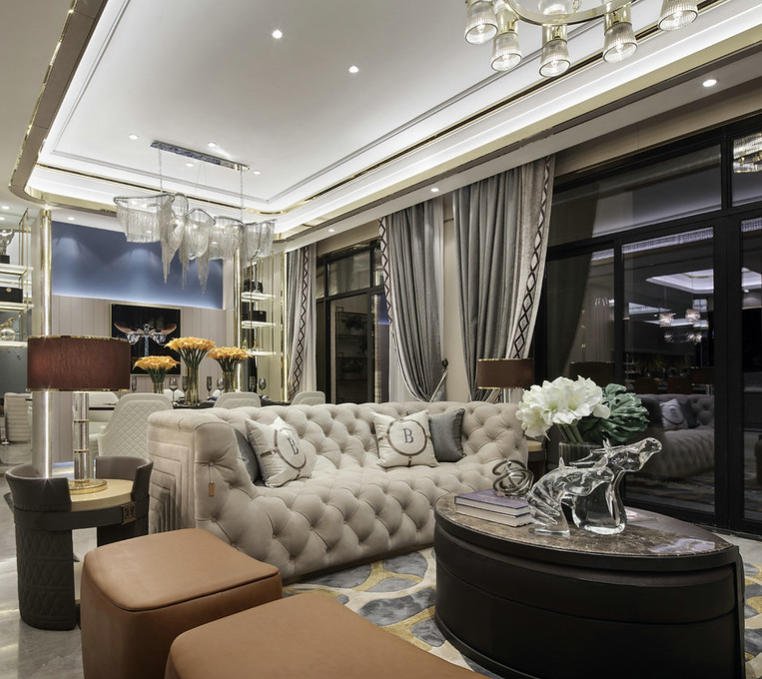
The definitive guide for distributors, showroom managers, and design professionals to source, evaluate, and confidently recommend timeless furniture pieces that justify premium pricing and build client loyalty.
Why Your Clients Demand Better Than Mass-Market Furniture
A hotel procurement director recently shared a calculation that her team now runs on every furniture specification: total cost over the replacement cycle, not purchase price. The $3,200 dining chairs she’d specified five years earlier — mass-produced, solid-looking in the showroom — required full replacement across 80 rooms after 4.5 years. Replacement cost: $192,000, plus three weeks of room downtime during the swap. The alternative she’d passed on — $5,800 chairs with solid hardwood frames and mortise-and-tenon joinery — carried a 10-year structural warranty and would have cost $139,200 less over the same period.
The $2,600 “savings” per chair cost the property $192,000. That calculation changed how she sources furniture. It should change how you sell it.
The global luxury furniture market was valued at $25.28 billion in 2025 y se prevé que alcance $42.02 billion by 2034 (Fortune Business Insights). The clients driving this growth are not simply spending more — they are buying differently. They’re asking harder questions, requesting material documentation, and evaluating suppliers on expertise as much as on product range. Premium clients — interior designers building reputations on project outcomes, hotel operators protecting asset values, residential buyers investing in spaces that will last — aren’t just purchasing furniture. They’re purchasing professional judgment. Yours.
Your ability to confidently evaluate investment-grade furniture — to know what separates a 20-year piece from a 5-year piece, to read a warranty clause, to verify a material claim, to recognize a shortcut in construction — is the difference between being a trusted advisor and being a catalog deliverer. This checklist is the tool that bridges that gap.
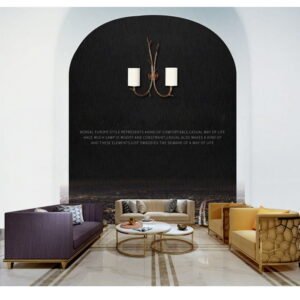
 Every joint, finish layer, and hardware choice in a piece like this tells a story — and your ability to read that story is what your premium clients are paying you to know.
The Foundation — Understanding Luxury Furniture Investment Principles
What Makes Furniture “Investment-Grade”?
The word “luxury” in furniture retail is frequently misappropriated. A polished marketing image, a high price tag, and a designer name are not evidence of investment-grade construction. Your clients — particularly the experienced ones — know this. What they need from you is the ability to articulate what actually separates a piece worth $8,000 from a piece that should cost $1,500 but is priced at $7,000 because the showroom has marble floors.
Investment-grade furniture shares four verifiable characteristics: material authenticity (the piece is made from what it claims to be made from), construction integrity (it’s assembled in ways that resist stress and time), finish durability (surface treatments that protect the material rather than just covering it), and repairability (when components eventually wear, they can be restored rather than replaced). Any piece that cannot satisfy all four criteria is not investment-grade regardless of how it’s positioned or priced.
Beyond Aesthetics — The Real Value Proposition
Your clients pay premium prices for outcomes, not objects. The outcome they are buying is a piece that performs visually and functionally for a decade or more — that ages beautifully rather than deteriorating, that requires predictable maintenance rather than emergency replacement, and that reflects positively on the professional who recommended it.
For interior designers, the value proposition is reputation protection: a piece that fails within two years of project completion damages their client relationship and their portfolio. For hotel operators, the value is asset performance: FF&E (Furniture, Fixtures, and Equipment — all physical items that furnish a commercial space) that lasts through multiple renovation cycles reduces capital expenditure and room downtime. For residential buyers, the value is inheritance-worthy quality: pieces that remain relevant and structurally sound long enough to carry meaning beyond their original purchase.
Understanding which outcome your specific client is buying determines how you position the investment case.
The Cost-Per-Year Advantage
The most effective tool for converting premium pricing conversations is the total cost of ownership calculation. TCO (coste total de propiedad) is simply: purchase price + maintenance costs over the ownership period + replacement cost at end of life, divided by years of use.
| Piece Type | Purchase Price | Annual Maintenance | Lifespan | Coste anual |
|---|---|---|---|---|
| Mass-market upholstered sofa | $1,800 | $120 | 5 years | $480/year |
| Mid-range contract sofa | $3,500 | $180 | 8 years | $618 total / $618/year |
| Investment-grade solid frame sofa | $6,200 | $200 | 18 years | $544/year |
| Heirloom-quality hand-tied sofa | $9,500 | $220 | 25+ years | $600/year |
The $6,200 investment-grade piece costs less per year than the $1,800 mass-market alternative — before factoring in the disruption, logistics, and relationship cost of replacement.
The average lifespan of a mass-manufactured furniture piece is approximately 4 years (House Beautiful/industry data). Investment-grade solid wood and properly constructed upholstered pieces regularly deliver 15–30+ years of primary use. When a client is fitting out a boutique hotel, a residential development, or a corporate office, the replacement cycle math is not abstract — it directly impacts their capital expenditure budgeting for the next decade.
Section 2: Material Mastery — What Your Sourcing Team Needs to Know
Wood Selection and Grading Standards
Wood is the most misrepresented material category in furniture retail. The gap between “solid oak” as a legitimate material description and “solid oak” as a marketing phrase applied to an oak-veneer-over-MDF product is enormous — and it is frequently exploited by manufacturers operating at every price point, including premium ones. Your sourcing team needs the vocabulary and inspection skills to close this gap.
Solid Wood vs. Veneer — And When Each Is Appropriate
Madera maciza (timber cut from a single log and used as a continuous piece) is the premium standard for structural components: legs, frames, aprons, drawer boxes. It accepts joinery, resists racking forces, and can be sanded and refinished multiple times over its lifespan. A solid walnut dining table frame that develops a surface scratch in year eight is a refinishing project. The same scratch on a veneer surface over particle board is a replacement conversation.
Veneer (a thin slice of real wood, typically 0.5–3mm, bonded to a substrate) is not inherently inferior — it is simply a different application. Legitimate veneer use in luxury furniture includes large flat panel surfaces (tabletops, cabinet doors, drawer fronts) where book-matched grain patterns are an aesthetic feature that solid wood cannot achieve. The substrate matters: veneer over high-quality MDF or multi-ply furniture-grade plywood is structurally appropriate for panels. Veneer over particle board is a cost-saving shortcut that will delaminate under humidity exposure and impact stress.
The red flag is misrepresentation: a piece marketed as “solid wood” that uses particle board or standard MDF substrates beneath veneer surfaces is a material fraud that your professional credibility cannot afford to ignore.
How to audit supplier claims: Request a cross-section sample of panel materials. Legitimate manufacturers of premium furniture will provide this without hesitation. Resistance to this request is itself a red flag. Tap the surface — solid wood produces a different acoustic response than hollow or composite constructions. Examine edge profiles: solid wood edges can be shaped and profiled in ways that laminate edging cannot replicate cleanly.
Premium Wood Species and Their Performance Characteristics
| Wood Species | Hardness (Janka lbf) | Primary Applications | Nivel de precios | Sustainability Status |
|---|---|---|---|---|
| American Black Walnut | 1,010 | Tables, cabinets, case goods | Premium | Widely available, FSC-certifiable |
| White Oak | 1,360 | Flooring, tables, frames | Premium | Widely available, FSC-certifiable |
| Hard Maple | 1,450 | High-wear surfaces, drawers | Gama media-alta | Widely available |
| Teak | 1,000 | Outdoor/indoor premium | Luxury | Requires FSC certification |
| White Ash | 1,320 | Bending applications, chairs | Gama media-alta | Check regional availability |
| Cherry | 950 | Cabinets, decorative pieces | Premium | Widely available |
| Ebony | 3,000+ | Decorative inlay | Ultra-luxury | Restricted — verify sourcing |
| Mahogany (genuine) | 900 | Traditional, classic pieces | Luxury | Restricted — verify sourcing |
Janka hardness: the force (in pounds) required to embed a steel ball to half its diameter into the wood surface — a direct measure of wear resistance and dent susceptibility.
Walnut, white oak, and hard maple are the workhorses of investment-grade furniture for a practical reason: they are hard enough to resist daily wear, stable enough to behave predictably through seasonal humidity changes, widely available in quality grades that allow FSC certification, and aesthetically compelling across contemporary and traditional design directions.
Exotic and tropical species — teak, ebony, genuine mahogany — require rigorous sourcing verification. For your designer and hospitality clients operating in markets where sustainability is a procurement criterion (and in 2025, this is most serious professional contexts), Certificación FSC (Forest Stewardship Council — an independent body that certifies responsible forest management and chain-of-custody tracking) is the minimum documentation requirement. Reclaimed and FSC-certified wood accounted for 34.6% of US sustainable furniture sales in 2025 (First Chair data), confirming that this is not a niche client preference — it is mainstream professional practice.
Evaluating Wood Finish Quality
The finish is the piece’s first line of protection and the first evidence of craftsmanship quality. It is also the most easily faked element in luxury furniture positioning.
Oil and hard-wax oil finishes penetrate the wood fiber and harden within it, creating protection that does not sit as a film on the surface. They require periodic re-oiling (typically annually or biannually, depending on use) but can be spot-repaired without full refinishing. The signature of a quality oil finish is a surface that still feels like wood — not like a coated product. Rubio Monocoat and Osmo are recognized trade standards; their presence on a specification sheet signals a manufacturer who takes finish quality seriously.
Catalyzed lacquer and conversion varnish finishes create a harder, more impact-resistant surface film with better water resistance. These are appropriate for dining tables, commercial surfaces, and pieces in high-humidity environments. Quality application involves multiple coats with inter-coat sanding, producing a surface with consistent sheen and depth. The failure mode of cheap lacquer is visible: orange-peel texture, inconsistent sheen, clouding around edges, and peeling within two to three years.
Hand-rubbed finishes — the application of finish by hand rather than spray application — are a legitimate quality marker, particularly for pieces where surface texture and depth are design features. They are also an easily claimed but difficult-to-verify attribute. The evidence is in the surface: hand-rubbed finishes show subtle variation in sheen depth that spray applications cannot replicate.
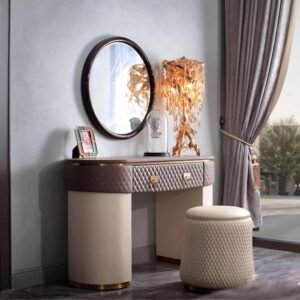
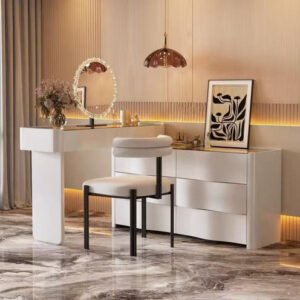
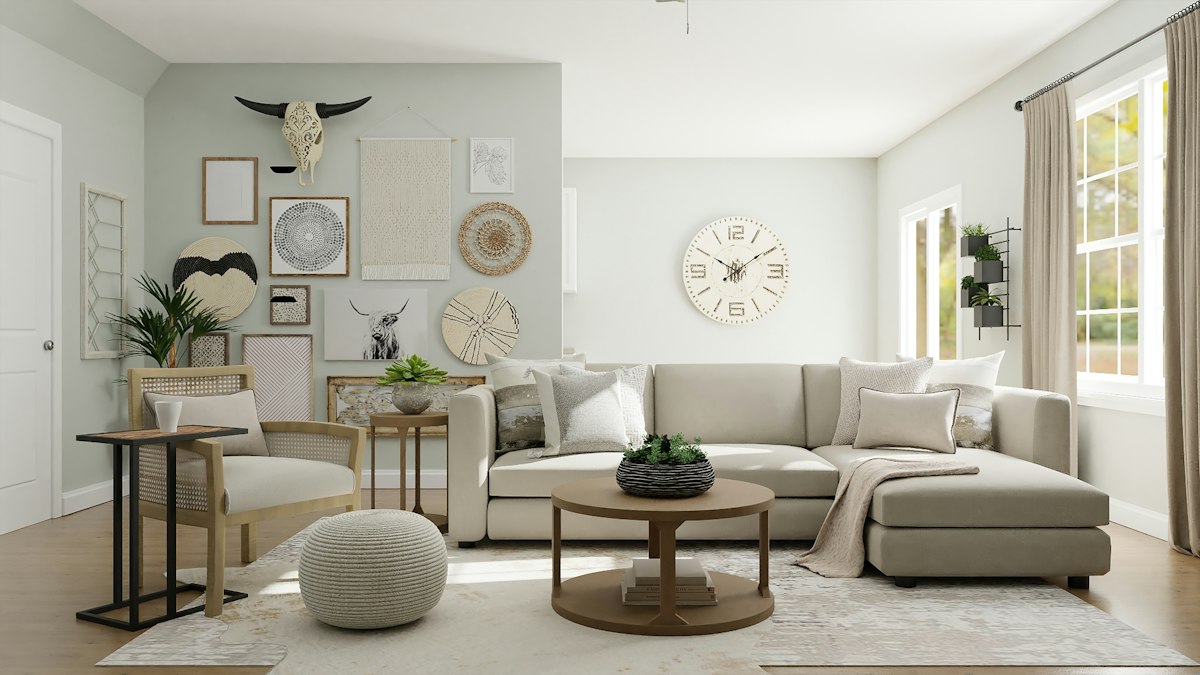 The joinery at the arm-to-seat junction and the finish depth across the flat surfaces are readable quality markers — if you know what you’re looking at.
Section 3: Upholstery Intelligence for Design Professionals and Showroom Managers
Fabric and Leather Standards That Protect Your Reputation
Upholstery failure is the most visible furniture quality problem — and the most professionally damaging. A sofa whose fabric pills after six months in a hotel lounge doesn’t fail quietly. It fails in front of every guest who walks through the space, and it does so under your name, because you specified it. Understanding fabric and leather performance standards is not optional for design professionals — it is professional self-protection.
Natural Fibers vs. Synthetics — Performance and Positioning
The client expectation that “natural = better” in upholstery is persistent and partially incorrect. Natural fibers — linen, wool, cotton — offer unmatched aesthetic qualities: texture depth, patina development, and the irreplaceable visual complexity of organic materials. They are the right specification choice for residential pieces in controlled environments and statement commercial pieces where visual impact justifies maintenance investment.
For high-traffic commercial applications — hotel lobbies, restaurant seating, corporate lounge areas — the performance calculus changes. High-performance synthetics (solution-dyed acrylic, Type 6,6 nylon, engineered polyester blends) outperform natural fibers on every durability metric that matters in commercial contexts: abrasion resistance, UV stability, stain resistance, and cleanability. Your hospitality designer clients who specify natural linen on lobby seating are creating future conversations about premature deterioration. Your role is to explain why, not simply to validate their preference.
Martindale abrasion testing (ISO 12947-2 — a standardized test that measures fabric durability by rubbing a fabric sample against a standard wool fabric in a figure-eight motion, counting cycles until the surface degrades) is the European and Asian standard for upholstery performance specification.
| Martindale Rating | Appropriate Application |
|---|---|
| Under 10,000 cycles | Decorative use only — not suitable for seating |
| 10,000–20,000 cycles | Light residential use |
| 20,000–40,000 cycles | General residential — standard quality |
| 40,000–100,000 cycles | Commercial low-to-medium traffic |
| 100,000+ cycles | Commercial high-traffic, hospitality, contract |
For hotel and commercial specifications, 100,000+ Martindale cycles is the minimum professional requirement. For residential luxury pieces in primary living areas, 40,000+ cycles is a credible performance baseline. Any supplier unable to provide a Martindale certification for their upholstery fabrics should not be in your commercial specification program.
Fabric weight is a related but independent indicator: fabrics for commercial seating should be a minimum of 15 oz per linear yard for heavy-use applications. Thread count (the number of threads per square inch in the warp and weft) indicates weave density and surface durability — for upholstery applications, a tighter weave with higher thread count resists pilling and surface degradation under friction stress.
Leather Grading Systems and Authentication
Leather is the most mystified material in luxury furniture retail, in part because the industry’s grading terminology is widely misunderstood and inconsistently applied.
Full-grain leather retains the complete outer surface of the hide — including the natural grain pattern, texture variation, and minor imperfections that are the material’s biological fingerprint. It is the most durable leather type because the grain layer is the hide’s densest and most fiber-rich zone. Full-grain leather develops a patina — a surface quality change as the leather ages and absorbs oils from contact — that is specifically valued in high-end residential pieces. It is more susceptible to staining than treated alternatives, which makes it appropriate for statement pieces in controlled residential environments, not high-traffic commercial seating.
Top-grain leather has had the outermost surface layer sanded or buffed to remove natural imperfections, then embossed with a uniform grain pattern and treated with a protective finish coating. The result is a more consistent, stain-resistant surface with less patina development over time. For hospitality and commercial applications where maintenance consistency and stain resistance are priorities, top-grain leather is often the more professionally appropriate specification — not a compromise, but a contextually correct choice.
Corrected-grain leather uses significantly altered hides with heavy surface treatment — these are lower-quality hides upgraded through processing. Appropriate for budget positioning, not for premium or luxury claims.
Bonded leather (shredded leather fibers bonded with polyurethane) is not genuine leather. It peels, cracks, and delaminates within two to five years under normal use. No premium furniture positioning should include bonded leather.
Authentication: Genuine leather produces a distinct smell, shows natural variation in texture and thickness, and has a warm, slightly irregular surface feel. Apply a small amount of water to an inconspicuous area — genuine leather absorbs moisture; bonded leather and faux leather repel it visually or bead differently. Request material certification from suppliers for any piece claimed to be genuine leather above a specific tier.
Certification and Testing Standards
Beyond Martindale, your upholstery specification toolkit should include familiarity with:
CAL TB 117-2013 (California Technical Bulletin 117-2013): The California standard for smolder resistance in upholstered furniture. Effectively the US industry baseline for fire safety. Required for hospitality specifications in California; widely adopted nationally as a professional standard.
BS 5852 (UK fire safety): The British standard for upholstered furniture fire resistance, required for commercial specifications in the UK and used as a benchmark in many European markets.
Norma OEKO-TEX 100: Certifies that textiles have been tested for harmful substances. For residential luxury pieces where end-users may have chemical sensitivities, and for any market where regulations require toxicological compliance, OEKO-TEX certification is a credible professional standard to require.
Colorfastness testing (AATCC standards for US; ISO 105 for international): Confirms that fabric color resists fading under light exposure, rubbing (crocking), and washing. For upholstery in spaces with significant natural light exposure — showroom floors, hotel lobbies, south-facing residential rooms — colorfastness Grade 4-5 ratings (on a 1–5 scale) are the minimum professional requirement. Grade 3 or below will visibly fade within one to two years in high-light environments.
Section 4: Construction Quality — The Invisible Factors That Separate Premium From Mediocre
Frame Construction and Joinery Techniques
The frame is the skeleton of an upholstered piece. You cannot see it in a finished sofa, which is precisely why it is the most compromised element in budget furniture disguised as premium. A showroom piece can look identical to an investment-grade piece from across the room — and differ by a decade of functional lifespan based entirely on what’s inside the upholstery.
Hardwood Frames vs. Engineered Alternatives
Kiln-dried solid hardwood frames — constructed from white oak, maple, poplar, or other furniture-grade hardwoods that have been dried to a stable moisture content (6–8%) to prevent warping after assembly — are the investment-grade standard for upholstered furniture frames. They accept joinery, resist racking and twisting forces, and maintain dimensional stability through seasonal humidity fluctuations.
Engineered wood alternatives — LVL (Laminated Veneer Lumber) and furniture-grade plywood — are legitimate frame materials when used in appropriate applications and at appropriate densities. High-quality plywood frames (13-ply or denser) can deliver comparable racking resistance to solid hardwood. They are more dimensionally stable than solid wood in humidity-variable environments.
The red flags are particle board frames y low-grade MDF frames: these materials cannot accept the screw or bolt fasteners that connect upholstery frame components reliably, have poor racking resistance, and will fail at joints under stress within two to five years of normal use.
Joinery Methods — A Quality Hierarchy
Mortise-and-tenon joinery (a joint where a rectangular tenon projecting from one component fits precisely into a matching mortise cavity in another, typically secured with adhesive and sometimes a dowel or wedge) is the historical and current benchmark for premium furniture frame construction. Testing confirms it is among the strongest wood joints for furniture stress patterns. When you see mortise-and-tenon construction in a frame, you are looking at a piece designed to last decades.
Dowel joinery is a legitimate secondary standard — multiple precision-fitted dowels with quality adhesive create joints with good shear resistance, though slightly lower racking resistance than mortise-and-tenon. Appropriate for mid-tier premium furniture; not the right choice for pieces positioned at the luxury apex.
Pocket-hole construction (screws driven at an angle through pre-drilled pockets into adjacent components) is a production shortcut appropriate for quick-assembly furniture. It is not appropriate for luxury furniture frames. Its presence in a premium piece is a red flag for compromised construction across the board.
Corner blocks — triangular reinforcement blocks glued and screwed into frame corners — should be present in all quality upholstered furniture frames. Their absence is a construction shortcut that predicts early joint failure.
Suspension Systems and Durability
Eight-way hand-tied springs (coil springs individually tied to each other and to the frame in eight directions using jute twine) are the benchmark suspension system for investment-grade upholstered seating. Each spring moves semi-independently, distributing weight evenly and maintaining support consistency as springs break in over time. Well-executed eight-way hand-tied systems can remain structurally sound for 30–40 years with appropriate maintenance. Their presence in a specification reflects a manufacturing investment — the process takes significantly longer per unit than alternatives.
Sinuous wire systems (S-shaped wire springs running front-to-back through the seat frame) are the efficient production alternative. Quality sinuous spring systems — using heavier gauge wire with appropriate temper — provide good support for a projected lifespan of 10-15 años under normal use. They are a legitimate specification choice for mid-tier luxury pieces; they are not equivalent to eight-way hand-tied when longevity is the primary criterion.
High-resilience (HR) foam density and ILD (Indentation Load Deflection — the pounds of force required to compress foam by 25% of its thickness, measuring firmness) ratings are the quantifiable quality indicators for cushioning. For premium residential seating: 1.8–2.5 lb/ft³ density, 28–38 ILD for seat cushions. For commercial hospitality seating: 2.0–2.8 lb/ft³ density. Foam below 1.5 lb/ft³ density will noticeably collapse within two to three years of regular use.
Hardware and Mechanical Components
In case goods (cabinets, tables, storage pieces), hardware quality predicts mechanical longevity more reliably than almost any other single factor. A beautifully constructed solid walnut cabinet with $3 hinges is a piece that will frustrate its owner daily within eighteen months.
Commercial-grade drawer slides from manufacturers like Blum, Hettich, or Grass use precision ball-bearing mechanisms rated for 80,000–100,000+ operational cycles. They extend fully, close smoothly, and support weight evenly across the slide. Cheaper alternatives use plastic-composite mechanisms or low-tolerance steel that binds, wears, and fails within 20,000–30,000 cycles — which in a frequently used piece represents two to three years.
Soft-close mechanisms — hydraulic dampers that decelerate the final movement of a drawer or door — are a quality marker in high-end case goods. They prevent slamming impact damage to joints and surfaces and extend mechanical life meaningfully.
Inspect hinge finishes: quality hardware uses plated or solid brass, stainless steel, or electroplated finishes that resist corrosion. Visible coating failure, thin plating, or rust marks are immediate red flags for both hardware quality and the manufacturing culture that allowed them.
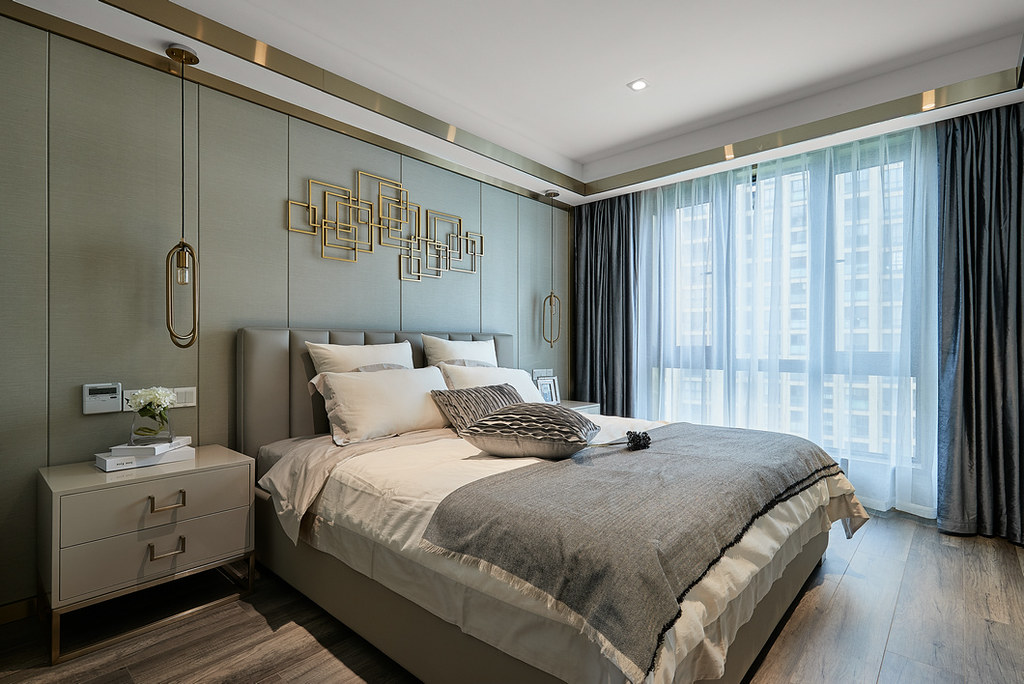
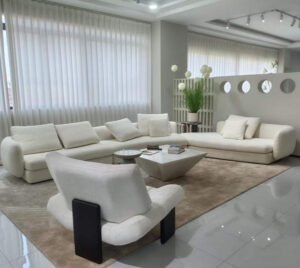
The show-wood frame on a piece like this is visible evidence of construction intent — but the real quality story is inside the upholstery, in the suspension system and frame joinery.
Section 5: Craftsmanship Indicators — The Details That Reveal True Quality
Visible Craftsmanship Markers
Investment-grade craftsmanship is readable — if you know the vocabulary. The following markers are the ones your showroom team should be evaluating on every piece, and that your designers and distributors should be communicating to their clients as evidence of quality rather than as technical jargon.
Joinery Visibility and Execution
In solid wood case goods and tables, visible joinery — the points where separate components are connected — is a direct quality indicator. Precise, tight-fitting joints with no visible gaps, filler, or inconsistent spacing signal skilled hand-finishing and quality-controlled production. Joints with visible gaps, filling compound residue, or misaligned grain direction signal production shortcuts and inadequate quality control.
Symmetry and alignment across a piece — drawer fronts that align with consistent gaps between them, doors that hang at identical heights, frames whose angles are true — indicate both precision manufacturing and rigorous quality inspection. These details are invisible in press photography but immediately apparent in physical inspection. Train your showroom team to look specifically at drawer face alignment and gap consistency as a quick quality proxy test.
Examine underside and back construction — the surfaces your clients never see after installation. In premium furniture, the underside of a table is finished to the same standard as the top. The back panel of a cabinet is solid wood or quality plywood, not cardboard-thin hardboard. The interior of a drawer box uses smooth, splinter-free surfaces. Manufacturers who finish hidden surfaces well are manufacturing for longevity, not for showroom photography.
Finishing Details That Separate Tiers
Edge treatment reveals manufacturing investment that’s invisible in flat photography. Softened, broken edges — where sharp 90-degree corners are eased to a consistent small radius — prevent chipping, protect against impact damage, and signal hand attention to the piece’s completion. Sharp, unfinished edges that cut the hand on examination are a clear quality deficiency.
Pattern matching in upholstery is a labor-intensive quality indicator: fabric patterns (stripes, weaves, geometric designs) should align consistently across seams, across cushions, and from front to back of cushion panels. Misaligned patterns signal cutting and assembly shortcuts that indicate compromised quality control throughout.
Stitching tension and consistency in upholstered pieces — uniform stitch length, consistent tension that neither puckers nor gaps the seam, precise distance from edges — are readable craftsmanship markers. Pull gently at seam areas: quality upholstery maintains tension without distortion; poor seams gap or pucker under minimal pressure.
Customization and Artisan Capabilities
The ability of a manufacturer to accommodate genuine custom specifications — not just color selection from a predetermined palette, but dimension adjustments, alternative joinery specifications, non-standard finishes, COM (Customer’s Own Material — upholstery fabric supplied by the specifier rather than the manufacturer) — is a reliable quality indicator for one simple reason: manufacturers who work at this level understand their construction well enough to modify it.
This is where relationships with manufacturing partners like Muebles Jade Ant create concrete business value for your clients. A manufacturer who can take a designer’s specification — specific walnut tone, modified cabinet depth, pull hardware from a client’s existing collection — and execute it with the same construction quality as their standard range is a manufacturer with genuine craftsman capability, not assembly-line production.
Lead times are also quality indicators: a legitimate custom piece requires 8–16 weeks for quality production. A “custom” offer with a two-week turnaround is not genuinely custom — it’s a standard piece with a different label applied.
Section 6: Longevity Assessment — Predicting Real-World Performance
Warranty and Durability Standards
A warranty is a legal document, not a marketing statement. Most furniture buyers — including many professional buyers — read warranty terms at a level of detail inversely proportional to the money being spent. This is a mistake your clients cannot afford.
What Warranties Actually Guarantee (and Don’t)
The standard structure of a furniture warranty includes structural warranty (frame and joinery integrity, typically 5–25 years in genuine luxury pieces), cushion and upholstery warranty (foam density retention, fabric integrity, typically 1–5 years), hardware warranty (mechanical component function, typically 2–5 years), and finish warranty (surface protection integrity, typically 1–3 years).
Read the exclusions. Common limitations that significantly narrow warranty protection include: “normal wear and tear” exclusions (which manufacturers interpret very broadly), exclusions for commercial use of residentially-specified pieces (a significant issue for designers using residential-grade furniture in hospitality projects), exclusions for damage resulting from “improper maintenance” (which can be defined very broadly), and exclusions for “natural characteristics of wood” (which can be applied to defects that are actually manufacturing failures).
For hospitality specifications especially: verify explicitly that a piece’s warranty covers commercial-use environments. Many residential furniture warranties are void the moment a piece is installed in a hotel room. This is not a hypothetical risk — it is a documented source of denied warranty claims.
Durability Predictions Based on Construction
| Construction Element | Premium Quality | Esperanza de vida | Budget Quality | Esperanza de vida |
|---|---|---|---|---|
| Solid hardwood frame, mortise-and-tenon | ✓ | 30–50+ years | Particle board, stapled | 3–7 years |
| Eight-way hand-tied suspension | ✓ | 25–40 years | Sinuous wire, light gauge | 7–12 years |
| HR foam, 2.0+ lb/ft³ density | ✓ | 10-15 años | Standard foam, 1.2 lb/ft³ | 3–5 years |
| Commercial hardware (Blum/Hettich) | ✓ | 20–30 years (100K cycles) | Basic slides | 3–5 years |
| Full-grain or quality top-grain leather | ✓ | 20–30 years | Bonded leather | 2–4 years |
| 100,000+ Martindale fabric | ✓ | 15+ years commercial | Under 30,000 Martindale | 2–4 years |
| Oil or catalyzed lacquer finish | ✓ | 10–20 years (refinishable) | Cheap UV lacquer spray | 3–7 years |
These are real-world use estimates, not theoretical maximums. Maintenance practices affect actual outcomes significantly.
Maintenance Requirements and Total Cost of Ownership
Build maintenance expectations into every specification conversation — not as a caveat, but as a service differentiator. A client who knows that their solid walnut table requires annual oiling (a 20-minute process) and should be protected from extended water contact will not call you in year three with a “defective finish” complaint. A client who received no maintenance guidance will.
The structured maintenance conversation positions you as a trusted advisor and creates an ongoing relationship: clients who learn from you about how to care for pieces come back to you when they have project needs. Clients who feel abandoned after the sale find a new advisor.
Section 7: Sustainability and Ethical Sourcing — The New Luxury Standard
What Premium Clients Now Demand
Sustainability is no longer a differentiator in premium furniture markets — it is a baseline expectation. The eco-friendly furniture market was valued at $53.7 billion in 2025 and is projected to grow at 10.0% CAGR through 2033 (Grand View Research). For design professionals and hospitality operators with ESG (Environmental, Social, and Governance) commitments from their institutional clients or brand owners, sustainability documentation is a procurement requirement, not a preference.
Certificación FSC (Forest Stewardship Council Chain of Custody — a certification that tracks certified materials from forest through production to end product) is the recognized standard for wood sourcing verification. PEFC (Programme for the Endorsement of Forest Certification) is the alternative standard with equivalent credibility. Verify certificates directly at info.fsc.org rather than relying on manufacturer-provided documentation — certificate fraud is documented in the timber trade.
For manufactured components, OEKO-TEX Standard 100 certification confirms that textiles and materials have been tested to be free from harmful levels of over 100 substances. For hotel projects with children’s areas or allergen-sensitive environments, this certification transitions from optional to required.
Environmental Impact Assessment
Your premium clients increasingly need to report on the carbon footprint of specification decisions — particularly hotel operators and corporate office designers with sustainability commitments. The practical guidance for your team:
Solid wood from certified sustainable forests represents a carbon-storage asset, not a carbon liability — growing trees sequester carbon, and certified forests are managed to maintain this function. This is a genuine positive claim your clients can make, with documentation.
Transportation distance meaningfully affects the carbon footprint of imported furniture. Chinese-manufactured solid wood furniture transported by sea freight has a lower carbon footprint per piece than the same piece transported by air freight — but higher than equivalent pieces produced domestically or regionally. This calculation is worth making explicit for clients with carbon reporting obligations.
Durability is sustainability. A piece that lasts 20 years has one-quarter the lifetime carbon footprint of an equivalent piece replaced every 5 years. This reframes the investment-grade quality conversation as environmental responsibility — a framing that resonates strongly with your clients’ professional and institutional commitments.
Transparency and Documentation
Build a documentation standard for your supplier relationships that matches the standards your premium clients are beginning to require: FSC or PEFC certificate numbers (verifiable independently), OEKO-TEX certification numbers, fire safety test reports (with test house names and dates), foam density certificates, fabric Martindale test reports, and country-of-origin documentation.
Suppliers who cannot or will not provide this documentation are either unable or unwilling to verify their quality claims. Either condition is disqualifying for a premium supplier relationship.
Identifying greenwashing: Generic environmental claims without certification numbers, vague references to “sustainable materials” without specifying which certification, and marketing language about “eco-friendly production” without supporting documentation are the identifiers of greenwashing. These are not just ethical concerns — they expose your professional credibility when your clients’ ESG reporting requires documented evidence that you cannot provide.

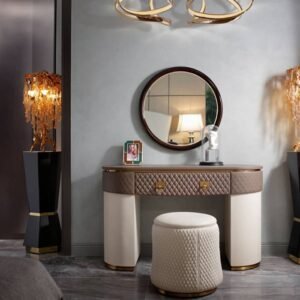
FSC certification, oil finish, solid wood construction — these details are visible in the specification, verifiable in documentation, and meaningful to the premium clients who ask for them.
Section 8: The Showroom Evaluation Protocol — A Practical Checklist for Your Team
Physical Inspection Techniques
The following 10-point protocol is designed for your showroom staff and field sales team. It provides a consistent, documented evaluation framework that can be applied to every piece entering your inventory or being evaluated for client recommendation.
The 10-Point Quality Assessment
1. Frame Inspection — Weight, Rigidity, and Joint Integrity Lift the piece. Investment-grade frames built from solid hardwood are substantially heavier than particle board or thin plywood alternatives. Rock the piece gently: no movement should be detectable at joints. Press downward on corners and arms: immediate joint flex indicates inadequate joinery. Apply lateral force to the frame: racking resistance separates quality from compromise.
2. Fabric/Leather Evaluation — Texture, Consistency, and Defect Identification Request the Martindale certificate. Examine fabric for consistent weave tension, absence of pilling, and pattern alignment across seams. For leather: check for consistent texture across the hide, appropriate surface depth, and absence of delamination at edges. Pull gently at seam joins — quality upholstery withstands gentle tension without distortion.
3. Hardware Testing — Smooth Operation, Secure Fastening, and Finish Quality Open and close every drawer, door, and mechanism on the piece five times. Quality hardware operates with consistent resistance throughout the travel and lands softly at both open and closed positions. Wobble drawer slides — no detectable lateral play indicates commercial-grade mechanisms. Check hardware finish for consistency and absence of corrosion, coating flaking, or visible plating failure.
4. Finish Inspection — Evenness, Clarity, and Protection Against Damage Examine the surface under raking light (angled light across the surface): quality finishes are even in sheen without orange-peel texture, drips, or inconsistent build-up at corners and edges. Run your hand across the surface: it should feel consistently smooth without rough patches, raised grain, or surface contamination trapped in the finish.
5. Seam and Stitch Quality — Consistency, Tension, and Durability Count stitches per inch across a seam: investment-grade upholstery maintains 7–9 stitches per inch consistently. Check stitch tension — neither pucker nor gap at seam joins. Examine corner construction: quality upholstery at corners shows tidy, consistent tuck work without bunching or stretched fabric.
6. Undercarriage Assessment — Construction Method and Material Quality Examine the underside of every case good and table. Investment-grade pieces finish back and underside surfaces consistently with visible faces. Check corner block presence and attachment method (glued and screwed vs. glued only). Examine center support construction on larger pieces. Dust covers in upholstered pieces should be present and securely attached.
7. Base and Leg Stability — Weight Distribution and Floor Protection Set the piece on a level surface and apply side pressure: no movement or rocking indicates properly constructed bases. Examine leg attachment method — legs bolted to a solid mounting block embedded in the frame are secure; legs screwed directly into particle board are a failure risk. Check foot pad material: quality felt or rubber pads protect floors and maintain grip.
8. Drawer and Door Operation — Smooth Glide, Proper Alignment, and Soft-Close Test every drawer at full extension: quality full-extension slides allow complete access to the interior. Drawers should close under their own momentum from the three-quarter point (indicating quality soft-close mechanisms) without requiring a push. Check door alignment: consistent margins between door edge and frame indicate both quality joinery and precision manufacturing.
9. Label and Documentation Verification — Authenticity and Warranty Information Request the product specification sheet, warranty document, and material certifications before finalizing any significant evaluation or recommendation. Cross-reference certificate numbers with issuing bodies. Verify that warranty coverage includes your intended use case (residential vs. commercial). Identify and clarify every warranty exclusion before client recommendation.
10. Comparison Testing — Side-by-Side Evaluation With Competing Pieces Never evaluate a piece in isolation when possible. The quality differential between an investment-grade piece and a compromised alternative becomes immediately apparent in direct comparison — in weight, joint rigidity, finish depth, hardware operation, and seam quality. Build a showroom culture where your team regularly compares pieces at different price points to calibrate their quality perception.
Red Flags That Should Eliminate Pieces From Your Inventory
These are not minor concerns to document and monitor. These are disqualifying defects:
- Particle board frames in seating or case goods — structural failure prediction within three to five years of normal use. No exceptions.
- Missing or vague material documentation — a manufacturer who cannot specify wood species, foam density, fabric Martindale rating, and hardware manufacturer is not operating at investment-grade standards.
- Inconsistent construction quality across similar pieces — if three samples of the same model show different joint quality, finish consistency, or hardware performance, production quality control is absent. Defects in shipments are inevitable.
- Weak or unstable joints under hand pressure — joints that flex, creak, or show movement under manual pressure in the showroom will fail under normal daily use within months.
- Poor fabric alignment or pattern mismatch — visible at purchase; deteriorates further with use. Indicates inadequate production standards across the entire piece.
- Plastic drawer slide mechanisms — not commercial-grade, not investment-grade. Replace the piece or the specification.
- Inadequate warranty coverage — warranties shorter than five years on structural components, or warranties with commercial-use exclusions on pieces being specified for commercial environments, indicate a manufacturer unwilling to stand behind their construction.
Documentation and Record-Keeping for Your Team
Build a standardized evaluation form based on the 10-point protocol above. Every piece entering your inventory or recommended to a client should have a completed evaluation form on file. This documentation serves three functions: it maintains consistent evaluation standards across your team, it provides evidence in warranty discussions with manufacturers, and it builds a quality performance database that informs future sourcing decisions.
Track warranty claims by piece, manufacturer, and claim type. A pattern of claims — two fabric failures on the same model, three drawer slide failures from the same manufacturer — is a sourcing signal that should prompt re-evaluation before further recommendations are made.
Section 9: Communicating Quality to Your End Clients — The Sales Advantage
Translating Technical Knowledge Into Client Confidence
Technical knowledge without communication skill is a private advantage. The goal is to translate what you know about construction quality into the client’s language — outcome language, not specification language.
The Value Conversation, Not the Price Conversation
When a client questions a $12,000 price point, the wrong response is to justify it with feature lists. The right response is to re-anchor the conversation around outcome: “Let’s look at what that actually costs over ten years compared to the alternative — and what the replacement looks like if the alternative fails on your timeline.”
Run the TCO calculation with them, not for them. When a client does the math themselves, they own the conclusion. A designer who calculates independently that the investment-grade piece costs less per year than the budget alternative becomes an advocate for that reasoning with their own clients — multiplying your value communication through their professional network.
For hospitality clients, the framing is operational risk: “The replacement cycle on a particle board frame sofa in a hotel lobby is three to five years. Your next renovation is planned for year eight. Which piece supports your capital expenditure planning better?” This is not a sales pitch — it is professional advice that happens to lead to a better product recommendation.
Building Trust Through Transparency
Share your supplier evaluation process with your premium clients. Tell them what you require before a manufacturer enters your recommended portfolio: the certifications you request, the factory visit protocols, the batch sampling procedures, the warranty terms you require. This transparency converts your curation from an invisible service into a visible value — clients understand that your recommendation carries the weight of a systematic evaluation, not just a sales relationship.
Jade Ant Furniture’s sourcing transparency — detailed material documentation, factory quality control records, and the sourcing frameworks available at jadeant.com — is the kind of supplier behavior that enables this transparency conversation with confidence. Working with manufacturers who operate at this documentation standard makes your advisory positioning credible rather than claimed.
Creating Competitive Advantage Through Expertise
Your mass-market competitors compete on price. You compete on knowledge — and the applications of that knowledge to specific client outcomes. An interior designer who brings your quality evaluation framework to their client meetings is bringing something their competitors cannot replicate without the same investment in sourcing knowledge. A showroom manager who can walk a hotel operator through the TCO calculation for every piece in a proposed specification is doing procurement work that saves the operator time, risk, and capital.
Position this expertise explicitly. “We evaluate every piece in our portfolio against a 10-point quality protocol before it enters our recommendation set” is a credentialing statement that mass-market competitors cannot match. Use it.
Section 10: Building Your Supplier Relationships — The Strategic Advantage
Sourcing Strategy for Distributors and Showroom Managers
Your supplier relationships are your competitive infrastructure. The manufacturers you work with determine the quality floor of your recommendations, the reliability of your lead times, the responsiveness of your warranty support, and the customization capabilities you can offer your premium clients.
Evaluating Manufacturers and Suppliers
Quality consistency across production batches is the most important and most overlooked evaluation criterion. A manufacturer who produces excellent quality in a first sample and inconsistent quality in production is a manufacturer whose client relationship will deteriorate after the first order. Request three samples from different production batches before establishing a primary supplier relationship. Evaluate them against your 10-point protocol independently.
Responsiveness to issues and warranty claims reflects manufacturing culture more than anything else. A manufacturer who responds to a defect claim within 48 hours, takes ownership of legitimate quality failures, and provides replacement or resolution without extensive negotiation is a manufacturer who takes quality accountability seriously. Test this before your first large order if possible — ask an existing client about their warranty claim experience.
Transparency about materials, production, and sourcing is the behavioral marker of investment-grade manufacturing partnerships. Manufacturers who proactively provide certificates, factory documentation, and supply chain information signal that they have nothing to hide — and that their claims are verifiable.
For Asian furniture manufacturing partnerships specifically, the Guía de abastecimiento de muebles de Jade Ant provides a practical framework for evaluating Chinese furniture manufacturers across quality, certification, customization capability, and communication standards. This evaluation framework can be adapted for manufacturers in any origin market.
Negotiating Quality Standards Into Contracts
Verbal quality commitments are not contracts. Every significant supplier relationship should include written specifications for:
- Material standards (minimum wood species, foam density, fabric Martindale rating)
- Joinery methods required (mortise-and-tenon where specified)
- Hardware standards (manufacturer names or equivalent specifications)
- Finish standards (finish type, application method, and acceptance criteria)
- Quality inspection protocols (sampling procedures and rejection criteria)
- Warranty terms (specific coverage periods, commercial-use coverage, exclusion list review)
- Remediation process for defects (timelines, replacement vs. repair policy, cost responsibility)
Manufacturers who resist contractual quality specifications are indicating that they are not confident in their ability to meet those specifications consistently. This is the clearest possible signal to source elsewhere.
Long-Term Partnership Development
The most commercially valuable manufacturer relationships in premium furniture distribution are not transactional — they are strategic. A manufacturer who knows your client base, understands your quality standards, and has built a production track record with your specific requirements is a competitive asset that your competitors cannot replicate quickly.
Invest in these relationships: visit factories when possible, attend trade events where your key manufacturers present, and provide detailed feedback on every order — both positive (which pieces performed best in client feedback) and constructive (where quality expectations weren’t fully met). This feedback investment builds the partnership that gives you access to new collections before public release, priority allocation during high-demand periods, and the manufacturing flexibility to say yes when a premium client has a specific custom requirement.
El High Point Market — the industry’s largest furniture trade event — and Salone del Mobile in Milan are the primary forums for developing and deepening these manufacturing relationships at scale. Annual attendance should be a budget commitment for any distribution operation with a premium positioning strategy.

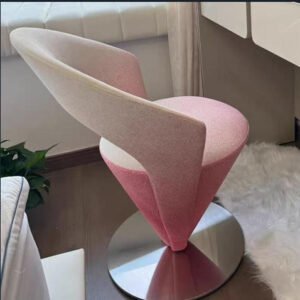
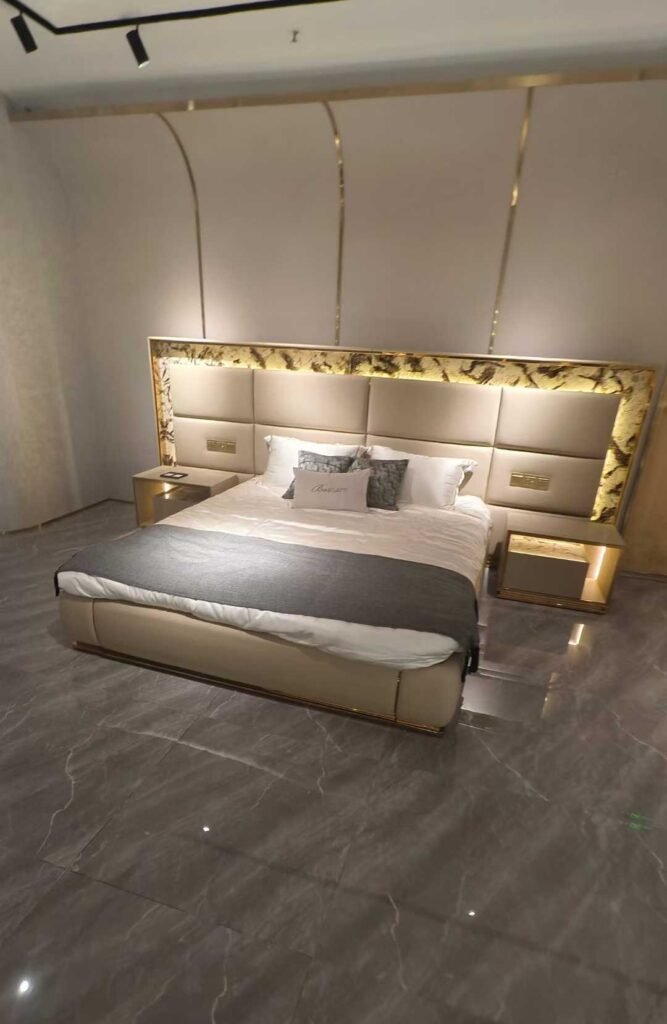
A piece like this isn’t manufactured — it’s built. The joint precision, finish depth, and material selection tell the quality story that your supplier documentation should verify.
A Reference Video: Understanding Furniture Construction Quality
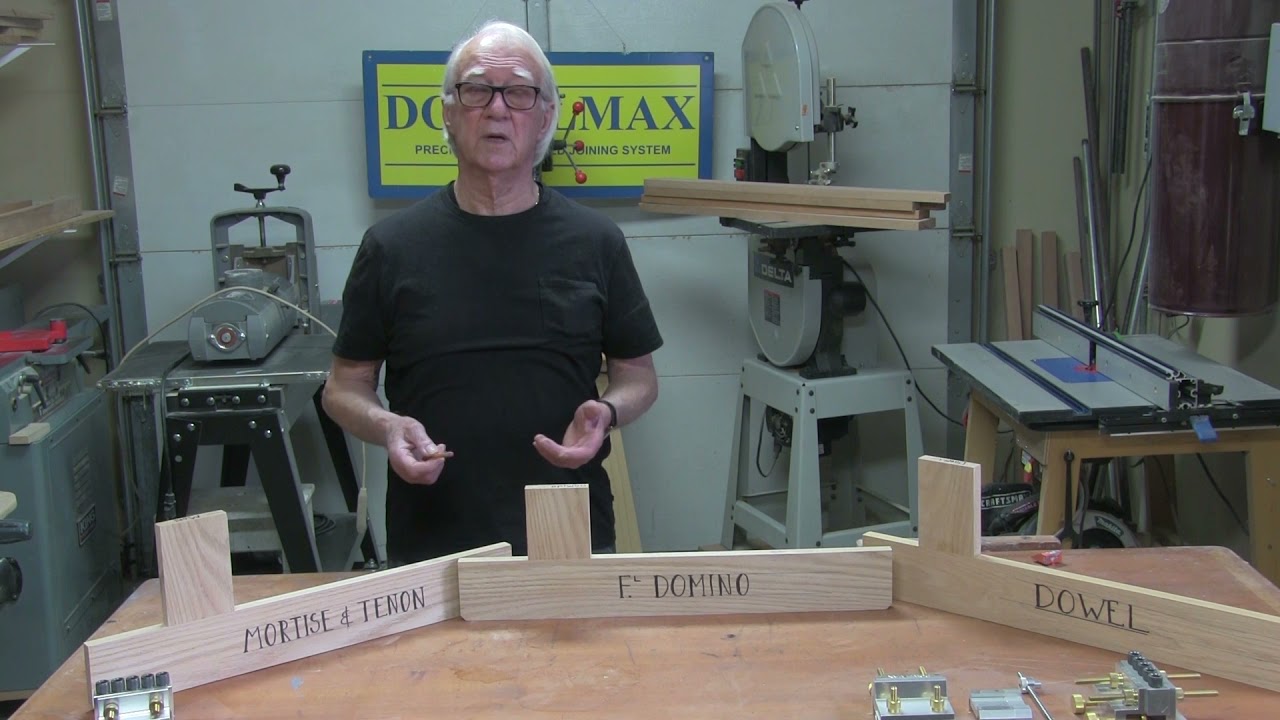
A practical demonstration comparing joinery systems and structural strength under real-load testing — useful reference content for showroom staff training and for explaining construction quality to clients who want to understand what differentiates premium from mediocre construction.
The Professional Advantage
Why This Knowledge Matters to Your Bottom Line
The furniture market doesn’t reward the most enthusiastic sellers. It rewards the most credible advisors. Your ability to evaluate a frame joint, read a Martindale certificate, interpret a warranty exclusion clause, and calculate a TCO comparison on the spot — these capabilities position you categorically differently from competitors who can only recite product descriptions.
Premium clients — the interior designers, hotel operators, and residential buyers who generate the most revenue per transaction and the most referrals over time — actively seek and reward this expertise. They are not buying furniture from you. They are hiring you to know what to buy, why to buy it, and how to justify that decision to their clients, their boards, and their own professional standards. The businesses that build this expertise systematically — training teams on the 10-point protocol, building supplier documentation standards, using TCO frameworks in every premium conversation — win the accounts that matter most in this market.
Continuous Learning and Market Evolution
Quality standards, materials, and manufacturing techniques evolve. The foam that was investment-grade three years ago has been superseded by higher-resilience formulations. New certified wood species are entering the market as FSC certification expands into previously uncovered regions. Hardware manufacturers continuously improve cycle ratings and mechanism precision.
Staying current requires active engagement: High Point Market twice annually, Salone del Mobile annually for international quality benchmarking, subscriptions to trade publications including Muebles hoy y Architectural Digest, and manufacturer-hosted technical training sessions. Professional associations including ASID (American Society of Interior Designers) and BIFMA (Business and Institutional Furniture Manufacturer’s Association) publish updated quality and sustainability standards that should inform your evaluation framework on an ongoing basis.
Next Steps: Implementing This Checklist Into Your Operations
- Train your team using the 10-point quality assessment — conduct quarterly evaluation sessions where team members assess the same pieces independently and compare findings
- Develop standardized evaluation forms based on the protocol above, ensuring consistent documentation across all new inventory additions
- Create client-facing materials that communicate your quality standards and evaluation process — converting invisible expertise into visible differentiation
- Build a supplier performance database tracking quality consistency, warranty claim rates, and client feedback by manufacturer
- Schedule annual sourcing reviews against updated quality benchmarks from trade events and industry publications
Download the Complete Luxury Furniture Quality Evaluation Toolkit
Access the professional-grade checklist, inspection forms, and supplier evaluation templates designed specifically for distributors, showroom managers, and design professionals. Elevate your team’s expertise and confidently recommend pieces that justify premium positioning.
Explore Jade Ant Furniture’s B2B Collection — a curated range of solid wood pieces with full material documentation, certification support, and customization capability for professional specifications.
Contact Our B2B Sourcing Team — discuss specific project requirements, customization options, and the documentation standards your clients require.
Read Our China Sourcing Guide — a region-by-region breakdown of Chinese furniture manufacturing capabilities, quality tiers, and evaluation criteria for sourcing partnerships.
Glossary of Key Terms
This reference section defines the technical terms used throughout this guide. Distribute to your showroom team as a training resource and share with clients who want to understand the quality framework behind your recommendations.
- FSC Certification: Forest Stewardship Council Chain-of-Custody certification. Verifies that wood products trace to responsibly managed forests. Verify at info.fsc.org.
- Martindale Abrasion Test (ISO 12947-2): Fabric durability test measuring cycles until surface degradation. 100,000+ cycles is the commercial hospitality standard.
- Mortise-and-Tenon Joinery: A structural wood joint where a tenon (projecting tongue) fits into a mortise (matching cavity), creating a high-strength mechanical connection.
- Eight-Way Hand-Tied Springs: Sofa suspension system where individual coil springs are tied to each other and the frame in eight directions. Longevity benchmark: 30–40 years.
- Janka Hardness: Measurement of wood hardness in pounds-force (lbf). Higher values indicate greater resistance to denting and wear.
- Full-Grain Leather: Leather retaining the complete outer hide surface. Develops patina with use; most durable leather type.
- TCO (Total Cost of Ownership): Purchase price + lifetime maintenance + replacement cost, divided by years of use. The correct framework for justifying investment-grade pricing.
- FF&E: Furniture, Fixtures, and Equipment. The collective term for all physical furnishing elements in a commercial or hospitality space.
- HR Foam (High-Resilience Foam): Seat cushion foam specified by density (lb/ft³) and ILD (firmness). Investment-grade: 2.0–2.5 lb/ft³ density minimum.
- CAL TB 117-2013: California’s smolder-resistance standard for upholstered furniture. Widely adopted as a US commercial specification baseline.
- COM (Customer’s Own Material): An arrangement where the specifier supplies upholstery fabric to the manufacturer for application to the specified piece.
- Veneer: A thin layer (typically 0.5–3mm) of real wood bonded to a substrate. Legitimate in quality panel applications; problematic over particle board.
Preguntas frecuentes
1. How do I verify that a supplier’s claims about materials are actually true?
Request material certifications with issuing body names and certificate numbers, then verify them independently. FSC and PEFC certificates can be validated at their respective public databases. For foam: request density test reports from named testing laboratories, not self-issued spec sheets. For fabric: request Martindale test reports from Contract Textiles or equivalent testing bodies. For orders above $50,000, budget for independent third-party quality inspection at the factory before shipment — this is standard practice in professional procurement and is typically priced at $300–$800 per inspection day. Manufacturers who resist independent inspection are telling you something important about their confidence in their own claims.
2. What’s the real difference between eight-way hand-tied springs and sinuous wire systems — does it actually matter?
Both can be well-constructed or poorly constructed — the quality tier within each system matters as much as the system type. That said, the performance ceiling differs meaningfully. Well-executed eight-way hand-tied systems can remain structurally sound for 30–40 years under normal residential use; premium sinuous wire systems realistically deliver 10–15 years. For hospitality applications with continuous daily use, the gap is more pronounced. The practical decision framework: for pieces positioned at the luxury apex of your range — statement sofas, flagship hotel lobby seating — eight-way hand-tied is the defensible specification. For mid-tier premium pieces where longevity expectations are 10–15 years, a quality sinuous wire system is legitimate. Never allow the specification to be determined by the manufacturer’s production convenience rather than your client’s performance requirements.
3. How can I explain the difference between full-grain and top-grain leather to clients without sounding like I’m making excuses for lower quality?
Frame it as performance matching rather than quality ranking. The accurate positioning is: “Full-grain leather ages into a piece — it develops patina, character, and a connection to use that makes it more beautiful over time. It’s the right choice for a statement sofa in a private study or a residential living room. Top-grain leather maintains a consistent appearance and resists staining more reliably — it’s the right specification for a hotel suite or a client-entertaining space where consistent appearance matters more than patina development.” Both are genuine premium leather. The professional value you add is matching the specification to the use case — not defaulting to a hierarchy that doesn’t reflect actual performance requirements.
4. What fabric weight should I recommend for high-traffic commercial applications?
For hotel lobbies, restaurant seating, and commercial lounge environments: minimum 100,000 Martindale cycles y 15+ oz/linear yard weight. In these environments, high-performance engineered synthetics — solution-dyed acrylic, Type 6,6 nylon, or engineered polyester blends — consistently outperform natural fibers on maintenance ease, stain resistance, and UV stability. For hospitality projects in regions with strict fire safety requirements, confirm CAL TB 117-2013 compliance (US) or BS 5852 compliance (UK/Europe) before specification. Natural fibers in commercial applications require significantly higher maintenance investment and shorter replacement cycles — factor this into your client’s operational cost projection before recommending them for high-traffic zones.
5. How do I know if a piece is truly bespoke or just mass-customization?
Ask the manufacturer three specific questions: (1) Can you modify the structural dimensions of this piece, and what does that require in terms of process and timeline? (2) Can you accommodate COM (customer’s own material) for the upholstery? (3) What is the minimum order quantity for a custom specification? True bespoke capability allows structural dimension modifications, COM, and single-unit production — though at appropriate pricing. Mass-customization offers finish or fabric selection within a fixed range and requires minimum quantities. The clearest indicator is lead time: genuine custom production takes 8–16 weeks minimum. A “custom” offer with a two-week delivery is not custom production — it is a standard piece with a relabeled spec sheet.
6. What should I look for in hardware to ensure it won’t fail prematurely?
Request manufacturer names for drawer slides and hinges — not generic descriptions. Quality hardware from Blum, Hettich, Grass, or Salice comes with documented cycle ratings (typically 80,000–100,000+ cycles) and verifiable warranties. Test every mechanism in the showroom: slides should extend fully and retract smoothly without lateral play; hinges should open and close with consistent resistance throughout their range; soft-close mechanisms should decelerate smoothly without bounce. Weight is an indicator: commercial-grade hardware is physically heavier than budget alternatives due to higher-density steel construction. Visible plastic components in slides or hinges on a premium piece are an immediate disqualification — not because plastic components always fail quickly, but because their presence signals a manufacturer who accepts quality shortcuts in areas they expect clients not to inspect.
7. How do I assess frame quality without being able to disassemble furniture?
The physical assessment protocol: lift the piece — solid hardwood frames are substantially heavier than particle board alternatives (a quality sofa should feel as though it could resist being kicked). Rock the piece gently from a corner — no joint movement or sound indicates sound joinery. Apply pressure to the seat rail junction with the arm — no flex indicates quality joint construction. Examine every visible joint for gaps, filler, and alignment. Check the undercarriage: visible corner blocks glued and screwed into position indicate quality frame construction. Knock on flat surfaces — solid wood produces a dense, low resonance; hollow or particle board construction produces a higher-pitched, less resonant sound. For case goods, examine interior construction: investment-grade pieces have the same construction quality in hidden areas as in visible ones.
8. What certifications should I require from suppliers for sustainability and ethical sourcing?
For wood materials: FSC or PEFC Chain-of-Custody — verify certificate numbers at info.fsc.org or the PEFC database. For textiles and upholstery: Norma OEKO-TEX 100 certifying freedom from harmful substances. For fire safety: CAL TB 117-2013 (US residential and commercial) and BS 5852 (UK/EU). For foam: request density and ILD certification from a named testing body. For exotic or tropical woods: verify CITES (Convention on International Trade in Endangered Species) compliance documentation. Certifications are necessary but not sufficient — additionally request supply chain documentation showing the chain from raw material to finished product. Manufacturers with genuine certification programs will provide this without friction.
9. How do I calculate total cost of ownership to justify premium pricing to price-sensitive clients?
Use the formula: Annual Cost = (Purchase Price + Lifetime Maintenance Costs) ÷ Expected Lifespan in Years. For a direct client comparison: Budget sofa at $2,200, 5-year lifespan, $100/year maintenance = $540/year. Investment sofa at $6,800, 18-year lifespan, $200/year maintenance = $578/year. Add: replacement disruption (for hotels, room downtime during furniture swap; for residential clients, the emotional and logistical cost of sourcing and specifying again), refinishing and repair options (available for investment-grade pieces, not for mass-produced alternatives), and resale value (high-quality solid wood furniture retains meaningful resale value; particle board furniture has none). The annual cost differential is typically marginal or favorable for investment pieces — but only when calculated honestly over the full lifespan. Run this calculation with specific numbers from your client’s actual project, not hypothetical averages.
10. What red flags in construction indicate a piece won’t hold up to professional use?
The failure predictors visible before purchase: particle board frames (identifiable by uniform density, visible surface flaking at cut edges, and atypical lightness relative to size), stapled fabric attachment to frames (visible at bottom edges of upholstered pieces — quality pieces use tacking strips or fully tacked attachment), thin plywood back panels that flex under hand pressure, plastic leg tips or inserts on high-load items, visible filler in wood joints, inconsistent stitch tension across seam lines, and foam that compresses immediately under seated body weight without the resistance of high-density material. Any single one of these is a yellow flag. Three or more in the same piece is a disqualification — the shortcuts are systematic, not incidental, and they predict an ownership experience that will reflect poorly on your recommendation.
11. How do I handle warranty claims and protect my reputation when furniture fails?
Prevention is the primary strategy: document delivery condition with photographs, provide written maintenance guidelines at handover, and establish clear contractual terms with your supplier about defect responsibility and remediation timelines before the first order. When failures occur despite prevention: communicate proactively with your client before they contact you, take ownership of the resolution process even when the fault is the manufacturer’s (your client’s relationship is with you, not the factory), and document everything — photos, dates, communication records — to support your claim against the manufacturer. The clients who become your most loyal references are often those who experienced a problem that you resolved quickly and professionally. The clients who become detractors are those who felt abandoned when something went wrong.
12. Should I stock inventory or order-to-client for luxury pieces?
The most effective model for premium furniture operations is a strategic hybrid: showroom floor samples of key investment-grade pieces (enabling clients to physically assess construction quality, feel materials, and experience hardware — the physical inspection that builds purchase confidence), combined with order-to-client production for custom specifications and high-value pieces (reducing inventory carrying risk for $8,000–$20,000+ pieces that represent significant capital). The floor sample inventory serves a different purpose than the deliverable inventory — it is a demonstration and trust-building tool. Clients who can sit on, open, and physically assess a piece before committing to a custom order develop a different level of purchase confidence than clients working from photography alone.
13. How do I differentiate my offering from online retailers selling “luxury” furniture at discount prices?
The differentiation lives in three categories that online retailers structurally cannot match: curation (you evaluate quality so clients don’t need to — your recommendation carries the weight of the 10-point protocol behind it), expertise (you can explain exactly why a $12,000 piece is worth more than a $4,000 piece with the same visual profile — and that explanation protects your client’s professional credibility when they justify the specification to their own clients), and accountability (when something goes wrong, you are there to resolve it — not a returns portal and an automated email response). The clients most worth winning are the ones who have been burned by online “luxury” purchases that arrived nothing like the photography. Your service model is the alternative they were looking for.
14. What’s the best way to train my team to evaluate and communicate quality?
Build a quarterly evaluation lab session: gather three to five pieces across quality tiers, have team members evaluate them independently using the 10-point protocol, then compare findings as a group. The discussion that follows — why did different team members reach different conclusions on the same piece? — is the most effective quality training available. Supplement with manufacturer training sessions (most premium manufacturers are willing to conduct technical briefings for distribution partners — request these as part of your supplier relationship), and invite team members to participate in factory visits when possible. Build a shared knowledge base of annotated quality photographs — showing specific examples of quality joints, substandard foam compression, excellent vs. poor seam execution — so that team members have visual references for the evaluation criteria. At BIFMA.org, published standards for commercial furniture performance provide a regulatory-grade benchmark against which your internal evaluation criteria can be calibrated.
15. How do I stay current with evolving quality standards and manufacturing innovations?
Establish an annual learning calendar: High Point Market (twice yearly, April and October) for North American market quality benchmarking and manufacturer relationships; Salone del Mobile (annually in April, Milan) for European and global design and quality standards; NeoCon (annually in June, Chicago) for commercial contract furniture innovations. Subscribe to industry publications including Muebles hoy, Interior Design, y Contrato. Maintain active membership in ASID (asid.org) and BIFMA (bifma.org) for access to updated quality and sustainability standards as they are published. Most importantly: visit manufacturing facilities annually with your primary suppliers. Seeing production processes, quality control procedures, and material sourcing directly — rather than through catalog descriptions and marketing materials — keeps your quality knowledge grounded in operational reality rather than theoretical standards