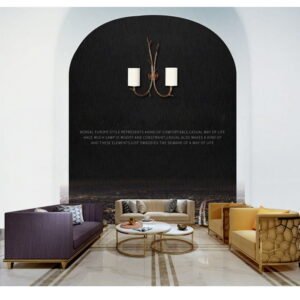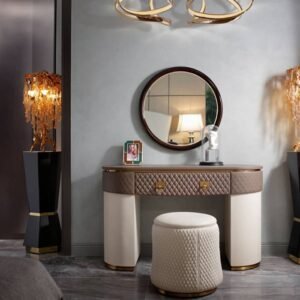

Nine out of ten B2B buyers who source furniture independently from China end up disappointed on at least one dimension — quality, timeline, specification accuracy, or logistics cost. Not because Chinese manufacturing is unreliable. Because sourcing without a systematic framework turns every decision into an improvisation, and improvisation in international manufacturing is expensive.
China’s furniture market reached USD $160.53 billion in 2025 and continues expanding. Furniture exports hit $5.93 billion in June 2025 alone — a 9% month-on-month increase. The manufacturing capability, the material diversity, and the cost economics are genuinely exceptional. The gap between buyers who consistently extract that value and those who consistently struggle with it is almost entirely process and knowledge.
This playbook closes that gap. It is organized in six parts, built for:
- Furniture distributors and wholesale agents managing import programmes
- Interior designers specifying for hospitality, commercial, and residential projects
- Hotel and resort procurement managers sourcing FF&E at volume
- Furniture showroom operators building curated luxury ranges
Every framework, checklist, and metric in this guide reflects operational reality — not theory.

The result of a well-executed sourcing programme: a fully specified luxury interior at margins that transform business profitability. This playbook is the framework that gets you there consistently.
📖 Core Terms — Quick Reference
- AQL (Nivel de calidad aceptable)
- The maximum defect rate considered tolerable in a production batch, per ISO 2859-1. For furniture exports: AQL 0% for critical defects, AQL 2.5% for major defects, AQL 4.0% for minor defects.
- FCL / LCL
- Full Container Load (FCL) — you rent an entire container. Less than Container Load (LCL) — your goods share space with other shippers. FCL is cost-effective above ~15 CBM; LCL suits smaller test orders.
- Incoterms (FOB / CIF / DDP)
- International trade terms defining risk transfer points. FOB: seller loads at origin port, buyer takes risk from there. CIF: seller covers freight and insurance to destination port. DDP: seller delivers duty-paid to your door.
- OEM / ODM
- OEM (Original Equipment Manufacturer): factory produces to your specifications under your brand. ODM (Original Design Manufacturer): factory’s own designs, which you can rebrand.
- Total Landed Cost (TLC)
- The complete cost of a product from factory to your warehouse, including FOB price, freight, insurance, duties, port handling, and inland transport.
- Value Engineering
- A structured process of analyzing a product’s function vs. cost to identify design modifications that reduce cost without reducing performance or perceived quality.
Understanding the Chinese Furniture Sourcing Landscape
Why China Remains the Global Furniture Manufacturing Hub
China’s furniture manufacturing dominance is not a historical legacy — it is an actively maintained competitive position. The country controls approximately 37% of global furniture exports, underpinned by an ecosystem of vertically integrated suppliers, specialized regional clusters, an unmatched domestic component supply chain, and a workforce with decades of accumulated manufacturing expertise concentrated in specific industrial zones.
Foshan’s Lecong and Longjiang districts alone host the world’s largest furniture wholesale market — a complex where B2B buyers can source upholstered, wooden, dining, bedroom, and hotel FF&E product from thousands of manufacturers within a 30-kilometer radius. Dongguan supplies high-specification wooden and executive furniture. Anji in Zhejiang is the global centre for bamboo and solid wood dining. Each cluster has a distinct specialty, quality tier, and logistics infrastructure that sophisticated B2B buyers can navigate strategically. This regional sourcing guide maps the key manufacturing hubs against product categories.
Key Advantages for B2B Sourcing Partners
The structural advantages of Chinese manufacturing for B2B furniture buyers operate at multiple levels simultaneously. Vertical integration eliminates 3–5 markup layers that exist in Western supply chains. Direct access to FSC-certified Southeast Asian timber, Italian-origin upholstery fabrics, and premium hardware from German suppliers like Hettich and Blum — all at volumes that command pricing unavailable to European manufacturers — creates a material quality ceiling that rivals any Western luxury proposition.
Customization capability is a frequently underestimated advantage. A mid-to-large Foshan manufacturer with an in-house design and engineering team can process CAD-based design modifications in 3–5 days, produce prototype samples in 10–18 days, and execute custom production runs from 20–30 units for fabric changes up to 50+ units for dimensional modifications. The same customization in an Italian atelier would cost 3–5× more and take twice as long.
Common Challenges and How to Overcome Them
The challenges of Chinese furniture sourcing are real, but they are overwhelmingly process failures rather than manufacturing failures. Communication specification gaps — where a buyer describes a design intent rather than providing precise technical drawings — produce the majority of the “wrong product” outcomes that create the industry’s negative reputation. Time zone and language friction, where important specification decisions get lost in translation or delayed across asynchronous communication cycles, generate the bulk of timeline overruns.
The solution framework is consistent across all of these challenges: precision documentation (technical drawings and written specifications, not verbal descriptions), structured communication protocols (defined contacts, response time expectations, email as the record system), and systematic quality verification (third-party inspections at key production milestones, not just at delivery).
Developing Your B2B Sourcing Strategy
Defining Your Sourcing Objectives
Identifying your product categories and specifications
The most common strategic error in Chinese furniture sourcing is treating it as a single activity — “we source from China” — rather than managing it as a portfolio of distinct product category programmes, each with its own supplier, quality standards, and logistics configuration. A dining chair and an upholstered king bed have nothing in common from a manufacturing perspective — they require different factory specializations, different inspection checklists, and different packaging standards.
Map your product categories first, then identify the manufacturing hub and supplier type that best matches each category. That mapping exercise will immediately reveal that your sourcing programme requires 2–4 different factory relationships optimized for different product types, not a single all-in-one supplier.
Setting quality benchmarks and compliance requirements
Quality benchmarks need to be market-specific and documented before supplier engagement begins. A furniture showroom selling to residential clients has different quality requirements from a hotel procurement team sourcing 400-unit F&B seating for a resort. The residential buyer may prioritize aesthetic finish quality; the hospitality buyer prioritizes structural durability under commercial use conditions — measured by BIFMA and EN 16139 standards. Define your specific compliance requirements by target market: CE marking for Europe, CARB Phase 2 for North America, and FSC certification for clients with sustainability procurement policies.
Building Your Supplier Evaluation Framework
Creating a vendor scorecard system
A vendor scorecard converts the subjective experience of “how good is this supplier?” into a measurable, comparable data set. Score each evaluated supplier across six dimensions: quality system (certifications, documented QC procedures, AQL standards) — 25% weight; production capability (in-house vs. subcontracted, equipment quality, capacity) — 20% weight; communication and responsiveness — 15% weight; financial stability and business legitimacy — 15% weight; customization capability (design team, prototyping lead time) — 15% weight; and logistics and after-sales support — 10% weight. Any supplier scoring below 65% on this weighted system warrants further scrutiny before engagement.
Establishing long-term partnership criteria
Transactional Chinese sourcing — placing one-off orders with whoever quotes cheapest — is the model that produces the most disappointments. Long-term partnerships with 2–3 vetted suppliers per product category, built on volume commitment and clear performance accountability, consistently outperform transactional sourcing on every commercial metric: price (volume discounts compound), quality (supplier learns your standards), and reliability (your orders are prioritized). Establish partnership criteria that include minimum volume commitments, performance KPI targets, and annual review structures before formalizing any supplier relationship.
Budget Planning and Cost Optimization
Understanding Chinese pricing structures
Chinese furniture FOB pricing has a consistent internal logic: material cost (typically 35–45% of FOB), labor (20–28%), factory overhead (12–18%), logistics to port (4–6%), and manufacturer margin (8–15%). Understanding this structure enables intelligent negotiation. If a quote seems high, a material specification review may reveal premium materials where a grade-equivalent alternative exists at 20% lower cost. If a quote seems suspiciously low, ask for the material specification sheet — low-ball quotes almost always involve material substitution.
Negotiating volume discounts and payment terms
Volume-based pricing tiers are standard in Chinese manufacturing. A typical structure: base price at 20–50 units, 8–12% discount at 51–100 units, 15–22% discount at 101–200 units, negotiable rates above 200 units that can reach 28–35% below base. Payment term improvement follows a similar progression — new relationships start at 30/70 T/T (30% deposit, 70% before shipment); established buyers with 3+ order history typically achieve 30/40/30 milestone payment structures; high-volume long-term partners can negotiate 60-day payment from bill of lading date.
Conducting Comprehensive Supplier Due Diligence

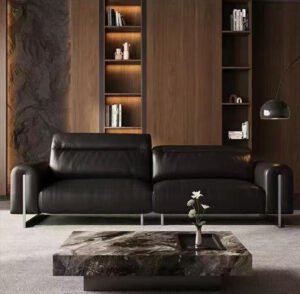
This caliber of executive lounge furniture — premium leather, precision hardware, custom millwork — is reliably produced by Foshan’s top-tier manufacturers. The due diligence process that gets you there is what this section covers.
Pre-Qualification Screening Process
Verifying business licenses and certifications
Business registration verification is non-negotiable. Every legitimate Chinese manufacturer has a Unified Social Credit Code (USCC) — an 18-digit identifier present on all official business registrations — that can be verified through China’s National Enterprise Credit Information Publicity System at gsxt.gov.cn. This lookup reveals registration date, registered capital, operational status, legal representative name, and any administrative penalties. A supplier who cannot or will not provide their USCC has no verifiable legal identity in China.
Certification verification requires going beyond certificate scans. ISO certificates must be verified through the named issuing body’s database. FSC Chain of Custody certificates are searchable at info.fsc.org by certificate code. BIFMA certification status is searchable at bifma.org. Any certificate lacking a searchable certificate number from a recognized issuing body should be treated as unverified.
Assessing manufacturing capabilities and capacity
The three questions that most efficiently filter production capability: What percentage of your production process is executed in-house vs. subcontracted? What is your current monthly production capacity in units for this product category? Can you provide the production milestone schedule and capacity commitment in writing? A manufacturer with genuine capability answers all three specifically. A trading company or capacity-limited factory will be vague on all three — especially the subcontracting question, since subcontracting is the primary mechanism by which quality control breaks down in Chinese furniture manufacturing.
Factory Audits and Site Visits
What to evaluate during on-site inspections
Factory audits — whether in-person or virtual via structured video tour — should systematically evaluate six areas: facility condition (equipment age and maintenance, organization, cleanliness of production floor and material storage), workforce structure (permanent vs. seasonal workers, evidence of specialized training), material storage and traceability (labeled materials with specification documentation, FIFO system for inventory), QC infrastructure (in-process inspection stations, measurement tools, defect documentation), export compliance (customs registration, freight documentation capability), and management infrastructure (dedicated export team, bilingual capability for specification communication).
Third-party factory audits from firms like SGS, Bureau Veritas, or Intertek cost $300–600 per audit day and produce documented reports against standardized criteria. For any order commitment above $20,000, the audit cost represents less than 3% of order value as insurance against structural manufacturing risk.
Quality Management System Assessment
ISO certifications and compliance standards
ISO 9001:2015 establishes that a manufacturer has documented, audited processes for quality management — not a guarantee of output quality, but verification that quality failures are traceable and systematically addressed. ISO 14001 covers environmental management systems. For buyers sourcing for European markets, EN 12520 (upholstered seating) and EN 16139 (commercial furniture durability) are the relevant performance standards. For North American commercial environments, BIFMA ANSI/BIFMA X5.1 and X5.4 govern seating and lounge furniture structural requirements. Request test reports showing compliance with the specific standards relevant to your market — not just certification claims.
Building Supplier Relationships That Deliver Results
Establishing Clear Communication Protocols
The most preventable problems in Chinese furniture sourcing are communication failures — not manufacturing failures. Establishing explicit communication protocols before production begins resolves the ambiguity that causes most specification deviations and timeline surprises.
Designate named contacts on both sides
Identify your primary contact at the factory (ideally a dedicated account manager or export coordinator with bilingual capability) and your primary contact at your company. Specify that all order-relevant communication goes through these channels — not through general inquiry emails or messaging apps that create documentation gaps.
Establish response time expectations in writing
Standard expectation: 24-hour response to all production-related queries during working days, 48-hour response to RFQs and specification questions. Slower response times in the pre-order phase predict slower response times when production issues need urgent resolution.
Use email as the official record system
WhatsApp and WeChat are useful for quick operational questions but dangerous as primary communication channels — messages are difficult to archive, translate inconsistently, and are not legally strong records. All specification confirmations, order changes, and quality claims should be documented in email, even if first discussed informally.
Schedule regular milestone update calls
For orders over $15,000, schedule bi-weekly 30-minute video update calls covering production status, any specification clarifications needed, and upcoming milestone dates. This rhythm surfaces problems before they compound into delivery failures.
Creating Supplier Contracts That Protect Your Business
Essential clauses for B2B furniture sourcing agreements
A robust B2B furniture supply contract is the document that determines your recourse when things go wrong. Essential clauses: technical specifications with approval documentation referenced as binding annexures; quality acceptance criteria with AQL standards specified by defect category; inspection rights (your right to commission third-party inspections at any production stage at your cost); IP protection provisions specifying design ownership and confidentiality obligations; payment trigger conditions with documentary evidence required for each milestone payment; dispute resolution mechanism (international arbitration preferred over Chinese courts for non-Chinese buyers); and warranty terms with specific defect reporting timelines and resolution procedures.
Intellectual property protection and design confidentiality
For custom designs, use a China-specific NNN Agreement (Non-Disclosure, Non-Use, Non-Circumvention) drafted under Chinese law — not a standard Western NDA. NNN agreements are enforceable in Chinese courts; Western NDAs typically are not. Register proprietary designs as Chinese utility model or design patents through WIPO’s China IP registration pathway before sharing detailed technical drawings. This two-layer approach — contractual + registered IP — provides the strongest available protection for buyers working with proprietary designs in Chinese manufacturing.
Ongoing Supplier Performance Management
Implementing KPI tracking and scorecards
Track four core supplier KPIs quarterly: On-Time Delivery Rate (target 90%+), Order Specification Accuracy (target 95%+ of items requiring no post-production correction), Defect Rate per Shipment (target below AQL 2.5 for major defects), and Responsiveness Score (% of queries answered within agreed timeframe). These four metrics, tracked consistently over 4–6 order cycles, produce a clear performance trend that informs decisions about relationship depth, order volume, and whether a supplier is improving or deteriorating.
Managing Custom Furniture Design Projects
Translating Your Design Vision into Production Specifications
Creating detailed technical drawings and CAD files
The single most effective quality improvement action available to any B2B furniture buyer is to provide technical drawings rather than reference images. A reference image communicates aesthetic intent — it says nothing about the 47 measurable parameters that determine whether the production piece matches your expectation: overall dimensions, internal frame dimensions, foam density and ILD rating, fabric yardage per component, stitching pattern specification, leg angle and finish code, hardware specification codes, and packaging requirement per unit.
A technical drawing communicates all 47. For buyers without in-house design capability, a furniture CAD drafter can produce a production-ready technical drawing set from a reference image and verbal description for $150–400 per piece — an investment that eliminates the vast majority of specification disputes before they occur.
Specifying materials, finishes, and hardware components
Material specifications must be measurable, not descriptive. “High-quality leather” is not a specification. “Full-grain bovine leather, minimum 1.0–1.2mm thickness, 25,000 Martindale abrasion cycles, grain pattern reference: [sample swatch]” is a specification. “Natural wood finish” is not a specification. “European oak veneer, 0.6mm thickness, UV-cured lacquer coat, Munsell value N7 (light natural), sheen level 20 GU (matte)” is a specification. Hardware should reference manufacturer codes where possible: “Grass 01182 soft-close hinge” is unambiguous; “soft-close hinge” is an invitation for substitution.
Customization Options and Manufacturing Capabilities
Understanding Chinese manufacturers’ specialty services
Leading Chinese furniture manufacturers offer a customization range that most B2B buyers significantly underestimate. Upholstery customization at premium factories includes: choice of fabric from 500+ in-stock options plus custom material procurement (minimum quantities typically 50m–100m), channel-back, tufted, and flat-panel configuration options, contrast piping and multi-fabric combination designs, and feather-down, memory foam, or hybrid cushion specifications. Frame customization includes dimensional modifications (width, depth, height) at minimal cost on existing profiles, and new frame tooling for proprietary designs from $800–3,500 depending on complexity.
Evaluating upholstery, veneer, and finishing options
For upholstered furniture, the highest-impact quality variables (in order of specification importance) are: spring system (8-way hand-tied > sinuous spring > webbing), foam specification (density in kg/m³ and ILD hardness rating), fabric grade (Martindale abrasion cycles and composition), and stitching pattern specification. For wooden case furniture, veneer species and grade, core material specification (solid wood, furniture-grade MDF, or hardwood plywood with minimum ply count), and finish coat type (catalyzed lacquer, UV-cured, or water-based) are the key specification variables.
Prototype Development and Approval Process
Requesting and evaluating sample furniture pieces
Request production samples — pieces manufactured using your actual specified materials on your intended production line — not showroom samples, which are often produced under different conditions. Sample costs (typically $200–800 per piece depending on complexity) are standard industry practice and are usually credited against the first production order. Evaluate samples against a written checklist covering dimensional accuracy (measure everything against the drawing, not the eye), material specification compliance (request the supplier’s material specification sheet and verify against the approved spec), finish quality (examine under multiple light conditions including directional side-light which reveals surface defects), and structural integrity (apply reasonable user stress loads to joints and frames).
Navigating Material Selection and Sourcing

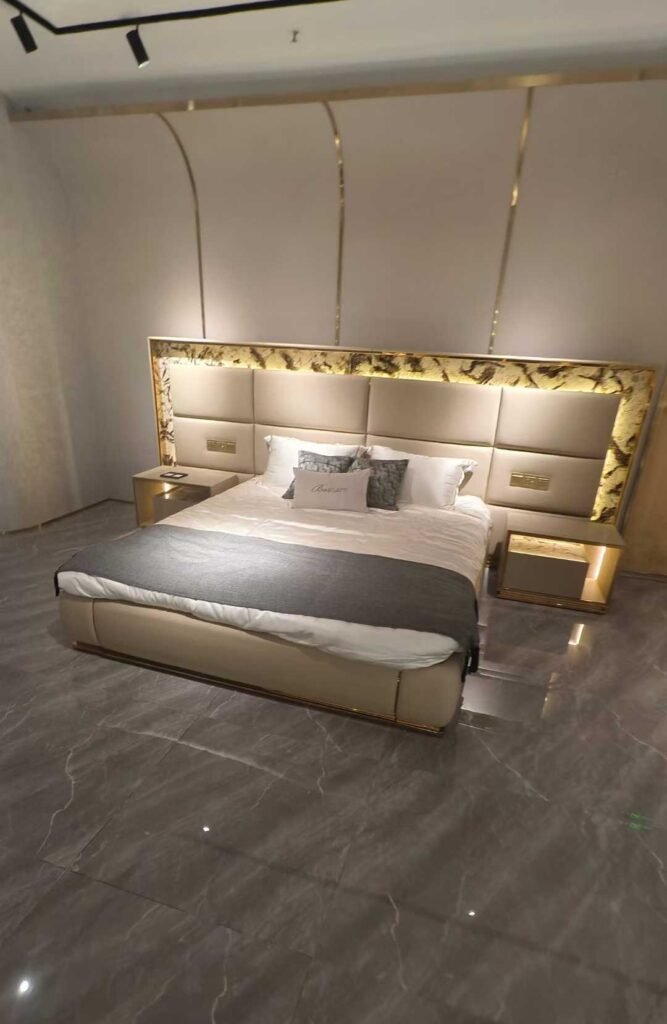
Hotel-suite quality bedroom furniture — custom upholstered headboard, matched timber nightstands, precision ambient lighting — represents the FF&E specification standard that premium Chinese manufacturing can consistently deliver. See Jade Ant’s hospitality bedroom range.
Understanding Furniture Material Quality Tiers
Wood types, plywood grades, and engineered alternatives
Wood material specification is the area where the most significant quality variation occurs in Chinese furniture manufacturing — and where specification precision has the most direct impact on product durability. Solid hardwood (oak, walnut, ash) represents the premium structural tier for visible components. Furniture-grade hardwood plywood (minimum 18-ply for panels above 600mm, E1 formaldehyde emission class) provides structural stability for carcass construction. Furniture-grade MDF (minimum density 720 kg/m³, E1 class) is appropriate for painted components. Particleboard is appropriate for concealed, non-structural elements only — specifying it for structural applications is the most common material downgrade in cost-cutting substitutions.
Upholstery fabrics, leather, and eco-friendly materials
The leather and fabric supply chain accessible to Chinese manufacturers includes direct access to the same Italian mills and Turkish tanneries that supply European luxury brands — at volumes that command lower pricing than European manufacturers receive from the same suppliers. Full-grain bovine leather from certified European tanneries, Rubelli and Dedar jacquards from Italian mills, and certified performance fabrics (Crypton, Ultrafabrics) for commercial applications are all routinely specified and sourced by premium Foshan factories for international B2B orders.
Sustainability and Compliance Considerations
VOC emissions and formaldehyde testing requirements
Formaldehyde emission standards are legally mandatory in most major furniture import markets. CARB Phase 2 (California Air Resources Board) limits formaldehyde emissions from composite wood products and is mandatory for all furniture sold in the US containing engineered wood. The EU’s E1 standard sets equivalent limits for European markets. Specify E1/CARB P2 compliance for all engineered wood components in your purchase order and request test reports from accredited Chinese testing laboratories (SGS, Intertek, or Bureau Veritas) — not just factory self-declarations.
FSC certification and responsible sourcing practices
FSC Chain of Custody certification has moved from a niche requirement to a mainstream procurement standard. FSC’s furniture supply chain certification requires each entity in the chain — from the forest to the factory to you — to hold FSC Chain of Custody certification to pass along an FSC claim. Verify your supplier’s FSC certificate at info.fsc.org before specifying FSC materials on your client-facing product documentation. As of 2025, approximately 58% of luxury hotels now mandate FSC-certified wood in their FF&E procurement policies — making this certification commercially essential for hospitality-focused buyers.
Implementing a Robust Quality Control Framework
📊 Cost of Defect Detection by Stage — Why Early QC Pays
(Relative cost to resolve defects detected at each stage, indexed to in-process detection = 1×)
Source: Industry cost modeling based on quality management research. The earlier a defect is identified, the cheaper it is to resolve — by orders of magnitude.
Pre-Production Quality Planning
Establishing AQL (Acceptable Quality Levels) standards
AQL (Acceptable Quality Level) is a statistical sampling method defined in ISO 2859-1 that determines how many units from a production batch to inspect and how many defects are acceptable before rejecting the batch. The standard B2B furniture export configuration is: 0% AQL for critical defects (structural failures, safety hazards, health-affecting chemical non-compliance), AQL 2.5 for major defects (dimensional inaccuracy, incorrect material, functional hardware failures, visible finish defects), and AQL 4.0 for minor defects (minor surface marks, slight color variation within tolerance). Specify your AQL standard in the purchase order — it becomes the acceptance criterion for the pre-shipment inspection.
Creating detailed inspection checklists for your product lines
A product-specific inspection checklist converts your AQL standard into actionable inspection criteria. For an upholstered sofa, a comprehensive checklist covers: overall dimensions (measured against drawing ±5mm tolerance), frame stability (no movement at joints under user-weight load test), foam density verification (probe weight test against specified density), fabric alignment and pattern match, stitching consistency (stitch density and thread tension), cushion fill specification, leg finish and hardware specification, and packaging integrity. Build this checklist once per product type — it becomes the permanent inspection standard for all future orders of that product.
In-Process Quality Monitoring
Scheduling factory inspections during production runs
For orders above $25,000, schedule at least one in-process inspection at the frame assembly stage — before upholstery is applied and before finish is completed. This timing is critical because upholstery covers structural frame defects that are expensive to remedy after completion, and finish coats cover surface preparation defects that affect durability. A single in-process inspection at this stage costs $300–500 and prevents the scenario where a completed batch fails final inspection and requires full rework — a scenario that adds 3–6 weeks to the delivery timeline and creates significant cost pressure on the supplier relationship.
Final Inspection Protocols
Comprehensive furniture inspection procedures
Pre-shipment inspection is the last quality gate before your goods are loaded. Commission this inspection from an independent third party (not the factory’s own QC team) when 80–100% of production is complete but before loading. The inspector should apply your AQL standard, photograph all defects, measure a statistically valid sample against your approved drawings, and issue a written inspection report with a pass/fail conclusion. Release the remaining balance payment only after reviewing and approving this report — this payment structure alignment ensures the pre-shipment inspection is genuinely consequential to both parties.
Third-Party Inspection and Testing Services
When and Why to Use Professional Inspectors
Selecting reputable inspection companies in China
The established international inspection providers operating in China’s furniture manufacturing regions include SGS, Bureau Veritas, Intertek, and TÜV Rheinland — all with offices in Guangzhou and Foshan specifically. For buyers seeking more specialized furniture inspection expertise or lower price points, QIMA (formerly AsiaInspection) and V-Trust offer furniture-specific inspection services at $200–350 per inspection day. Whichever provider you use, ensure they have experience with furniture-specific inspection criteria — a general product inspector unfamiliar with furniture construction will miss frame defects that a furniture specialist catches immediately.
Cost-benefit analysis of third-party quality assurance
A pre-shipment inspection costing $350 on a $12,000 furniture order represents 2.9% of order value. A failed shipment requiring full rework, reshipment, and client timeline management costs a minimum of $4,000–8,000 in direct costs plus the unmeasurable cost of client relationship damage. The math is not close. The question is not whether third-party inspection is cost-effective — it demonstrably is for any order above approximately $5,000. The question is which inspection type (pre-production, in-process, or pre-shipment) provides the highest value at each order scale and complexity level.
🥧 Where B2B Furniture Quality Failures Originate
(Root cause analysis of post-delivery quality claims)
- Specification ambiguity / miscommunication — 38%
- Material substitution after sample — 27%
- In-process QC failure — 18%
- Subcontracted production not disclosed — 11%
- Transit packaging failure — 6%
Source: Aggregate B2B furniture import quality claim analysis. Illustrative based on industry data (Sofeast, QIMA, industry reporting). Note that 65% of failures originate before production begins — in specification and supplier selection.
Handling Quality Issues and Disputes
Communicating concerns effectively with suppliers
When quality issues arise, the communication approach determines whether the outcome is collaborative resolution or adversarial dispute. Lead with evidence, not accusation: “The attached inspection report and photographs document 47 units (of 200 inspected) with [specific defect], which falls outside the AQL 2.5 standard specified in our purchase order clause 8.2.” This framing references the objective standard, provides documented evidence, and gives the supplier a clear understanding of the claim — without language that triggers defensive responses.
Establishing clear resolution procedures in contracts
Pre-establish resolution timeframes in your supply contract: defect reporting within 7 days of receipt, supplier acknowledgment within 3 business days, resolution proposal within 7 business days, resolution execution within 30 days. These timelines are the structure that converts a quality dispute from an open-ended friction point into a managed, time-bound process. Without pre-established timelines, disputes drift — and drifting disputes damage relationships faster than the original defect.
Mastering Furniture Shipping Logistics

A fully specified luxury dining room — marble table, upholstered dining chairs, statement chandelier — needs packaging and logistics infrastructure commensurate with the product value. Getting the container strategy right is as important as getting the factory right. Explore Jade Ant’s dining room collection.
Selecting the Right Shipping Method
FCL vs. LCL analysis — which is right for your shipment
The FCL vs. LCL decision has a clear economic break-even point, but its implications for luxury furniture extend beyond cost: FCL is also the superior choice for damage risk management, customs efficiency, and timeline reliability.
| Factor | FCL (Full Container Load) | LCL (Less than Container Load) |
|---|---|---|
| Volume sweet spot | 13 CBM+ (20ft container) | 1–12 CBM |
| Typical cost (China → N. America) | $2,800–4,500 / 20ft container | $75–120 / CBM |
| Transit time | Faster — direct routing available | Slower — consolidation warehouse adds 3–7 days |
| Damage risk (luxury furniture) | Lower — single handler, controlled loading | Higher — multiple handling events at consolidation |
| Customs clearance | Single bill of lading, simpler documentation | More complex — goods arrive with other shippers’ cargo |
| Best for | Production orders, hotel FF&E, full showroom ranges | Sample orders, trial shipments, small restocks |
Packaging and preparation standards for furniture
Luxury furniture packaging requires multiple protection layers. The standard for export-grade furniture packaging: inner layer — 2–3mm bubble film wrapped around all surfaces; intermediate layer — high-density foam corner and edge protection; outer layer — export-grade carton or custom wooden crating for structural pieces. Upholstered pieces require moisture barrier film as the innermost layer in humid shipping environments. Specify packaging standard in your purchase order and request photographs of packed goods before container loading is confirmed — this is one of the most reliable indicators of a manufacturer’s professionalism and of the condition in which your goods will arrive.
Freight Forwarding and Customs Documentation
Selecting reliable freight forwarders in China
Your freight forwarder is the logistics execution partner who bridges factory and destination port. Criteria for selection: FIATA membership or NVOCC license (verifiable and required for legal freight operations in China), demonstrated furniture shipping experience in your target trade lane (China to your destination country), English and Mandarin capability for factory coordination, and a track record of accurate documentation — customs documentation errors cause delays and penalties that are entirely avoidable with a competent forwarder.
Preparing export documentation and HS codes
Furniture falls under two primary HS code categories: HS 9401 (seats and chairs, including sofas and upholstered seating) and HS 9403 (other furniture — tables, cabinets, shelving, case goods). The specific sub-heading within these categories determines your import duty rate. Verify HS code classification for each product type with your customs broker before your first shipment — misclassification can result in duty underpayment penalties or delays. The US International Trade Commission’s Harmonized Tariff Schedule is the authoritative reference for US import classification.
Managing Customs, Compliance, and Landed Costs
The Total Landed Cost Formula — Used Correctly
Most B2B buyers underestimate landed cost by 15–25%. Here is the complete formula and a worked example:
+ $3,200 ocean freight (20ft FCL) + $45 insurance (0.45% of $10,000) + $1,050 import duty (~10.5% on HS 9401) + $350 customs brokerage + $420 port handling + exam fees + $280 inland drayage + $450 pre-shipment inspection = $15,795 Total Landed Cost (~58% above FOB)
This example illustrates why calculating margin against FOB price produces dangerously optimistic profitability projections. Calculate all unit economics against TLC — and build a 10% contingency into the TLC for first-time routes.
Understanding Tariffs and Import Duties
As of 2025, US furniture tariffs on Chinese-manufactured goods operate under a revised framework following the May 2025 tariff adjustments. Section 301 tariffs remain in effect at reduced levels for many furniture categories. The applicable rate for a specific HS code should be verified through the USITC HTS database or with a licensed US customs broker before each sourcing decision — tariff rates change with trade policy and can materially affect landed cost calculations. For European imports, standard MFN (Most Favored Nation) duties typically apply, with category-specific rates ranging from 0% to 5.6% depending on product type.
Supply Chain Visibility and Risk Management
Building resilient supply chains
Supply chain resilience for B2B furniture buyers requires two structural decisions: supplier diversification and inventory buffering. Supplier diversification means maintaining active relationships with 2–3 vetted manufacturers per product category — not using them all simultaneously, but maintaining the relationship so you can activate a backup within 30 days if your primary supplier experiences a production disruption. Inventory buffering means holding 45–60 days of safety stock for your highest-velocity SKUs — expensive in working capital, but less expensive than an 8-week supply gap during a production disruption.
Marine insurance and liability protection
Marine cargo insurance is not optional for B2B furniture shipments — it is the financial protection layer for a risk exposure that is certain to materialize at some point over a multi-year sourcing programme. All-risk marine cargo insurance covers physical damage and loss from virtually all causes during transit. Standard valuation is CIF value + 10% (covering cost, insurance, freight plus a 10% margin for profit and selling costs). Purchase through your freight forwarder or an independent marine insurer such as Travelers or through Lloyd’s of London underwriters for specialized coverage. Ensure the policy explicitly covers furniture and includes loading/unloading coverage, as some policies exclude damage during port handling operations.
📹 Real-World Furniture Sourcing from China — What Buyers Get Wrong
This video from an experienced furniture importer covers the practical realities of sourcing furniture from China — including the hidden costs, quality pitfalls, and logistics considerations that most buyers discover too late:
Scaling Your Sourcing Operations Efficiently
Systematizing Your Sourcing Processes
The transition from ad-hoc sourcing to a systematic sourcing operation is what separates B2B furniture businesses that scale profitably from those that grow their revenue and their problems at the same rate. Systematization means converting each critical process into a documented SOP (Standard Operating Procedure) that can be executed consistently by any team member — not just the person who created the relationship.
📄 Supplier Onboarding SOP
Document the exact sequence and timeline for verifying, auditing, sampling, and contracting a new Chinese furniture supplier — from initial inquiry to first production order confirmation.
🔍 Order Management SOP
Define the workflow from purchase order creation through production monitoring, pre-shipment inspection, shipping documentation approval, and receipt inspection — with responsible parties and timeline benchmarks at each step.
⚠️ Quality Dispute SOP
Establish the exact procedure for documenting, communicating, and resolving quality claims — including photographic evidence requirements, communication templates, escalation triggers, and resolution timeline expectations.
📦 Logistics SOP
Map the end-to-end logistics workflow: freight forwarder booking, documentation review, customs filing, port pickup, and final-mile coordination — with decision trees for FCL vs. LCL and contingency steps for delays.
Leveraging Technology and Tools
Sourcing management platforms and supplier databases
The sourcing technology landscape for B2B furniture buyers has matured significantly. Supplier database platforms like Alibaba International (for discovery), Made-in-China.com (for verified manufacturers), and platform comparison guides help buyers understand where to source by product type and quality tier. Project management tools — Asana, Monday.com, or a customized Notion workspace — enable shared visibility into order status, production milestones, and documentation status across team members and time zones. Sourcing management platforms like GEP SMART or SAP Ariba are appropriate for larger organizations managing multiple supplier relationships across product categories.
Optimizing Costs Without Sacrificing Quality
Strategic Negotiation and Pricing Strategies
Volume-based pricing and long-term contracts
The most reliable mechanism for achieving long-term pricing improvement with Chinese furniture manufacturers is the annual volume commitment. A buyer committing to purchase 300 units of a specific product line over 12 months — even in quarterly batches — enables the manufacturer to plan material procurement, production scheduling, and capacity allocation with certainty. That certainty has real economic value to the factory, and the best manufacturers price it explicitly: a typical volume commitment earns 12–18% pricing improvement over spot order pricing for the same product.
Value engineering and design optimization opportunities
Value engineering is the systematic analysis of a product’s function versus its cost, to identify modifications that reduce cost without reducing the performance characteristics that matter to your end client. For furniture, productive value engineering reviews typically examine: frame material (can an identical structural performance be achieved with a lower-cost timber species?), foam specification (is the specified density above what durability testing requires?), fabric coverage (can panel dimensions be slightly modified to reduce per-unit fabric waste?), and hardware specification (are there equivalent-performing components at lower cost in the factory’s existing supplier network?).
A structured value engineering session with your factory’s engineering team — conducted annually or at major design refresh cycles — typically identifies 8–18% cost reduction opportunities on established product lines without visible quality impact.
Measuring ROI and Performance Metrics
Calculating total cost of ownership for sourced products
Total Cost of Ownership (TCO) extends beyond Total Landed Cost to include: post-delivery quality management costs (inspection, defect processing, client management time), warranty and replacement costs (annualized as a percentage of order value), and the opportunity cost of capital tied up in inventory and transit stock. A supplier with a 3% defect rate costs more in TCO than their unit price suggests — conversely, a supplier with a 0.5% defect rate and 2% higher unit pricing may deliver lower TCO. Calculate TCO across at least 4 order cycles before concluding that a lower-priced supplier is the economically superior choice.
📊 Margin Improvement Levers — Relative Impact for B2B Furniture Buyers
(Indexed contribution to gross margin improvement)
Source: Industry benchmarking. Margins are illustrative ranges based on aggregate B2B furniture sourcing data. Results vary by product category, volume, and supplier relationship maturity.
Master Sourcing Checklist

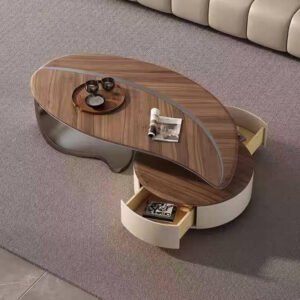
A curated luxury living room — modular bespoke sofa, handcrafted coffee table, designer accessories — reflects the full scope of what a well-executed Chinese sourcing programme can deliver for showrooms and interior designers. Browse Jade Ant’s living room collection for B2B sourcing options.
🔍 Pre-Engagement Supplier Verification Checklist
- Verify USCC (Unified Social Credit Code) on gsxt.gov.cn — confirm active registration status
- Independently verify all claimed certifications through issuing body databases
- Contact minimum 3 B2B references with specific operational questions
- Request and review written QC procedure documentation (IQC, IPQC, FQC) with AQL standards
- Clarify subcontracting arrangements — identify all off-site production processes
- Assess communication responsiveness: send detailed RFQ and evaluate response quality within 48 hours
- Commission third-party factory audit for any potential order above $20,000
- Confirm freight forwarder relationship and NVOCC/FIATA credentials
- Evaluate payment terms — reject any 100% upfront demand
- Request production samples (not showroom samples) before volume commitment
📋 Active Order Management Checklist
- Confirm all specifications in writing with technical drawings formally approved and signed
- Receive written production milestone schedule with committed dates
- Request in-process photos at frame assembly and pre-finishing stages
- Commission pre-shipment inspection from independent third party before balance payment
- Review complete documentation package: commercial invoice, packing list, bill of lading, CoO, all certificates
- Confirm container loading photos and verify packing standard against specification
- Verify cargo insurance coverage at CIF value + 10%
- Track shipment via provided B/L number through carrier portal
- Inspect goods within 48 hours of receipt — document all defects with timestamped photos
- Update supplier KPI scorecard within 7 days of delivery
Your Path to Sourcing Excellence
Building a reliable Chinese furniture sourcing operation is not a single decision — it is the accumulated result of hundreds of small decisions made systematically, with discipline, across every sourcing cycle. The B2B buyers who consistently extract the best value from Chinese manufacturing are not the ones with the best connections or the lowest prices — they are the ones with the most rigorous processes.
The frameworks in this playbook — from vendor scorecards and AQL standards to FCL optimization and value engineering — are tools. Tools that only produce results when they are consistently applied. The competitive advantage available to buyers who implement these systems is not marginal. At the quality tier that interior designers, hotel procurement teams, and luxury showrooms require, a structured sourcing programme versus an ad-hoc one can represent 15–25 percentage points of gross margin difference, applied across every product in the range.
For buyers ready to implement a structured approach, Jade Ant Furniture’s B2B sourcing framework provides factory-matched sourcing support, quality assurance coordination, and ongoing supplier performance management for distributors, designers, and hotel procurement teams across all major product categories.
— Furniture showroom buyer, UK, 2025
Ready to Optimize Your Furniture Sourcing Strategy?
Access the tools, factory network, and expert support that turn Chinese furniture sourcing from a risk into a competitive advantage.
- Download our Supplier Vetting Checklist, Quality Inspection Template, and Cost Calculation Worksheet — three tools designed specifically for B2B furniture sourcing
- Schedule a consultation with our sourcing specialists to map your product categories to the right manufacturing hubs
- Get access to our pre-vetted manufacturer network — verified by category, certification, and client history
- Receive a personalized landed cost analysis for your top product categories
Explore product ranges: Living Room | Bedroom | Dining Room | Full Catalogue
Frequently Asked Questions: Chinese Furniture Sourcing
These FAQs address the most common questions from furniture distributors, interior designers, hotel procurement specialists, and showroom operators managing Chinese furniture sourcing programmes.
Business registration verification through China’s National Enterprise Credit Information Publicity System (gsxt.gov.cn) using the supplier’s Unified Social Credit Code is the foundation. This lookup reveals registration date, registered capital, operational status, and any administrative violations. Supplement this with independent certification verification (ISO through the issuing body, FSC through info.fsc.org, BIFMA through bifma.org), minimum three verifiable B2B reference checks with specific operational questions, and — for orders above $20,000 — a third-party factory audit from SGS, Bureau Veritas, or Intertek. Reputable manufacturers not only tolerate this process — they welcome it as evidence that you are a serious long-term buyer rather than a transactional price-shopper. This supplier selection guide provides the complete verification framework.
Production lead times for custom Chinese furniture range from 35–55 days for standard upholstered pieces with material and color customization, to 60–80 days for complex designs requiring new frame tooling. Add ocean freight transit: 25–35 days to European ports, 30–38 days to US East Coast, 16–22 days to US West Coast. Total lead time from order confirmation to warehouse receipt therefore runs 60–90 days for standard orders and 80–120 days for complex custom pieces. For inventory planning, this means seasonal product needs to be ordered 90–120 days before your peak selling period. Buffer stock of 45–60 days’ supply for high-velocity SKUs provides protection against production delays without excessive working capital commitment. Build a 10–14 day buffer into all supplier-committed lead times to absorb minor scheduling variations without impacting your client commitments.
Total Landed Cost (TLC) = FOB Price + International Freight + Cargo Insurance + Import Duties + Customs Brokerage + Port Handling + Inland Transport + Inspection Costs. Most buyers underestimate TLC by 15–25% by forgetting import duties, port handling fees, and inspection costs. A practical benchmark: for shipments to the US East Coast, total logistics and duty costs add approximately 50–65% to the FOB price for furniture in HS 9401/9403 categories at current tariff rates. For European destinations, add 35–50%. Always calculate your unit economics and margin projections against TLC — not FOB price — and build a 10% contingency into first-route TLC calculations to cover unforeseen customs examination fees or logistics surcharges.
AQL (Acceptable Quality Level) is a statistical sampling standard defined in ISO 2859-1 that determines how many units to inspect from a production batch and how many defects are acceptable before rejecting the batch. For B2B furniture exports, the standard configuration is: 0% for critical defects (structural failures, safety hazards, formaldehyde non-compliance), AQL 2.5 for major defects (dimensional inaccuracy beyond ±5mm, wrong material, functional hardware failure, visible finish defects), and AQL 4.0 for minor defects (minor surface marks, slight color variation within tolerance). Specify your AQL standard in the purchase order — it becomes the contractually binding acceptance criterion for your pre-shipment inspection. A supplier who cannot articulate their AQL standard almost certainly operates without a formal inspection system.
The FCL vs. LCL decision has a clear economic break-even. For shipments below 10 CBM, LCL is typically 40–60% cheaper than renting an underutilized container. Between 10–15 CBM, the economics are comparable — compare rates specifically for your route and timing. Above 15 CBM, FCL becomes more cost-effective and offers significant additional advantages for luxury furniture: lower damage risk (a single handler controls loading rather than a consolidation warehouse handling goods alongside other shippers’ cargo), faster transit (no consolidation warehouse delay of 3–7 days), simpler customs documentation, and full control over container stuffing standards. For hotel FF&E projects and production furniture orders, FCL in a 40ft container (65–68 CBM capacity) is almost always the right choice. LCL is appropriate for sample orders, trial shipments, and small restocks under 10 CBM.
The milestone-based payment structure that provides optimal protection: 30% deposit on order confirmation (funds material procurement), 40% upon production completion confirmed by pre-shipment inspection report approval, and 30% balance against the bill of lading. This structure ensures you never reach 100% payment before independently verifying production. For large orders above $50,000, a Letter of Credit (L/C) through your bank adds bank-intermediated documentation verification protecting both parties. Annual volume commitments with established suppliers can earn extended payment terms of 60 days from bill of lading — a meaningful working capital improvement. Never pay 100% upfront to any supplier, regardless of justification, and never use informal payment channels. The 30/40/30 milestone structure aligns supplier incentives with your quality requirements throughout the production cycle.
IP protection requires a layered strategy. First, use a China-specific NNN Agreement (Non-Disclosure, Non-Use, Non-Circumvention) — not a standard Western NDA — drafted under and enforceable by Chinese law. Second, register proprietary designs as Chinese utility model patents or design patents before sharing detailed technical drawings — WIPO’s Beijing office provides guidance for international buyers. Third, limit design documentation shared with factories to production drawings rather than concept development files. Fourth, consider splitting component production across factories for highly sensitive designs so no single supplier has complete product knowledge. Build trust progressively — start with catalogue product, move to proprietary designs as the relationship demonstrates reliability. The combination of NNN agreement + registered IP + relationship-based trust development provides robust practical protection.
Required certifications depend on your target market. For all export: ISO 9001:2015 (quality management baseline). For European sales: CE marking for relevant product categories, FSC Chain of Custody for wood products (verify at info.fsc.org), and EN standard compliance test reports. For North American sales: CARB Phase 2 compliance for any engineered wood components (mandatory, not optional), BIFMA/ANSI for commercial and hospitality environments (verify at bifma.org), and GREENGUARD Gold for education, healthcare, and LEED-certified projects. Always verify certificates directly through the issuing body’s public database — do not rely on certificate scans alone. Certified documents from recognized bodies have searchable certificate numbers; those that don’t cannot be verified and should not be accepted as valid.
The most effective cost reduction strategies that don’t compromise quality: volume commitment pricing (committing to annual volumes earns 12–18% unit cost reduction at established manufacturers); value engineering reviews (structured analysis of materials and construction with your factory’s engineering team typically identifies 8–15% cost reduction without visible quality impact); supplier consolidation (fewer, larger suppliers generate stronger volume pricing than many small suppliers); shipment consolidation (maximizing container utilization reduces per-unit freight cost); and extended lead time planning (giving suppliers 90+ days notice enables better production planning and material procurement, which some manufacturers translate into pricing benefits). The cost reduction strategies to avoid are material specification downgrade, reducing quality inspection investment, and selecting suppliers primarily on price — all three consistently produce quality failures whose costs exceed the initial savings.
Annual price increases of 3–8% are a structural feature of Chinese furniture manufacturing, driven by labor cost inflation, raw material pricing, and currency movements — not supplier opportunism. Manage them proactively: build annual escalation clauses into long-term supply agreements that allow predictable, formula-driven increases (e.g., CPI-linked or raw material index-linked) rather than unilateral supplier requests. When facing unexpected increase requests, ask for a detailed cost breakdown showing the specific drivers — a supplier who can demonstrate material cost increases is a partner; one who cannot justify the increase may be testing your price sensitivity. Maintain active relationships with 2–3 vetted alternative suppliers in each product category — not as a threat, but as market intelligence that keeps your pricing benchmarked against genuine alternatives. Long-term volume commitments in exchange for 12-month price stability are a win for both sides and reduce the frequency of mid-contract price renegotiations.