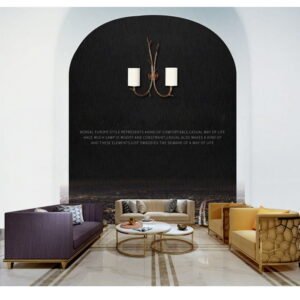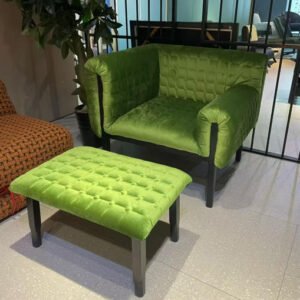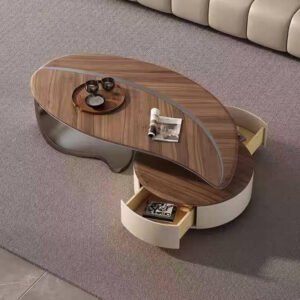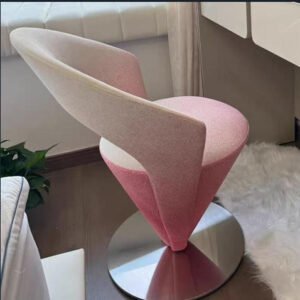

A hotel fit-out company in the Middle East committed $68,000 to a Chinese furniture supplier based on polished catalogue images, a convincing WhatsApp conversation, and samples that arrived looking immaculate. The production shipment arrived seven weeks late, with three out of four chair models failing the client’s specification — wrong fabric grade, visible glue at joints, and frame dimensions 40mm off the approved drawing.
That scenario plays out hundreds of times per year across the global furniture import trade. It is not just a risk for inexperienced buyers — it catches distributors and design firms with years of sourcing experience, because scam suppliers have become more sophisticated, not less, as competition has intensified.
This guide exists to give you a systematic, evidence-based framework for distinguishing reputable Chinese furniture manufacturers from suppliers who will cost you money, clients, and reputation. It is written for:
- Furniture distributors and wholesale agents managing import programmes
- Interior designers specifying Chinese furniture for residential and commercial projects
- Hotel and hospitality procurement managers sourcing FF&E at scale
- Furniture showroom operators building curated luxury product ranges
Every section of this guide is built around observable, verifiable criteria — not instincts or generalities.
📖 Quick Reference Glossary
- AQL (Nivel de calidad aceptable)
- The maximum defect rate considered acceptable in a production run. For furniture exports, AQL 2.5 means no more than 2.5% major defects in a sampled batch. Defined in ISO 2859-1.
- OEM (fabricante de equipos originales)
- A factory that produces goods to your exact specifications under your brand. You own the design; they execute it.
- ODM (fabricante de diseño original)
- A factory that designs and manufactures products from its own catalogue, which you can rebrand. The factory owns the design IP.
- Acuerdo NNN
- A China-specific legal agreement stronger than a standard NDA — it covers Non-disclosure, Non-use, and Non-circumvention. Required for IP protection under Chinese law.
- Incoterms (FOB / CIF / DDP)
- International trade terms defining who holds risk and responsibility at each stage of shipment. FOB = buyer’s risk from port of origin. CIF = seller covers freight and insurance to destination port. DDP = seller delivers duty-paid to your door.
- L/C (Letter of Credit)
- A bank-guaranteed payment instrument where your bank commits to pay the supplier only upon presentation of specified shipping documents — protecting both parties.

Premium Chinese manufacturers produce interiors at this caliber — the challenge for B2B buyers is identifying which suppliers can consistently deliver it, and which cannot.
Understanding the Chinese Furniture Manufacturing Landscape
The Market Overview — Quality Tiers and Manufacturer Categories
China’s furniture manufacturing sector is not a single entity. It is a layered market with dramatically different capability levels operating side by side — sometimes in the same industrial zone, occasionally in adjacent buildings. Understanding those tiers is the starting point for any credible vetting process.
Entry-level manufacturers typically operate at low MOQs, quote aggressively, and compensate for thin margins by substituting materials after sample approval. They serve domestic trade markets and export platforms with high-volume, low-complexity product. Mid-tier manufacturers have stable export histories, maintain basic ISO certifications, and deliver acceptable consistency for commodity product categories. Premium-tier manufacturers — the suppliers that distributors, hotel procurement teams, and interior designers targeting luxury positioning actually need — operate with multi-stage QC systems, dedicated account management, full certification stacks, and verifiable client references in your target market.
The critical insight: these tiers often look identical in their online presentation. A premium manufacturer and a chronic underperformer can both have a polished Alibaba storefront, similar product photography, and comparable price lists. The differentiation only emerges through systematic verification.
Key Market Segments: OEM vs. ODM
For B2B buyers sourcing custom furniture, the OEM model — where the factory produces to your exact specifications under your brand — is the relevant operating framework. ODM suppliers, who sell you existing designs to rebrand, offer less customization control and typically retain design IP. When evaluating a supplier, clarifying which model they operate — and whether they have dedicated engineering resources for OEM work — is an early-stage filtering question that quickly separates serious manufacturers from trading companies posing as factories.
Industry Standards and Certifications
ISO 9001:2015 (Quality Management System) establishes that a factory documents and audits its production processes systematically. It does not guarantee product quality — but it does mean quality failures are traceable and correctable through a formal recorded process. ISO 14001 addresses environmental management. BIFMA (Business and Institutional Furniture Manufacturers Association) standards cover structural performance for commercial furniture. FSC Chain of Custody certifies timber traceability back to responsible forest management. Each of these can be verified through the issuing body’s public database — not just by looking at a certificate scan on a supplier’s website.
Critical Red Flags: What to Watch For

A premium bespoke study — hand-finished leather armchair, brass hardware, custom shelving — is achievable through vetted Chinese manufacturers. Recognizing the red flags early determines whether you get this, or a pale imitation.
Communication and Responsiveness Issues
Communication quality in the pre-engagement phase is one of the most reliable leading indicators of how a supplier will behave once your money is committed. Reputable manufacturers with professional export infrastructure respond to detailed RFQs (Request for Quotations) with structured, itemized responses within 24–48 hours. They ask clarifying questions about specifications. They identify constraints proactively.
What you are observing in those early exchanges is the factory’s real operating cadence — not a sales performance. A supplier who takes four days to respond to an initial inquiry and provides a vague, single-paragraph price estimate has just shown you their operational standard. That standard does not improve when they have your deposit.
🚩 Evasive Documentation Responses
When asked for technical drawings, material specifications, or certification documents, the supplier deflects with “we can discuss after order confirmation.” Reputable manufacturers share documentation proactively — it is part of how they build confidence.
🚩 Urgency Pressure Without Basis
“This price is only valid for 48 hours” or “we have limited capacity this month” applied before any factory verification has occurred is a pressure tactic designed to shortcut your due diligence. No legitimate manufacturer with capacity constraints needs to manufacture urgency in a first conversation.
🚩 Reluctance to Provide References
A supplier who has delivered quality product at scale has clients willing to vouch for them. If a supplier cannot provide three verifiable B2B references in your market — with contact information you can independently use — the absence of references is itself evidence.
🚩 Vague or Inconsistent Pricing
Initial quotes that lack material specification breakdowns, or that change significantly between first contact and formal quotation without corresponding specification changes, indicate either a trading company with opaque markups or a manufacturer who doesn’t control their own cost base.
🚩 No Written QC Procedures
Ask directly: “Can you share your quality control procedure document for upholstered furniture production?” A manufacturer running a professional QC system has this document. A supplier with no documented QC process will either produce excuses or a hastily assembled generic document.
🚩 Missing or Unverifiable Certifications
Certificate images that lack certificate numbers, show different factory names from the business registration, or cannot be verified through the issuing body’s official database are common in the mid and lower tiers. Treat unverified certificates as no certificate at all.
The Bait-and-Switch — The Most Costly Scam in Furniture Importing
The most financially damaging scam in Chinese furniture sourcing is the bait-and-switch: a supplier sends high-quality samples — sometimes sourced from a premium factory specifically for this purpose — to win the order. The bulk production is then executed with inferior materials, lower-grade hardware, and reduced labor investment. By the time the container arrives at your port, the supplier has your payment and the leverage has shifted completely.
The protection against this is not trusting samples alone. It is requiring in-production photo documentation at key stages, commissioning a third-party pre-shipment inspection against the approved sample, and structuring payment so that a meaningful portion (30%) is withheld until pre-shipment inspection approval. Companies like SGS, Bureau Veritas, and Intertek all offer furniture-specific pre-shipment inspection services in Guangdong province for $300–600 per visit.
— Interior design procurement director, UK, 2024
Quality Control — The Foundation of Reliability
What Separates Top-Tier Suppliers From Competitors
Quality control at premium Chinese furniture manufacturers is not a single inspection at the end of production — it is a multi-stage system embedded throughout the production process. Understanding what that system should look like gives you the framework to ask the right questions and evaluate the answers critically.
A professional QC system in a reputable furniture factory includes: incoming material inspection (moisture content testing for timber, grade verification for fabric and leather, hardware specification confirmation before production begins), in-process inspection checkpoints at frame assembly, upholstery application, and pre-finishing stages, and outbound final inspection against the approved sample with photographic documentation and dimensional verification. Each stage generates a documented record — inspection reports, photos, measurement logs — that should be available to the buyer on request.
Quality Assurance Systems You Should Demand
When evaluating a manufacturer’s QC system, ask for their Incoming Quality Control (IQC) procedure, their In-Process Quality Control (IPQC) checkpoints with evidence of how non-conformances are handled, and their Final Quality Control (FQC) standard — specifically the AQL level they use for outbound inspection. Top-tier Chinese export furniture manufacturers typically use AQL 2.5 for major defects and AQL 4.0 for minor defects, matching international commercial standards. A supplier who cannot articulate their AQL standard almost certainly does not have a formal inspection system.
Material Sourcing and Traceability
Ask premium suppliers for their material specification sheets and supplier lists for key inputs. A reputable manufacturer can tell you the timber species, origin, and moisture content standard for their frames; the leather grade, origin tannery, and Martindale abrasion rating for their upholstery; and the hardware manufacturer for key mechanical components. This level of traceability is standard at manufacturers who have built export programmes for B2B clients and is essentially absent from suppliers operating without professional infrastructure.
📊 Quality System Indicators: Premium Manufacturer vs. Unreliable Supplier
(Performance score out of 100)
Source: Industry benchmarking based on B2B sourcing audits and supplier evaluation frameworks. Illustrative scoring.
Production Capacity and Lead Time Reliability
Assessing Manufacturing Capabilities
A manufacturer’s production capacity claims need to be tested, not accepted. Reliable capacity assessment involves understanding three things: physical production infrastructure (factory floor area, number of production lines, equipment type and age), workforce structure (number of permanent vs. contract workers, and critically, what percentage of production is executed in-house versus subcontracted), and historical delivery performance against committed lead times — verifiable through references.
The subcontracting question deserves specific attention. A factory that subcontracts significant portions of production to secondary facilities has fundamentally weaker quality control over the final product — the QC system you evaluated applies only to the work done in their facility. Subcontracting is common practice in Chinese furniture manufacturing and is not inherently problematic, but it must be disclosed, and the buyer must understand which processes are subcontracted and to whom.
Red Flags in Capacity Management
Lead times that seem unusually short for the complexity of the order are almost always a signal of one of two things: the supplier intends to subcontract to a facility that can move faster (with corresponding quality risk), or the supplier is giving you the answer they think you want to hear. Standard lead times for custom upholstered furniture from a Foshan manufacturer run 35–55 days in production, plus 25–35 days ocean freight to European or North American ports. A supplier quoting 30-day door-to-door for a complex custom upholstered piece is describing an impossibility or a subcontracted order you didn’t agree to.
Inability to handle reasonable volume fluctuations — for example, a 20–30% order increase during peak season — is another capacity signal. Reputable manufacturers plan production scheduling with buffer capacity precisely because B2B clients have seasonal demand patterns. A supplier who becomes “unavailable” at scale is not a manufacturer you can build a business relationship around.
Scaling Assurance for Growing Partnerships
When evaluating whether a manufacturer can grow with your business, ask specifically about their capital investment plans, their backup production facilities for contingency scenarios, and whether they have experience managing scaled programmes — for example, hospitality projects involving 200–500 identical pieces. Manufacturers who have successfully executed hotel FF&E programmes for international chains have demonstrated exactly the logistics and QC discipline that growing B2B relationships require. Muebles Jade Ant, for instance, works specifically with hotel developers and showroom operators managing this kind of scaled procurement, matching buyers to factories with verified capacity in their specific product category.
Customization Capabilities — Beyond Standard Offerings

A fully bespoke luxury living room configuration — custom frame profiles, designer fabric specifications, and tailored dimensions — is a legitimate expectation from premium-tier Chinese manufacturers equipped with in-house engineering and design teams.
Technical Customization Expertise
For interior designers and hotel procurement teams, customization capability is often the deciding factor in supplier selection. The difference between a manufacturer with genuine customization capability and one who claims it is visible immediately when you ask them to process a real design request.
A manufacturer with real CAD-based engineering capability will respond to a customization brief with a technical drawing and a clarifying question about the specification — typically within 3–5 business days. A manufacturer without it will respond with a revised product photo or a verbal confirmation that they “can do it.” The first response comes from an engineering team that has understood the design intent and can execute it. The second comes from a salesperson who doesn’t want to lose the inquiry.
Customization Red Flags
The red flag equivalent in customization discussions is the manufacturer who says yes to everything immediately. Every genuine customization has constraints — material availability, tooling requirements, structural engineering limitations. A manufacturer who claims they can customize “anything” without ever identifying a constraint or asking a clarifying question is not being honest about their capability. Reputable manufacturers push back on specifications that are technically problematic, because they would rather manage expectations now than manage a defect claim later.
Documentation of Custom Specifications
Every customization, however minor, must be confirmed in writing with a technical drawing that the buyer has formally approved. This is not bureaucratic formality — it is the only mechanism by which a B2B buyer can enforce their specification claim if the production deviates. A manufacturer who resists written specification confirmation (“don’t worry, we understand”) is establishing the conditions for a dispute they expect to win. Insist on written approval documentation for every custom element — material, dimension, finish, hardware — before production commences.
Shipping Reliability and Logistics Management
Understanding Export Logistics From China
Logistics is where the cost and timeline reality of Chinese sourcing is determined — and where many B2B buyers discover too late that their supplier’s logistics capability is as weak as their quality control. Understanding the fundamentals of Chinese furniture export logistics gives you the questions to ask and the answers to evaluate.
The primary choice in container logistics is between LCL (Less than Container Load) — where your goods share container space with other buyers’ cargo — and FCL (Full Container Load), where the entire container is yours. For luxury furniture, FCL is almost always preferable: LCL consolidation introduces handling touchpoints that increase damage risk, and your goods are exposed to the loading practices of other shippers in the consolidation warehouse. Most serious B2B buyers at volume use FCL to maintain control over packaging, loading, and handling standards.
Incoterms define the legal boundary of risk transfer between buyer and seller. FOB (Free On Board) means the seller’s responsibility ends when goods clear the origin port — freight, insurance, and customs clearance at destination are the buyer’s cost and risk. CIF (Cost, Insurance, Freight) means the seller arranges freight and insurance to the destination port, but the buyer takes risk once it arrives. DDP (Delivered Duty Paid) means the seller delivers to your door with duties and customs cleared — maximum convenience, but minimum visibility into logistics costs, as these are embedded in the product price. For most B2B buyers, FOB with their own freight forwarder is the optimal balance of control and cost transparency.
Shipping Red Flags and Risk Indicators
Suppliers who resist sharing tracking information until after shipment, who cannot name their freight forwarder, or who are vague about the port of loading are displaying logistics opacity that is almost always correlated with either subcontracted shipping arrangements or lack of professional export infrastructure. A manufacturer who handles regular B2B export shipments has established freight forwarder relationships and can provide tracking reference numbers within 24 hours of vessel departure.
Inadequate packaging is another logistics red flag that buyers often discover only upon delivery. Luxury furniture requires custom-built export packaging — typically multiple layers of foam padding, corner protection, and moisture barrier wrapping, within rigid wooden crating for structural pieces. A supplier who quotes packaging costs significantly below industry norms, or who sends product images showing basic cardboard packaging for hardwood furniture, is demonstrating packaging standards that will produce transit damage rates incompatible with luxury product business.
Logistics Partner Verification
Ask your supplier to name their primary freight forwarder and confirm that the forwarder is a licensed NVOCC (Non-Vessel Operating Common Carrier) or FIATA-registered agent. Verify that your cargo insurance covers the actual replacement value of the furniture — not the FOB invoice value, which may be 40–70% below retail replacement cost. Understand your customs clearance procedure in your destination country and whether your supplier’s documentation package (commercial invoice, packing list, bill of lading, certificate of origin) is complete and accurate — documentation errors are a significant source of customs delays and additional cost.
Financial Stability and Payment Security
Assessing Manufacturer Financial Health
A manufacturer’s financial stability directly affects their ability to source quality materials, retain skilled workforce, and maintain equipment — all of which directly determine what ends up in your container. Financially stressed manufacturers cut corners on inputs first, then on labor quality, and eventually on delivery commitments.
Business registration verification is the foundation of financial due diligence. Chinese companies are registered with the State Administration for Market Regulation (SAMR), and their registration details — registered capital, date of establishment, legal representative, and operational status — are publicly searchable through China’s National Enterprise Credit Information Publicity System (GSXT) at gsxt.gov.cn. A manufacturer who cannot provide their Unified Social Credit Code (a 18-digit identifier on all legitimate Chinese business registrations) has no verifiable legal existence in China.
Payment Terms and Risk Mitigation
The milestone-based payment structure that provides optimal protection for B2B buyers is 30% deposit on order confirmation, 40% upon completion of production with photographic in-process evidence and pre-shipment inspection report approval, and 30% balance against the bill of lading. This structure means that at no point has the buyer paid 100% before the goods are verified. For large orders above $50,000, Letters of Credit (L/C) through your bank add a layer of bank-intermediated documentation verification that protects both parties.
| Forma de pago | Buyer Protection Level | Typical Use Case | Key Risk |
|---|---|---|---|
| T/T Wire Transfer (milestone) | Medio | Standard B2B orders with established suppliers | Requires disciplined milestone structure |
| Carta de crédito (L/C) | Alto | Large orders ($50,000+), new supplier relationships | Bank fees; requires precise document compliance |
| Alibaba Trade Assurance | Medio | Platform-sourced orders with dispute mechanism | Limited to platform suppliers; dispute process can be slow |
| Escrow (third-party) | Alto | New supplier, no prior relationship, mid-size orders | Escrow fees; requires supplier agreement |
| 100% Upfront Wire | Ninguno | Never recommended for new suppliers | Complete loss of leverage after payment |
| Western Union / Informal | Ninguno | Never appropriate for B2B furniture orders | Essentially unrecoverable in dispute |
Red Flags in Financial Dealings
Any demand for 100% upfront payment — regardless of the justification offered — is an immediate disqualifying red flag. Pressure to use informal payment channels (personal bank accounts, cryptocurrency, payment apps) from a supposed manufacturer is evidence of either a trading company attempting to obscure its identity or an outright scam operation. Inconsistent pricing across quotations without corresponding specification changes indicates either a supplier who does not control their own cost base or one who is adjusting prices based on their read of the buyer’s price sensitivity rather than actual production economics.
References, Certifications, and Verification
Conducting Thorough Supplier Due Diligence
Reference checking is systematically underutilized by B2B furniture buyers, primarily because it feels awkward to request — and because bad suppliers have become skilled at managing the reference request by providing contacts who give scripted positive responses. The way to extract genuine intelligence from references is to ask questions that produce specific, verifiable answers rather than general satisfaction ratings.
What to Ask References
Ask: “What was the defect rate on your last three shipments, and how did the manufacturer handle the defects?” Ask: “Was your most recent custom order delivered within 7 days of the committed date?” Ask: “Can you describe a specific problem that arose during production and how the supplier resolved it?” These questions produce narrative responses that reveal operational reality. A reference who gives generically positive answers to all three questions without any specific detail is either reading from a script or has minimal actual engagement with the supplier being verified.
Certifications Worth Verifying — And How
Each major certification has a public verification pathway that takes less than five minutes and produces definitive results. ISO certifications are verifiable through the issuing certification body’s public database — the certificate will name the body (e.g., Bureau Veritas, SGS, TÜV Rheinland). FSC Chain of Custody certificates are searchable through the FSC certificate database by certificate code. BIFMA certification status is verifiable through bifma.org. GREENGUARD Gold certification is searchable through UL’s Product Lens database. Any certificate that cannot be verified through the issuing body’s public system should be treated as potentially fraudulent.
| Certificación | What It Proves | Fuente de verificación | Market Requirement |
|---|---|---|---|
| ISO 9001:2015 | Documented quality management process | Issuing body database (SGS, BV, Intertek) | Universal export baseline |
| ISO 14001 | Environmental management system | Issuing body database | EU, corporate sustainability |
| Cadena de custodia del FSC | Sustainable timber traceability | info.fsc.org — certificate search | Hotels, corporate, EU mandatory trend |
| BIFMA / ANSI | Commercial furniture structural performance | bifma.org | USA commercial & hospitality |
| GREENGUARD Gold | Low VOC emission — indoor air quality | UL Product Lens database | Healthcare, education, LEED projects |
| Fase 2 del CARB | Formaldehyde emission (engineered wood) | CARB ATCM registry | Mandatory — USA market |
Comparative Analysis: Top-Tier Suppliers vs. Unreliable Competitors

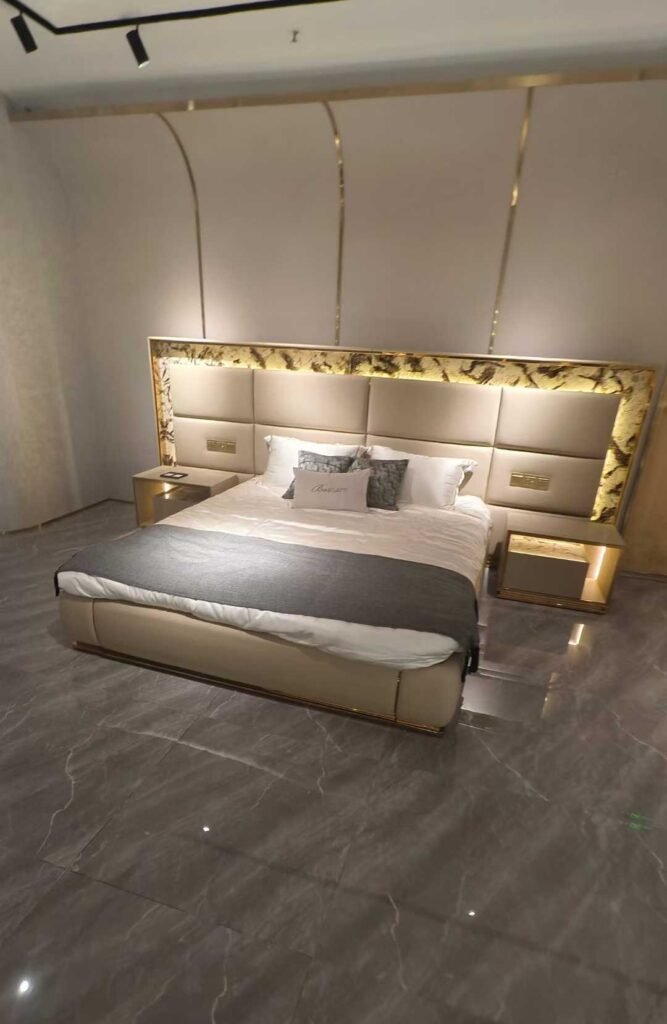
This caliber of master bedroom suite — upholstered headboard, custom drapery, precision-fitted bedside units — is the expected output from premium-tier Chinese manufacturers with verified hotel programme experience. Explore La colección para dormitorio de Jade Ant Furniture for hospitality and residential sourcing.
Case Study Framework — Industry Benchmarks for Premium vs. Unreliable Suppliers
The distinction between a premium Chinese furniture manufacturer and an unreliable one is not a single dimension — it is a systemic difference in organizational investment and operational culture. Premium-tier manufacturers invest in technology (CNC equipment, digital pattern cutting systems, 3D scanning for QC), in human capital (dedicated design and engineering teams, trained QC inspectors, bilingual account managers), and in process infrastructure (documented procedures, third-party audit compliance, client-facing reporting systems). These investments are costly — they are the reason premium manufacturers cost more than entry-level alternatives — and they are the source of the delivery consistency that B2B businesses require.
Quality Metrics Comparison
🥧 Root Causes of B2B Furniture Import Disputes
(Analysis of industry claim data)
- Material substitution (bait & switch) — 34%
- QC system failure — 26%
- Late or missed delivery — 18%
- Specification deviation — 14%
- Packaging / transit damage — 8%
Source: Aggregate analysis of B2B furniture import dispute claims. Illustrative based on industry reporting (Sofeast, QualityInspection.org, topohut.com).
Service Differentiation
The service layer that separates premium manufacturers is particularly visible in three areas. First, dedicated account management: a named contact with decision-making authority who understands your product range, your client specifications, and your business cycle. Not a rotating sales assistant who needs to be briefed on your specifications from scratch each time. Second, proactive communication: updates initiated by the manufacturer when milestones are reached or when production issues arise, rather than updates you have to chase. Third, post-delivery support: documented warranty terms, clear defect reporting procedures, and a track record of honoring warranty commitments without requiring a legal dispute to trigger action.
These service qualities are not incidental. They reflect organizational investment in client retention, which is itself evidence of a business operating with long-term strategic intent rather than transactional opportunism.
Building a Sustainable Supplier Partnership
Establishing Long-Term Relationships With Trustworthy Manufacturers
The most commercially valuable relationships in Chinese furniture sourcing are not transactional — they are structured partnerships built on clear expectations, mutual accountability, and progressive trust development. Manufacturers invest more in clients who invest in them: priority production scheduling, earlier access to new product development, more favorable payment terms, and genuine problem-solving commitment in dispute situations all flow toward buyers who operate as strategic partners rather than one-time purchasers.
Building toward that partnership level requires deliberate structure from the outset. That means establishing communication protocols (defined response time expectations, primary and escalation contacts on both sides), performance KPIs that are measured and reviewed regularly (on-time delivery rate, defect rate by shipment, specification accuracy), and a quarterly business review cadence where both parties can surface issues before they become disputes.
Contract Essentials for B2B Partnerships
A robust B2B furniture supply contract is not a formality — it is the document that determines what recourse you have when things go wrong. Key clauses include: detailed technical specifications with approval documentation referenced as binding annexures, quality acceptance criteria with AQL levels specified by defect category, inspection rights (your right to conduct or commission third-party inspections at any production stage), intellectual property protection provisions (ownership of custom designs and tooling), dispute resolution mechanism (specifying jurisdiction — ideally international arbitration rather than Chinese court proceedings for non-Chinese buyers), and liability and indemnification for quality failures and delivery defaults.
For IP-sensitive custom designs, a China-specific NNN Agreement (Non-Disclosure, Non-Use, Non-Circumvention) — not a standard Western NDA — is the appropriate legal instrument. NNN agreements are enforceable under Chinese law in Chinese courts, which is where any enforcement action would need to occur. For buyers working with proprietary designs, registering a Chinese utility model or design patent before sharing detailed specifications is an additional protective layer worth the relatively modest cost.
Ongoing Monitoring and Relationship Management
Quality monitoring does not stop after the first successful shipment. Reputable manufacturers welcome structured performance reviews because they provide actionable feedback that improves their operations and strengthens the relationship. Schedule quarterly business reviews that include delivery performance data, defect rate trend analysis, upcoming order forecasts, and any specification or process improvement discussions. Annual factory audits — either in-person or virtual with video documentation — maintain your visibility into the operational reality of the facility. Benchmarking your supplier’s performance against market alternatives periodically is not a sign of distrust; it is standard commercial practice that top-tier manufacturers understand and respect.
Practical Checklists: Evaluating a Chinese Furniture Manufacturer
Pre-Engagement Assessment Checklist
🔍 Before You Commit — Complete Due Diligence Checklist
- Verify business registration via China’s GSXT system using the supplier’s Unified Social Credit Code
- Confirm physical factory location, total floor area, and owned vs. leased facility status
- Request and independently verify all claimed certifications (ISO, FSC, BIFMA, CARB) through issuing body databases
- Obtain minimum 3 verifiable B2B references in your product category — contact each with specific operational questions
- Request technical drawings and full material specification sheets for your target products
- Review written QC documentation — IQC, IPQC, and FQC procedures with AQL standards specified
- Confirm in-house vs. subcontracted production processes and identify which stages are executed off-site
- Assess communication responsiveness: send a detailed technical RFQ and evaluate response quality within 48 hours
- Evaluate payment terms: confirm milestone-based structure; reject any 100% upfront demand
- Request production samples (not showroom samples) and conduct independent material testing if warranted
- Verify freight forwarder name and confirm they are NVOCC or FIATA registered
- Commission a third-party factory audit (SGS, Bureau Veritas, Intertek) for orders above $20,000
During Engagement Monitoring Checklist
📋 Active Order Monitoring — Production Through Delivery
- Confirm all order details in writing with technical drawings formally approved and signed
- Receive and confirm production timeline with milestone dates (material procurement, frame assembly, upholstery, finishing, QC, shipment)
- Request in-process quality photos at frame assembly and pre-finishing stages
- Commission pre-shipment inspection from independent third party before balance payment is released
- Verify shipping booking details — vessel name, ETD, ETA, container number
- Confirm complete documentation package: commercial invoice, packing list, bill of lading, certificate of origin, relevant certificates
- Document all custom modifications or change orders in writing with cost implications confirmed
- Maintain complete correspondence records with timestamps (email preferred over WhatsApp for legal evidence)
- Inspect goods within 48 hours of receipt and document any damage or defects with timestamped photos
- Submit any defect claims in writing within the contractually specified timeframe
Making Confident Supplier Decisions

This level of luxury dining room specification — bookmatched marble table, sculptural upholstered chairs, architectural lighting — is achievable through vetted premium Chinese manufacturers. The difference between receiving this and receiving a disappointment is the vetting process you apply before you commit. Browse Jade Ant Furniture’s dining collection for verified B2B sourcing options.
Key Takeaways for B2B Buyers
Red flags are almost always visible in the pre-engagement phase — before any money has been committed. The communication quality, documentation responsiveness, certification verification outcomes, and reference check results you observe in the first two to three weeks of engagement are the most reliable predictors of the supplier’s operational performance over the following months.
Thorough due diligence is not a bureaucratic overhead — it is the primary risk management mechanism available to B2B furniture buyers who cannot continuously monitor production in person. A third-party factory audit costs $300–600. A pre-shipment inspection costs the same. A failed container of luxury furniture costs $15,000–80,000 plus the downstream client relationship damage that cannot be invoiced.
The manufacturers worth building long-term relationships with — the ones who will grow with your business, honor their commitments, and resolve problems without requiring legal escalation — are the ones who welcome verification processes rather than resisting them. They have nothing to hide because they have invested in building something worth revealing.
Next Steps for Finding Your Ideal Manufacturing Partner
Use the checklists in this guide as your vetting framework for every new supplier relationship. Prioritize reference checks and third-party verification over catalogue quality and price competitiveness — because the suppliers with the most impressive catalogues are often the ones who have invested most in sales infrastructure and least in production capability. Start new supplier relationships with smaller evaluation orders before scaling to container volumes — not because you don’t trust the supplier, but because trust is built through demonstrated performance, not promised performance.
For distributors, designers, and hotel procurement teams who want to shortcut the vetting process by accessing pre-audited manufacturer networks, Muebles Jade Ant operates specifically to connect B2B buyers with factory partners whose credentials, capabilities, and client histories have already been verified. The complete sourcing guide on their platform provides additional operational depth for buyers building their Chinese manufacturing programmes.
Ready to Find a Reliable Chinese Furniture Manufacturer?
Stop gambling with supplier selection. Access our network of pre-vetted Chinese manufacturers — each evaluated against the criteria in this guide — and get personalized sourcing recommendations for your specific product categories and business needs.
- Download our complete supplier vetting checklist (print-ready PDF)
- Schedule a consultation with our sourcing specialists — no obligation
- Access our verified manufacturer database, screened by category and certification
- Get a personalized supplier shortlist matched to your volume and specification requirements
Explore verified product categories: Living Room | Bedroom | Dining Room | About Jade Ant
Frequently Asked Questions: Vetting Chinese Furniture Manufacturers
These FAQs are designed to address the most common questions from furniture distributors, interior designers, hotel procurement specialists, and showroom operators evaluating Chinese furniture suppliers.
Start with business registration verification through China’s National Enterprise Credit Information Publicity System (GSXT) at gsxt.gov.cn — every legitimate Chinese manufacturer has a searchable Unified Social Credit Code that reveals registration date, registered capital, operational status, and legal representative. Next, verify all claimed certifications (ISO, FSC, BIFMA) directly through the issuing body’s public database — never rely on a certificate scan alone. Request a minimum of three verifiable B2B references in your product category and contact them with specific operational questions, not general satisfaction questions. Commission a third-party factory audit from SGS, Bureau Veritas, or Intertek for any order above $20,000. Reputable manufacturers welcome these processes — resistance to verification is itself a red flag. This B2B verification guide provides a step-by-step framework for the complete process.
The bait-and-switch occurs when a supplier sends high-quality samples — sometimes sourced from a premium factory specifically for this purpose — to win your order, then executes bulk production with inferior materials, lower-grade hardware, and reduced labor standards. By the time your container arrives, the supplier holds your payment and the quality differential is irreversible. Protection requires a multi-layer approach: structure payment as 30/40/30 milestones with the final 30% contingent on pre-shipment inspection approval; commission a third-party pre-shipment inspection from SGS or Bureau Veritas against your approved sample; require in-production photo documentation at frame assembly and finishing stages; and specify materials in writing by grade, origin, and technical specification — not just by description. Vague specifications are the bait-and-switch supplier’s most valuable tool. Removing that tool through precise written specification is your primary protection.
Request the manufacturer’s written QC procedure documents — specifically their IQC (Incoming Quality Control), IPQC (In-Process Quality Control), and FQC (Final Quality Control) procedures. Ask them to specify their AQL (Acceptable Quality Level) standard for major and minor defects. Request examples of quality reports from recent production runs — photographic evidence, measurement records, and non-conformance logs. Commission a virtual factory audit via video call, requesting a live walkthrough of the production floor, QC station, and material storage. For any order of significance, commission an in-person pre-shipment inspection from an independent third party ($300–600) — this is the most reliable remote quality verification mechanism available, and the cost is negligible against any meaningful order value.
The optimal structure for new supplier relationships is a milestone-based payment: 30% deposit on order confirmation (this funds material procurement), 40% upon production completion confirmed by in-process photos and a third-party pre-shipment inspection report you approve, and 30% balance against the bill of lading. This structure ensures you never reach 100% payment before independently verifying the goods. For orders exceeding $50,000, add a Letter of Credit (L/C) through your bank — this creates bank-intermediated documentation verification that protects both parties. Never pay 100% upfront to a new supplier under any circumstances, and never use informal payment channels (personal accounts, Western Union, cryptocurrency) regardless of the justification offered.
Standard production lead times for custom upholstered furniture from premium Chinese manufacturers run 35–55 days in production, depending on complexity and customization level. Simple catalogue orders with fabric and color changes run 25–35 days. Highly complex custom pieces with new frame tooling can require 60–75 days in production. Add 25–35 days ocean freight to European ports, 30–38 days to US East Coast, and 16–22 days to US West Coast for total lead time from order to warehouse. Be suspicious of any supplier quoting significantly shorter production timeframes for complex custom orders — this almost always indicates subcontracting to a secondary facility or a commitment they cannot realistically honor, both of which compromise quality and timeline reliability. Always get the production milestone schedule in writing with committed dates, not estimates.
The required certification set depends on your target market. For all export markets: ISO 9001:2015 (Quality Management). For European sales: CE marking for relevant product categories and FSC Chain of Custody for wood products. For North American sales: CARB Phase 2 compliance (mandatory for engineered wood), BIFMA/ANSI standards for commercial environments, and GREENGUARD Gold for indoor air quality-sensitive applications. Verify ISO certificates through the named issuing body’s database. Verify FSC certificates at info.fsc.org using the certificate code. Verify BIFMA certification at bifma.org. Verify GREENGUARD at UL’s Product Lens database. Any certificate that lacks a verifiable certificate number and issuing body should be treated as potentially fraudulent.
IP protection in Chinese manufacturing requires a layered strategy. First, use a China-specific NNN Agreement (Non-Disclosure, Non-Use, Non-Circumvention) — not a standard Western NDA — drafted under and enforceable in Chinese law. NNN agreements cover non-disclosure of your design, non-use of your design for other clients, and non-circumvention of your relationship by selling direct to your clients. Second, register your key designs as Chinese utility model patents or design patents before sharing detailed specifications — registration is faster and more affordable than many buyers expect. Third, limit shared documentation to production drawings rather than concept development files. Fourth, work with manufacturers who have established client confidentiality systems and can demonstrate prior experience protecting client IP. The WIPO China IP resources provide guidance on registration procedures for international buyers.
Inspect goods within 48 hours of receipt and document all damage and defects with timestamped photographs of the condition upon unpacking — before any items are moved to display or use. Submit a formal written defect claim to your supplier within the timeframe specified in your contract (typically 7–14 days from receipt), including itemized defect descriptions with photo evidence and reference to the approved sample specification. For transit damage, file a claim with your cargo insurance carrier simultaneously — transit damage is covered by cargo insurance, not manufacturer warranty. Reputable manufacturers with professional export operations will acknowledge the claim and propose resolution — replacement parts, credit against future orders, or replacement pieces in a subsequent shipment. Avoid accepting damaged goods without written acknowledgment of the defect from the manufacturer, as this weakens your legal position.
OEM (Original Equipment Manufacturer) produces goods to your exact specifications under your brand. You own the design; the factory executes it. ODM (Original Design Manufacturer) designs and manufactures products from its own existing catalogue, which you can rebrand. The factory owns the design IP. For B2B buyers in the luxury furniture segment — distributors, interior designers, and hospitality procurement teams working with custom or exclusive product — OEM is the relevant model. It gives you full specification control, exclusivity over your designs, and the ability to position product authentically in your market. ODM is appropriate for buyers who don’t have proprietary designs and want to source catalogue product under their own brand. The critical distinction to verify early in supplier evaluation is whether the factory has in-house engineering capability to execute OEM work — a factory without a design and engineering team cannot genuinely execute OEM manufacturing, regardless of what they claim.
Total Landed Cost (TLC) is the only figure that enables accurate margin calculation. It comprises: FOB price (factory price + domestic freight to origin port) + ocean freight (typically $1,800–4,500 per 20ft container, $2,800–6,500 per 40ft container depending on route) + cargo insurance (0.3–0.5% of CIF value) + import duties (market-dependent — US furniture tariffs on Chinese goods are approximately 10–14% under current 2025 trade terms; EU applies standard MFN rates) + port handling and customs clearance ($300–800 typically) + inland freight to your warehouse. Add third-party inspection fees if applicable ($300–600). A useful rule of thumb: for European destinations, total logistics and duty costs add 35–55% to the FOB price. For North American destinations, 40–65% depending on tariff category and port. Always calculate TLC before comparing Chinese sourcing economics to local or European alternatives.
For established suppliers, conduct quarterly performance reviews tracking three core metrics: on-time delivery rate (target 90%+ for premium tier), defect rate by shipment (target below AQL 2.5 for major defects), and specification accuracy (percentage of orders requiring no post-production correction). Perform annual comprehensive audits — either in-person site visits or video-documented virtual audits — that cover production facility condition, workforce changes, equipment status, certification renewals, and subcontracting arrangements. Increase audit frequency immediately if any performance metric deteriorates, if the supplier changes ownership or management, or if you observe unexplained pricing volatility. Decrease order volume proactively while auditing a supplier showing warning signs — do not reduce vigilance simply because a supplier has performed well historically, as operational conditions change.
The transition protocol that minimizes business risk is parallel sourcing: begin placing small evaluation orders with the new supplier — 10–20% of your typical volume — while maintaining orders with the existing supplier. This allows you to verify the new supplier’s quality, lead time reliability, and communication standard across 2–3 real orders before committing significant volume. Gradually shift volume as the new supplier demonstrates consistent performance. Maintain the relationship with your existing supplier at reduced volume rather than terminating abruptly — you may need their capacity as a fallback during the transition period. Never depend on a single supplier for more than 70% of your total volume for any product category; maintaining relationships with 2–3 vetted suppliers in each category is the structural risk management approach that resilient B2B furniture businesses use to ensure continuity regardless of individual supplier performance issues.