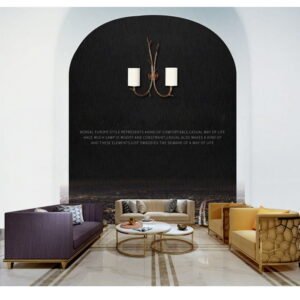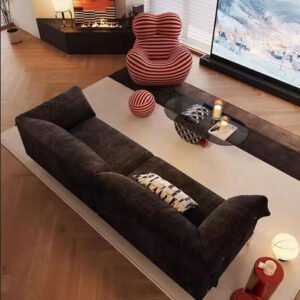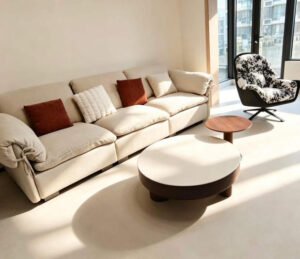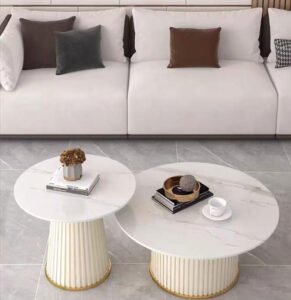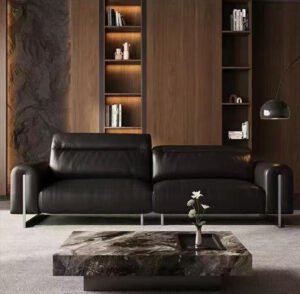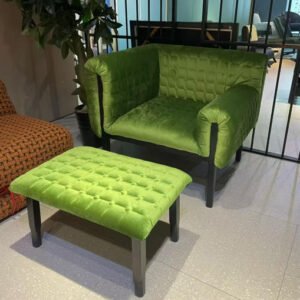

Choosing between a Chinese sofa manufacturer and a domestic brand is not just a price decision — it is a supply chain decision, a quality-control decision, and a long-term partnership decision. This guide gives furniture dealers, interior designers, showroom buyers, and hospitality specifiers the factual framework to make it correctly.
(Mordor Intelligence, 2025)
(Mordor Intelligence)
(CBM Living, 2025)
(Sorse Furniture Guide)
Walk through any major furniture market in the US, Europe, or Southeast Asia and a striking pattern emerges: sofas retailing at $4,000–$8,000 carry labels quietly reading “Made in China.” The factory price of many of those pieces sits below $700. Between the production floor in Foshan and the showroom floor in Manhattan, the sofa passes through a sourcing agent, a regional wholesaler, a brand headquarters, a marketing department, and a retail margin — each layer adding 40–60% to the cost.
For dealers, distributors, and design professionals who understand this value chain, sourcing directly from Chinese manufacturers is not a compromise — it is a strategic lever that can reshape product margins, customization capability, and competitive positioning. But the same market that contains world-class factories producing furniture for global luxury brands also contains commodity operations that will ship a golden-sample showroom piece and a substandard production run.
This guide covers the real comparison — price structures, lead times, MOQ mechanics, after-sales realities, and supplier evaluation — between Chinese sofa manufacturers and domestic brands. The goal is not to declare a winner, but to give you the precision tools to make the right call for each sourcing decision your business faces.
📖 Key Terms — Quick Reference
- OEM (fabricante de equipos originales)
- The manufacturer produces sofas to the buyer’s specifications and design. The buyer owns the design; the factory owns the production process. Common for brands wanting proprietary product without in-house manufacturing.
- ODM (fabricante de diseño original)
- The manufacturer designs and produces a sofa; the buyer purchases and brands it. Faster to market, lower tooling cost, but the same design may be sold to other buyers — unless exclusivity is contracted.
- FOB (Libre a bordo)
- The seller delivers goods to the named Chinese port and clears Chinese export customs. The buyer takes responsibility from the moment goods are loaded onto the vessel. The standard B2B trade term for furniture exports.
- EXW (En fábrica)
- The seller makes goods available at their premises. The buyer arranges and pays for all transport, export clearance, and inland logistics. The raw factory price — but maximum responsibility on the buyer.
- MOQ (cantidad mínima de pedido)
- The smallest order a manufacturer will accept for a given product or material configuration. Driven by material procurement minimums, production setup costs, and factory capacity planning.
- Landed Cost
- The true total cost of goods: factory price + inland freight in China + ocean freight + port fees + import duties + last-mile delivery. The only valid number for comparing supplier options.
- BSCI (Iniciativa para el Cumplimiento Social Empresarial)
- A supply chain compliance framework that audits factories for labor standards, working conditions, and social accountability — increasingly required by European retailers and hotel groups.
Overview of the Market Landscape

Key Players in China and Domestic Markets
China’s sofa manufacturing ecosystem is concentrated in three primary clusters: Foshan, Guangdong (the world’s largest furniture manufacturing hub, home to producers like Cheers Sofa, Jason, and hundreds of export-focused factories); Hangzhou and Zhejiang Province (known for technology-integrated and modular seating); and Shandong Province (solid wood and traditional upholstered furniture). Foshan alone accounts for an estimated 70% of high-end furniture exports from China, with the Lecong Furniture Market — the world’s largest furniture wholesale center at over 30km of showrooms — at its center.
Domestic brands in destination markets (US, UK, Australia, Germany) operate on a fundamentally different model. Names like La-Z-Boy, Natuzzi, and Poliform maintain brand equity through design intellectual property, marketing investment, retail distribution networks, and — increasingly — Asian production partnerships that they do not publicize in consumer-facing material. A significant portion of “European” and “American” sofas are manufactured in China, Vietnam, or the Philippines and finished or assembled locally to qualify for origin labeling.
For B2B buyers — dealers, distributors, hotel purchasing teams — the practical competitive landscape is this: domestic brands offer recognized brand equity, shorter domestic lead times, and an established warranty and after-sales infrastructure. Chinese manufacturers offer substantially lower production costs, greater customization depth, and the ability to develop proprietary product without the retail margin burden. The decision is not binary; sophisticated buyers typically maintain both in their sourcing portfolio.
Typical Business Models: OEM vs. ODM — and What They Mean for Your Business
🏭 OEM — You Own the Design
- You provide design files, material specs, dimensions
- Factory produces exclusively to your specification
- Proprietary product — competitors cannot buy the same piece
- Higher tooling/development cost upfront ($500–$3,000 per model)
- Best for: established dealers building a house brand; hotel groups specifying proprietary FF&E
- MOQ typically higher (50–200 units per SKU)
📐 ODM — Factory Owns the Design
- Factory offers existing designs you can brand and sell
- Faster to market — no development phase
- Lower upfront cost; no tooling fees
- Risk: same design may be available to competitors
- Best for: smaller dealers testing new product categories; designers needing speed-to-market
- MOQ typically lower (10–30 units depending on factory)
Price: Chinese Manufacturers vs. Domestic Brands
How Pricing Is Structured: FOB, EXW, and MOQ Impact
The first mistake buyers make when comparing Chinese sofa prices to domestic alternatives is comparing factory quotes to retail prices. The correct comparison is coste en destino — the Chinese factory price fully loaded with all costs to your warehouse door — versus the domestic supplier’s wholesale or trade price.
A real-world example from 2025 market data: a high-end velvet sectional sofa retails domestically at USD 5,600. The Chinese factory price (EXW Foshan) for a comparable specification is approximately USD 800. But EXW is not the full picture. Add: inland freight in China (~USD 50), ocean freight LCL (~USD 350), documentation fees (~USD 100), import duty (varies widely — 0–5% standard, up to 25%+ with Section 232 tariffs on US imports from China), port fees, customs bond, and last-mile delivery. Total landed cost arrives in the range of USD 1,800–2,500 depending on destination market and current tariff regime — still 55–65% below the domestic retail equivalent, but not the 86% saving implied by the factory price alone.
Price Comparison: Chinese Manufacturer vs. Domestic Brand — Mid-Grade Sectional Sofa
USD per unit, 2025 estimates. FOB + full landed cost vs domestic trade/retail pricing.
⚠ Note: US tariff impact includes Section 301 / Section 232 duties. EU landed cost assumes standard import duty (currently 0% on most furniture HS codes under GDPR-trade agreements). Always verify current tariff schedules with your freight forwarder before finalizing sourcing decisions.
El Cantidad mínima de pedido directly affects unit pricing at Chinese factories. A factory quoting USD 780 per sofa at 50-unit MOQ will typically quote USD 920–1,050 for a 10-unit order of the same specification — because the fixed costs (material procurement, cutting setup, quality inspection) are distributed across fewer units. Understanding this relationship allows buyers to negotiate more effectively: volume commitments for price, not just individual order size.
Hidden Costs and Negotiation Tips
| Categoría de costes | Typical Range | Who Controls It | Negotiation Leverage |
|---|---|---|---|
| Inland freight (China) | $30–$80 per piece | Factory / freight agent | Ask factory for FOB price — they handle inland |
| Ocean freight (FCL 40ft) | $2,500–$5,000 per container | Freight forwarder | Request quotes from 3+ forwarders; consolidate volume |
| Ocean freight (LCL) | $80–$150 per CBM | Freight forwarder | Combine orders to reach FCL threshold (~15 CBM) |
| Import duties (EU) | 0–5.6% (upholstered furniture) | Government fixed | Verify HS code classification — wrong code = wrong rate |
| Import duties (USA) | 0% base + up to 25% Section 301 | Government fixed | Verify current rate for specific HS code — rates have changed |
| Sample / development cost | $200–$1,500 per design | Negotiable | Waivable against confirmed bulk order (negotiate in writing) |
| Inspección previa al envío | $300–$500 per inspection day | Buyer’s choice | Non-negotiable — always invest for orders >$10,000 |
| Customs clearance fees | $150–$350 per shipment | Customs broker | Bundle with freight forwarder for package pricing |
| Packaging upgrade (wooden crate) | $15–$50 per piece | Factory | Essential for LCL — always specify; prevents transit damage |
Lead Time and Production Speed
Factors Affecting Timelines: Materials, Customization, and Logistics
Lead time is the variable that most frequently disrupts furniture procurement plans — particularly for hospitality projects and retail launches with hard opening dates. Understanding what drives lead time variation at Chinese manufacturers allows buyers to build realistic project timelines and identify where compression is possible.
The lead time clock starts not from order placement, but from sample approval. A common planning error is treating sample development time (typically 15–25 working days for a new design) as part of the production lead time — when in practice it is a separate phase that must complete before mass production can begin. For custom specifications — non-standard dimensions, fabric from an external supplier, modified frame design — add 10–20 additional days for material procurement and sample iterations.
Typical Lead Time Comparison by Sofa Category (Working Days, Production Only)
Factory-to-FOB, excluding sample development and ocean transit. Source: Industry aggregated data, 2024–2025.
🔴 Add Chinese New Year (Jan–Feb): +15–25 days for orders placed in November–December. Factory closure period typically 2–3 weeks, plus material supplier recovery time.
Typical Ranges by Category and Planning Implications
The total planning horizon from RFQ (Request for Quotation) to installed product in a European or North American market runs 12–18 weeks for standard-specification orders and 18–26 weeks for new OEM designs. For interior designers and hospitality procurement teams working to a fit-out schedule, the practical discipline is to treat the Chinese production path as a parallel-track activity that begins alongside — not after — the design finalization process.
Where Chinese manufacturers have a structural disadvantage versus domestic brands is in emergency replenishment. A domestic distributor holding stock can fulfill a 5-unit reorder in 3–10 days. A Chinese factory reorder for 5 units will rarely be accepted at competitive pricing and will not arrive for 10–14 weeks. B2B buyers who source primarily from China should either carry appropriate buffer stock for fast-moving SKUs or establish relationships with local holding warehouses — a service that some Chinese export manufacturers now offer through bonded warehouse arrangements in European and US logistics hubs.
▶ Inside a Chinese sofa and custom chair factory — full production process walkthrough covering frame construction, foam selection, upholstery, and quality control. A practical reference for buyers evaluating Chinese manufacturing capability. (Source: YouTube)
Minimum Order Quantity (MOQ) Differences
Why MOQs Differ Between Chinese Manufacturers and Domestic Brands
Cantidad mínima de pedido is the friction point most commonly cited by smaller dealers and interior design firms when evaluating Chinese manufacturer sourcing. A showroom buyer who needs 5 sofas of a specific design encounters a factory requiring 30-unit minimums and concludes that Chinese sourcing is inaccessible at their scale. This conclusion is often wrong — but it requires understanding why MOQs exist to navigate them.
Chinese sofa factory MOQs are driven by three converging factors. First, fabric and material procurement: upholstery fabrics are typically purchased in rolls with minimum cut lengths of 50–100 linear meters; ordering 5 sofas in a non-stock fabric may require buying 3× more fabric than the order requires, raising per-unit cost unacceptably. Second, production setup: cutting, sewing, and framing a sofa model requires setup time that is proportional to the number of distinct specifications, not the number of units — a 5-unit order and a 30-unit order of the same model require the same setup time, but the setup cost per unit is 6× higher for the smaller order. Third, factory economics: most Chinese export factories are optimized for batch production efficiency; small orders disrupt their scheduling rhythm and create opportunity cost.
Typical MOQ Ranges by Chinese Sofa Manufacturer Type (2024–2025)
Based on B2B sourcing data across export-focused factories in Foshan, Guangdong and Zhejiang provinces.
Source: B2B sourcing industry aggregation, 2024–2025. Distribution approximate; varies by product category and factory type.
Strategies to Manage MOQ: Sampling, Co-Packs, and Negotiation
For buyers whose volume does not naturally meet a factory’s MOQ, several practical strategies exist that experienced sourcing professionals deploy routinely:
Mix-and-match MOQ: Many factories apply their MOQ to a production run across multiple variants of the same model — for example, 30 units total across 3 colorways (10 units per color) rather than 30 units of a single color. This allows smaller buyers to access factory pricing while offering product variety. Always ask explicitly: “Is your 30-unit MOQ per SKU or per model?”
Consolidated sampling programs: Rather than ordering individual samples at full unit price, establish a relationship that allows multiple design samples to be produced in a single batch — negotiating a bundled sample cost against a projected bulk order. This is standard practice for dealers building a new product range and is more efficient than sequential single-sample orders.
Shared container co-packing: Two or more buyers (different product categories, compatible packing dimensions) share a 40-foot container, each meeting their individual factory MOQs independently but sharing ocean freight costs. This is particularly effective for interior designers sourcing sofa + dining + bedroom furniture from different Foshan factories in a single project procurement.
Working with a production partner who has established factory relationships — and the purchasing volume to negotiate favorable MOQ terms across a portfolio of buyers — is one of the most effective ways to access Chinese factory pricing at scale below standard minimums. Muebles Jade Ant operates precisely this model: as a China-based manufacturer and wholesale supplier with over 15 years of industry experience, working with furniture importers, distributors, and interior design firms who need factory-level access without the overhead of managing factory relationships independently.
After-Sales Service and Support
Response Times and Service Scope
After-sales service is where the gap between Chinese manufacturers and established domestic brands is most acutely felt — and most misunderstood. The core structural difference is geographic: a domestic dealer’s warranty claim involves a local warehouse, a regional service team, and a familiar regulatory environment. A Chinese manufacturer warranty claim, from a buyer in the UK or UAE, involves cross-border communication, photographic evidence review, parts shipment from Foshan, and potential customs complications for replacement components.
This does not mean Chinese after-sales is inherently inferior — it means it is differently structured and requires different management. Export-focused Chinese manufacturers with serious B2B client bases have developed response protocols: initial response within 24–48 hours for documented quality issues, photographic review process for warranty assessment, and replacement parts shipment within defined lead times (typically 15–30 working days for structural components). The key is contractualizing these terms — including response time standards and parts availability commitments — before order placement, not after a problem occurs.
| Service Dimension | Chinese Manufacturer (Export-Grade) | Domestic Brand / Distributor |
|---|---|---|
| Initial response time | 24–72 hours (varies by communication channel) | Same day to 48 hours (local office) |
| Warranty assessment | Photo/video submission → review 3–7 days | In-person inspection possible; 2–5 days |
| Parts availability | Varies — must be contractualized; 7-year minimum is reasonable standard | Typically 5–10 years; local stock available |
| Replacement shipping | 15–30 working days from China | 3–10 days domestic |
| Return/refund policy | Not available post-shipment (B2B norm); credit or replacement negotiated | Varies; 30–90 day return windows common for distributors |
| On-site service | Not typically available outside China | Available through dealer network |
| Language / communication | English available at export manufacturers; may require follow-up | Native language, standard business hours |
Spare Parts and Maintenance Programs
The serviceable life of a quality Chinese sofa is materially extended by the availability of replacement components — particularly for recliner mechanisms, modular connector systems, and removable cushion covers. Export manufacturers with serious B2B credentials maintain spare-parts inventories for a minimum of 5 years post-production; the better-organized ones commit to 7–10 years in writing.
For dealers and hotel furniture specifiers, negotiating a spare-parts package as part of the initial order — covering a defined set of high-wear components at a pre-agreed price — is a practical risk mitigation that costs relatively little upfront and prevents expensive replacement situations later. Foam cushion insert replacements, recliner motor and mechanism components, modular connector kits, and upholstery replacement panels are all feasible spare-parts inclusions for a well-structured procurement.
Quality and Materials: Red Flags and Guarantees
Certifications to Verify
Certification in the Chinese furniture market is a landscape of genuine quality signals mixed with commercially inflated claims. The discipline of reading certifications correctly — understanding what each covers and what it does not — is one of the most important skills in Chinese furniture procurement.
| Certificación | Qué cubre | Market Relevance | Verification |
|---|---|---|---|
| ISO 9001:2015 | Quality management system — production process discipline and documentation | Global — minimum credibility baseline | Factory-level; does not certify individual products |
| Auditoría BSCI | Labor conditions, working hours, social compliance | EU, retail brands, hotel groups | Audit report searchable on BSCI portal |
| OEKO-TEX® Standard 100 | Fabric and upholstery free from 100+ harmful substances | EU, health-conscious markets, children’s furniture | Certificate references specific material/article number |
| REACH Compliance | EU chemical safety for materials — relevant for fabric, foam, finishes | Mandatory for EU market access | Declaration of Conformity from manufacturer |
| California Prop 65 | US (California) — restricts 900+ chemicals in consumer products | Essential for US market sales | Supplier documentation + third-party testing recommended |
| Certificación FSC | Timber sourced from responsibly managed forests | Eco-conscious markets, LEED/BREEAM projects | Certificate must reference factory and wood species |
| SGS / Bureau Veritas Test Reports | Product-specific testing — foam density, fabric durability, structural strength | Global — strongest quality evidence available | Must reference specific model number and production date |
Common Quality Issues and How to Mitigate Them
🚩 Red Flags: Signs of a Quality Problem Before It Ships
- Golden sample divergence: The showroom sample uses premium foam (45 kg/m³ HR) and genuine fabric; the production order specification sheet lists “standard foam” with no density value. If it is not in writing, it will not be in the chair.
- Foam density vagueness: Any supplier who cannot state foam density in kg/m³ is using below-specification foam. For seat cushions: minimum 35 kg/m³ for residential use; 45 kg/m³ for commercial/hospitality; anything below 28 kg/m³ will deform visibly within 12 months.
- Martindale rating missing: If the fabric specification does not include a Martindale abrasion rating, the fabric has not been tested or the rating is too low to state. Minimum 20,000 rubs for residential; 40,000+ for commercial/hotel applications.
- Frame construction vagueness: “Solid wood frame” without species identification is a common misrepresentation. Pine, rubber wood, poplar, and birch have vastly different structural properties. Ask for species and moisture content (kiln-dried to 8–12% is the standard).
- Refusal to provide video production walk-through: A legitimate factory will walk you through the production floor on video call on request. Reluctance to do this in real time is a strong signal that they are a trading company, not a factory.
- Extremely low price outliers: If a quote is 30%+ below market rate for the stated specification, one of the specification elements is not as described. The arithmetic of furniture manufacturing is not negotiable — materials, labor, and overhead have floors below which quality cannot be maintained.
- Certifications with no product-level reference: A factory ISO certificate that does not reference the specific sofa model being purchased provides no quality guarantee for that product. Always request product-level test documentation.
Customization and Design Capabilities

Range of Customization Options
The customization capability of Chinese sofa manufacturers is a genuine competitive advantage over domestic brands — but it exists on a spectrum that varies significantly by factory type and tier. Understanding what is achievable at different levels of customization depth allows buyers to match their sourcing strategy to their actual project requirements.
| Nivel de personalización | What’s Possible | Typical MOQ Impact | Lead Time Addition | Cost Premium |
|---|---|---|---|---|
| Level 1 — Stock Variant | Color change within available fabric library; leg finish selection | No change to standard MOQ | 0–5 days | None or minimal |
| Level 2 — Material Upgrade | Customer-specified fabric (buyer provides material or specifies a sourced alternative); foam density upgrade; genuine leather substitution | +5–10 units for fabric MOQ compliance | 10–15 days (material sourcing) | Material cost difference + small setup fee |
| Level 3 — Dimension Modification | Width, depth, height adjustments within structural parameters; modular configuration changes; seat count variation | Typically +10–20 units | 15–25 days (sample development) | $300–$800 tooling/sample fee (often waived against bulk order) |
| Level 4 — Full OEM Design | Original design developed from buyer brief; proprietary pattern; exclusive production rights | 50–200 units depending on factory | 30–60 days (design + sample + approval) | $500–$3,000 development fee; waived or credited against large orders |
For interior designers and hotel fit-out specifiers, Level 2 and Level 3 customization represent the most commercially practical range — allowing project-specific material and dimension specifications without the full OEM development overhead. A hotel project specifying a custom-dimension sectional sofa in a brand-specific fabric requires Level 2–3 capability, which is achievable at factories like those that Muebles Jade Ant works with — and at lead times and MOQs that remain manageable within a standard project procurement schedule.
Collaboration Process and Lead Times
The collaboration process with a Chinese sofa manufacturer at Level 3–4 customization follows a defined sequence: brief submission → factory design response (3D renders or technical drawings, typically 5–10 days) → buyer feedback and revision rounds (1–3 cycles, 3–7 days each) → sample production (15–25 days) → sample review and approval → mass production authorization → production (25–50 days) → pre-shipment inspection → shipment.
The phase that most commonly causes delay is the sample approval cycle — particularly for buyers in different time zones who are slow to provide feedback. A missed sample feedback round costs 3–5 working days and pushes the entire production timeline back proportionally. Project-managing this process with the same rigor applied to any other critical-path project activity is the single most effective way to protect lead time commitments on customized sofa orders from China.
Warranty, Returns, and Reliability
Warranty Terms Typical in the Chinese Export Market
Warranty terms from Chinese sofa manufacturers exist on a spectrum from genuinely robust to cosmetically reassuring. Understanding what “1-year warranty” or “3-year structural warranty” means in practice — not in marketing copy — is essential before placing a production order.
The most common warranty structure from a credible export-grade Chinese sofa manufacturer covers: frame and mechanism (2–5 years, structural defects only), foam compression (typically not covered explicitly — negotiate for a “30% compression set at 12 months” threshold to be written in), fabric surface wear (6–12 months, manufacturing defects only), and zipper / mechanism failures (12 months). Warranty claims process: photographic or video evidence submitted to factory → assessment within 5–10 business days → replacement component or credit negotiated.
Returns Policy and the RMA Process
RMA (Return Merchandise Authorization) in a Chinese export context operates differently from domestic RMA processes. The standard industry position for B2B export orders is: no physical returns once goods have cleared customs at destination. This is not a China-specific practice — it is the global standard for international B2B manufacturing procurement. The economic reality is that return freight, customs duties, and inspection costs on a returned sofa from Europe or North America to Foshan typically exceed the FOB value of the item.
The practical RMA alternatives are: photographic evidence review → factory acceptance of quality claim → replacement components shipped (15–30 days) → or credit applied to next order. For systemic quality issues affecting an entire production batch, commercial negotiation for a price adjustment or supplementary shipment is standard.
Pre-shipment inspection by an independent third party — SGS, Bureau Veritas, or Intertek — is the most effective RMA prevention. For orders above USD 10,000, the cost of a one-day inspection (USD 300–500) is the single highest-return quality investment available. Inspection catches defects before goods leave China, while remediation options are still practical.
Supplier Selection and Due Diligence
How to Vet Factories: A Practical Framework
Supplier selection in the Chinese furniture market is the investment that determines everything that follows. A well-selected factory partner delivers quality consistency, communication reliability, and production transparency. A poorly selected one generates quality disputes, timeline failures, and specification drift — problems that are expensive and difficult to resolve from a distance.
The vetting framework used by experienced B2B buyers combines document review, digital verification, and — whenever possible — physical or video confirmation. Jade Ant Furniture’s factory due diligence checklist provides a structured evaluation framework covering legal standing, production capacity, QMS discipline, material sourcing practices, and export compliance — the same framework applied by procurement teams sourcing for hospitality groups and multi-site retail chains.
✅ Supplier Pre-Qualification Checklist — Chinese Sofa Manufacturers
- Business license verification — confirm registered business entity, not individual trader
- Export license / Customs registration number — confirms legal authority to export internationally
- ISO 9001 certificate — check issue date and certification body (must be accredited)
- BSCI audit result — request most recent audit report, not just certificate
- Product-specific test reports — foam density, fabric Martindale rating, frame load test — all referencing the model being purchased
- Factory video walk-through — real-time, unscheduled, covering production floor, material storage, QC area
- References from existing export clients in your target market — request and follow up
- Sample order — full specification with materials spec sheet; allow 15–20 working days for production
- Bill of materials for the ordered model — foam density, fabric specification, frame species, mechanism type stated in writing
- Warranty terms document — specific, signed, covering component categories and claim process
Factory Visits and Audits
For procurement decisions above USD 50,000 annually, a factory visit — either in person or via a commissioned factory audit — is standard practice and worth the investment. The annual China International Furniture Fair (CIFF) in Guangzhou provides a concentrated opportunity to evaluate multiple manufacturers in person over 3–4 days — meeting production teams, reviewing sample quality, and comparing specification sheets from multiple factories simultaneously. CIFF is held annually in March (home furniture) and September (office furniture / commercial).
For buyers who cannot visit in person, third-party factory audit services from SGS o Bureau Veritas provide a structured factory assessment covering production capacity, QMS discipline, labor compliance, and material handling practices — delivered as a formal report within 5–7 business days of the on-site audit.
Buying Guide: What to Ask and How to Compare

Checklists for RFQ (Request for Quotation)
The quality of an RFQ response from a Chinese sofa manufacturer is one of the most revealing pre-qualification signals available. A factory that responds to a detailed specification request with a price list and delivery time without addressing the technical questions has either not read the enquiry or cannot answer it. Both are disqualifying outcomes.
A well-structured RFQ for a Chinese sofa manufacturer should include — and require responses to — all of the following elements:
| RFQ Element | What to Specify | What a Credible Response Includes |
|---|---|---|
| Product specification | Model reference or design brief, dimensions, configuration | Confirmed dimensions, 3D render or technical drawing |
| Frame material | Request: species, moisture content %, joint method | Specific species (e.g., kiln-dried eucalyptus, beech), MC 8–12%, mortise/dowel/corner block details |
| Foam specification | Request: density (kg/m³), type (HR foam), layers | Numerical density values per cushion zone; HR designation; dual-density structure if applicable |
| Fabric / upholstery | Request: material type, Martindale rating, weight (g/m²) | Martindale rub count, material composition, weight, origin |
| Pricing structure | Request: EXW, FOB (named port), MOQ breakpoints | Price at 1 unit (sample), 10 units, 30 units, 50 units; EXW and FOB specified |
| Lead time | Request: production days from order confirmation to FOB ready | Production days stated; sample lead time stated separately; holiday blackout periods noted |
| Certificaciones | Request: ISO 9001, BSCI, OEKO-TEX, SGS test reports | Actual documents provided; product-specific test reports with model reference |
| Warranty | Request: warranty period per component category; claims process | Written warranty policy document; specific component coverage; response time commitments |
| Condiciones de pago | Request: standard terms and T/T details | Standard 30/70 T/T stated; flexibility options for established accounts |
| References | Request: 2–3 existing export clients in your target region | Named clients with contact details (or consent to provide on request) |
Red Flags to Watch in Supplier Responses
Beyond the supplier pre-qualification checklist, several specific response patterns in RFQ replies consistently predict downstream quality or reliability problems. These are the patterns that experienced B2B furniture buyers treat as automatic disqualifiers:
A supplier who quotes a price without confirming the specification — treating the RFQ as a sales opportunity rather than a technical brief — is demonstrating that their production process is not specification-driven. A supplier who provides a factory ISO certificate in response to a request for product-specific test reports either does not have product test data or does not understand the difference. Either way, the answer is inadequate. A supplier who cannot state foam density numerically is using below-specification foam that they do not want documented. And a supplier who agrees immediately to every specification request at the lowest price with the shortest lead time — without asking any clarifying questions — is telling you that they have not actually evaluated whether they can deliver what you have described.
Strategic Partnerships, Not Just Price Decisions
The comparison between Chinese sofa manufacturers and domestic brands is not a question with a single correct answer — it is a framework for portfolio construction. Chinese manufacturers offer price leverage, customization depth, and scale that domestic brands cannot match at equivalent specification levels. Domestic brands offer brand equity, shorter replenishment lead times, established warranty infrastructure, and communication simplicity that Chinese sourcing requires investment to replicate.
The B2B buyers who derive the most value from Chinese sourcing — furniture dealers who have expanded margins without compromising product quality, interior designers who deliver bespoke hospitality projects within budget, hotel groups who specify proprietary FF&E at a fraction of branded alternatives — share a common discipline: they treat supplier selection as a strategic decision, not a procurement transaction. They invest in documentation, quality verification, and relationship development before placing production orders. And they calculate landed cost — not factory price — as the metric that determines whether a sourcing decision is actually advantageous.
For buyers ready to approach Chinese sofa sourcing with the discipline and partner support that produces consistent results, Muebles Jade Ant brings 15+ years of B2B manufacturing experience, production transparency, and end-to-end logistics coordination — designed specifically for the needs of furniture importers, distributors, design firms, and hospitality procurement teams who need China’s capability without its complexity.
Further sourcing intelligence for buyers evaluating the Chinese furniture manufacturing landscape is available from the CIFF Guangzhou sourcing resource center and the Jade Ant guide to comparing Foshan furniture manufacturers — a structured comparison of manufacturer types, production capabilities, and pricing positions across the world’s largest furniture manufacturing hub.
Ready to Compare the Right Chinese Sofa Manufacturers for Your Business?
Jade Ant Furniture works with dealers, interior designers, and hospitality procurement teams to source luxury and custom sofas with transparent documentation, pre-shipment quality review, and logistics coordination from factory to destination port.
Solicita una consulta sobre abastecimiento →