The Definitive Buyer’s Guide · Home Office Seating
A mismatched chair is one of the most expensive mistakes a home office setup can make — not because of its price tag, but because of what it costs in daily discomfort, lost focus, and long-term spinal health. This guide cuts through the marketing noise to give furniture dealers, interior designers, hospitality specifiers, and showroom buyers a clear, data-grounded framework for choosing the right Chinese office chair — confidently.
The global shift toward hybrid and remote work has fundamentally changed what a “home office chair” needs to deliver. For furniture dealers, interior designers, hotel fit-out teams, and showroom curators, this shift represents both a demand opportunity and a specification challenge. Clients are no longer satisfied with a chair that looks good in a mood board — they want seating that performs across eight-hour workdays, accommodates diverse body types, fits precisely into a designed space, and arrives with credible documentation of quality and safety.
Chinese manufacturers are not a category to approach with blanket assumptions in either direction. The market spans factory-floor commodity producers and world-class ergonomic engineering facilities that supply Fortune 500 headquarters, five-star hotels, and government tenders globally. The criteria in this guide will help you reliably distinguish the two — and source with confidence, whether you are placing a 10-unit showroom order or a 500-seat hospitality specification.
Throughout this guide, we reference key evaluation checkpoints tested against industry research, procurement data, and the practical sourcing experience of Muebles Jade Ant, a China-based custom and luxury furniture manufacturer serving furniture importers, distributors, interior design companies, and hotel fit-out professionals worldwide.
Understanding Your Home Office Space and Usage

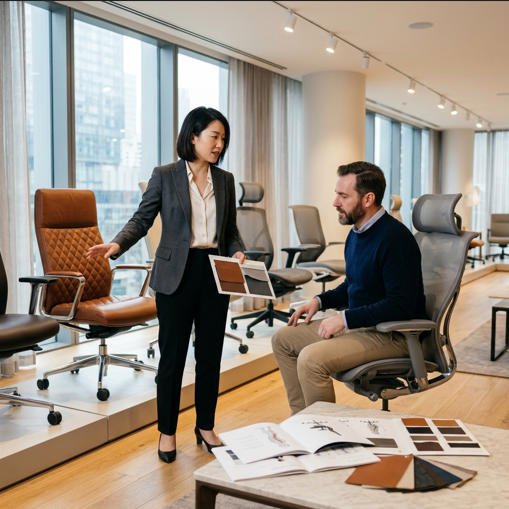
A considered home office environment — the chair’s footprint, aesthetic language, and ergonomic specification must all harmonize with the space and its daily demands.
Room Size, Desk Height, and Chair Footprint
Before evaluating any ergonomic specification, the physical context of the space defines what is possible. A standard five-star base office chair requires approximately 70 × 70 cm of floor clearance at rest and up to 90 × 90 cm when the user reclines. In compact home study rooms — a reality for many urban buyers — an oversized executive chair can create a space that feels crowded rather than composed. Measure the usable floor space between the desk and the nearest wall with the desk at working distance, and factor in the chair’s depth when reclined to its maximum position.
Desk height is equally critical and often overlooked at the chair selection stage. Standard desk heights range from 73 to 76 cm, but sit-stand desks — increasingly common in home office specifications — extend upward to 120 cm or more. For a fixed desk at 75 cm, the chair’s seat height range must comfortably position the user’s elbows at desk level without shrugging (shoulders rise) or drooping (elbows below desk surface). A pneumatic seat height range of 42 to 52 cm covers most adults working at a standard desk height; narrower ranges — still common in budget-tier chairs — create ergonomic compromises for users outside the middle of the height distribution.
Typical Daily Tasks and Seating Duration
The seating duration and primary task profile are the two most important variables in determining the appropriate specification tier. A home office user who spends four hours daily on video calls and light document work has materially different needs from someone spending eight or more hours in deep-focus keyboard work, financial modelling, or architectural drafting. The latter demands a chair with synchro-tilt mechanism, adjustable lumbar depth, 4D armrests, and foam density above 45 kg/m³ — all of which are overkill for the former, but non-negotiable for the latter.
For your clients who are interior designers or hotel project managers specifying home office furniture for residential developments, understanding end-user task profiles allows you to propose a tiered specification rather than a single model — matching the chair to the occupant’s actual daily schedule rather than the aspirational image of a home office.
Aesthetic Fit with Home Decor
In a dedicated commercial office, seating aesthetics are subordinate to fleet consistency and procurement efficiency. In a home environment, the chair is visible from living spaces, appears in video calls, and must integrate with the broader interior design language. This is where Chinese manufacturers have made remarkable strides — contemporary Chinese ergonomic chairs are available in architectural mesh in over 20 colorways, genuine leather in neutral and accent tones, and upholstered fabric panels in boucle, technical wool, and premium polyester blends that would not look out of place in a designer showroom.
For showroom buyers and interior designers, it is worth establishing aesthetic shortlists in parallel with ergonomic specifications — the best chair for a client is the one that performs correctly y belongs in the space. Jade Ant’s home office chair collection is curated specifically for clients who need both — high-performance ergonomics in designs appropriate for luxury residential and boutique hospitality environments.
Core Ergonomic Principles for Office Chairs
📖 Key Ergonomics Terms — Quick Reference
- Lumbar Lordosis
- The natural inward curve of the lower spine (L4–L5 vertebral region). A good chair maintains this curve to reduce disc pressure during prolonged sitting.
- Synchro-Tilt (Synchronous Tilt)
- A chair mechanism where the backrest reclines at twice the speed of the seat pan (2:1 ratio), maintaining an open hip angle of approx. 100–110° during recline — reducing lumbar disc compression compared to basic tilt.
- Seat Depth
- The front-to-back measurement of the seat pan. Correctly sized seat depth leaves a 2–3 finger gap between the back of the knee and the seat edge, preventing thigh compression that restricts circulation.
- Compression Set
- The permanent deformation of foam after repeated loading. Expressed as a percentage — a compression set below 15% indicates foam that retains its shape and support over the chair’s commercial lifespan.
- BIFMA X5.1
- The North American standard (Business and Institutional Furniture Manufacturers Association) for office chair structural safety and durability — including cyclic load testing, stability, armrest, and caster performance.
Posture Support and Lumbar Curve
The human spine has a natural S-curve, and maintaining it during seated work is the central goal of ergonomic chair design. When the lumbar curve (the inward curve of the lower back) collapses — as it does in a chair without adequate lumbar support — the intervertebral discs at L4–L5 absorb disproportionate compressive and shear forces. Research published in PubMed Central on musculoskeletal outcomes in sedentary workers confirms that chairs with adjustable lumbar support consistently outperform fixed-back chairs in reducing reported lower back discomfort across work periods exceeding four hours.
For your clients, the practical implication is this: a chair that “feels fine” in a ten-minute showroom test may cause significant discomfort during a full working day if the lumbar position is fixed at the wrong height for that user’s torso proportions. Adjustable lumbar support — both in vertical height (minimum 6 cm range) and depth (projection into the back, adjustable between 2–5 cm) — is the specification that transforms a comfortable chair into an ergonomic one.
Seat Depth, Height, and Backrest Angle
El two-finger rule is the simplest field test for seat depth: when seated with the back against the lumbar support, two fingers should fit comfortably between the back of the knee and the seat edge. Less clearance indicates thigh compression, which restricts popliteal circulation and leads to numbness and discomfort in extended sessions. More clearance means the user is not accessing the lumbar support — they are perching on the front edge of the seat, which negates the chair’s ergonomic value entirely.
The backrest angle interacts directly with spinal disc pressure. Research by Nachemson and Andersson, widely cited in occupational ergonomics literature, established that seated posture at 90° produces significantly higher lumbar disc pressure than a slightly reclined position of 100–110°. A chair that allows and encourages a dynamically reclined working posture — through a well-calibrated synchro-tilt with appropriate tilt tension — is not a “relaxed” chair. It is an ergonomically superior one.
▶ Industry review: Best ergonomic and office chairs for every height and budget — covering key features buyers should evaluate before committing to a specification. (Source: YouTube, 2024–2025)
Key Chinese Office Chair Brands and What to Look For

Brand reputation, third-party certifications, and genuine after-sales infrastructure separate category leaders from commodity suppliers in the Chinese office chair market.
Reputation, Certifications, and Warranty Standards
The Chinese office chair manufacturing landscape includes publicly listed groups with international showrooms, mid-tier factories serving export markets, and small-batch OEM producers whose quality is entirely dependent on the buyer’s specification discipline. Among manufacturers with established reputations in the B2B and hospitality segments, names such as Sunon Group, Loctek Ergonomic Technology, and ZUOWE have invested in international compliance documentation — BIFMA X5.1 for North American markets, EN 1335 for European markets, and China’s own GB/T 38733-2020 ergonomic chair standard.
For buyers evaluating warranty standards, the benchmark set by the international market — Herman Miller’s 12-year warranty, Steelcase’s comprehensive parts coverage — creates an expectation that credible Chinese manufacturers in the export segment are increasingly meeting. Five-year structural warranties on frames and mechanisms are now achievable from well-specified Chinese suppliers; 2–3 year coverage on upholstery and pneumatic components is standard at mid-grade and above. What matters most is the specificity of what is covered: does the warranty extend to foam compression set (permanent deformation of seat foam), or only to visible structural fractures? The answer reveals how confident a manufacturer is in their material specification.
Certifications require product-level verification, not just factory-level claims. A factory holding ISO 9001 quality management certification is a positive indicator of production discipline — but it does not certify any specific chair model. Buyers should request test reports that reference the exact model number being purchased, the testing laboratory name, and the test date. BIFMA’s public standards database and the ISO certification register both provide independent verification tools that experienced procurement teams use as a matter of routine.
Availability of Replacement Parts and Service Centers
A chair’s serviceability is its true long-term value proposition for dealers and end-users alike. The most common failure points in office chairs — gas cylinders, caster wheels, armrest pads, and tilt mechanism components — are all replaceable at a fraction of the cost of a new chair, provided the manufacturer maintains a spare-parts supply chain accessible to the markets where the product is sold. For dealers and distributors, this is a concrete sales differentiator: a chair with a 7-year documented spare-parts availability commitment is a fundamentally different product proposition to one where parts become unavailable after 18 months of production run.
When evaluating Chinese suppliers for your showroom or distribution portfolio, ask directly: what is the committed spare-parts availability period? What is the maximum lead time for replacement cylinder, mechanism, and caster orders? Are spare-part SKUs listed on the manufacturer’s commercial portal or available through a regional distributor? Brands that cannot answer these questions specifically — or that deflect to “contact us for each case” — are signaling a parts supply chain that was not designed with after-sales serviceability as a priority.
Online Reviews and Local Showroom Access
For B2B buyers sourcing for the first time from a Chinese manufacturer, the combination of independent online reviews (particularly from verified buyers on platforms like Alibaba Trade Assurance, Global Sources, or industry-specific procurement communities) and physical showroom access is the strongest pre-purchase validation available. Chinese furniture manufacturing hubs — Guangdong, Zhejiang, Shandong — host domestic showrooms and exhibition facilities where production samples can be evaluated against specification claims. Major international trade events such as the Feria Internacional del Mueble de China (CIFF) in Guangzhou and FIBO in Shanghai provide structured access to the Chinese commercial furniture market for international buyers.
Seat Design and Comfort Considerations
Cushion Density, Materials, and Breathability
Foam specification is where the most significant quality divergence occurs between price tiers — and where the divergence is least visible to buyers evaluating chairs in a showroom. Two chairs with identical visual presentation can differ by a factor of three in foam density, with entirely different consequences for comfort after six months of daily use. The technical metric that matters is foam density, expressed in kilograms per cubic meter (kg/m³): the mass of foam contained in a standardized volume. Higher density indicates more material, greater structural resilience, and more reliable shape retention under repeated compression.
Recommended Foam Density by Seating Category
Industry ergonomics standard — minimum specification for full-day seated use (kg/m³)
⚠ Industry threshold: 45 kg/m³ is the minimum recommended for chairs used ≥6 hours/day. Below this level, compression set typically appears within 18–24 months.
Breathability is a separate but equally important comfort variable, particularly relevant for home office use in tropical and subtropical climates — a significant portion of the Southeast Asian and Chinese domestic markets. Non-breathable upholstery materials (PVC leather, low-porosity synthetic fabrics) trap heat and moisture between the seat surface and the occupant, creating a skin temperature differential that measurably increases perceived discomfort after 30–45 minutes of continuous sitting. Mesh backrests eliminate this entirely; high-quality engineered fabric seats provide reasonable airflow; genuine leather and technical fabrics occupy a middle position.
Edge Design and Pressure Distribution
The front edge of the seat pan — the waterfall edge — is a design feature that significantly affects circulation in the lower legs during extended sitting. A hard, square-cut seat edge creates a pressure ridge across the back of the thighs that restricts popliteal blood flow; a contoured, downward-sloping waterfall edge distributes this pressure across a broader contact area and reduces compression on the femoral artery. In premium ergonomic chairs, waterfall seat edges are now a standard feature; their absence in budget-tier chairs is one of the most consequential comfort compromises in extended-use seating.
Adjustability Features That Matter

Full adjustability is not a luxury addition — it is the mechanism through which a chair becomes ergonomically effective for the specific body proportions and work style of its user.
Height, Tilt, Back Tension, and Headrest Options
| Adjustment Feature | Minimum Spec (Home Office) | Premium Spec | Impact on Ergonomics | Priority Level |
|---|---|---|---|---|
| Seat Height | 42–52 cm range | 40–55 cm range | Critical — sets foot-to-floor contact and elbow-to-desk alignment | 🔴 Essential |
| Lumbar Height | Fixed at mid-back | 6 cm+ vertical range, depth-adjustable | High — matches lumbar curve to individual torso proportions | 🔴 Essential |
| Backrest Tilt | Basic tilt, 1 lock position | Synchro-tilt, multi-lock, free-float | High — reduces disc pressure during reclined postures | 🟠 High |
| Tilt Tension | Basic spring adjustment | Wide range covering 50–120 kg users | Medium — enables proper recline resistance for different body weights | 🟠 High |
| Seat Depth | Fixed (standard 46 cm) | 38–52 cm sliding adjustment | High — prevents thigh compression for diverse body proportions | 🟠 High |
| Headrest | Optional / fixed | Height + angle adjustable | Medium — valuable for users with neck strain or video call posture | 🟡 Recommended |
| Seat Pan Tilt | Not available on most | Forward tilt option available | Low-Medium — beneficial for active sitting, reduces posterior pelvic tilt | 🟡 Optional |
Armrest Adjustability and Width
Armrest specification is among the most frequently underinvested features in home office chairs, despite having a direct, measurable impact on upper trapezius muscle tension and shoulder discomfort. The armrest type determines the adjustment range available:
1D armrests (height only) are the minimum for any chair used in sustained seated work — they allow the user to position the elbow at desk height to reduce shoulder elevation (shrugging). 2D armrests (height + width) add lateral adjustment, allowing the armrests to move inward to the natural shoulder-width position — eliminating the compensatory lateral shoulder tension that fixed-width armrests create. 4D armrests (height + width + depth + pivot rotation) are the ergonomic optimum for keyboard-intensive roles; they allow the forearm to be supported at the precise angle of keyboard and mouse use, reducing the deviation loading on the wrist and elbow joints that contributes to repetitive strain injury (RSI) in prolonged desk workers.
For dealers and designers sourcing chairs for clients who are knowledge workers spending six or more hours daily at a keyboard, the incremental cost of upgrading from 1D to 4D armrests — typically USD 30–60 at factory level for a quality mechanism — is one of the highest-return ergonomic investments available in office seating specification.
Materials, Durability, and Build Quality
Frame Materials: Steel vs. Aluminum, Welds, and Coating
| Frame Material | Typical Weight Capacity | Durability | Corrosion Resistance | Mejor aplicación |
|---|---|---|---|---|
| Cold-Rolled Steel (1.5mm+ wall) | 150–250 kg | ⭐⭐⭐⭐⭐ Excellent | Medium (requires powder coating) | Commercial / heavy-duty seating |
| Die-Cast Aluminum | 120–180 kg | ⭐⭐⭐⭐ Very Good | High (natural oxide layer) | Executive / premium aesthetic |
| Glass-Filled Nylon | 100–150 kg | ⭐⭐⭐ Good | Excelente | Standard weight users, budget-tier |
| Standard Polypropylene | 80–120 kg | ⭐⭐ Fair | Excelente | Not recommended for primary B2B seating |
Weld quality is not visible from the outside of an assembled chair, but it is the structural variable that most often determines whether a chair survives its second year under commercial use. The indicators accessible during showroom inspection are the smoothness of tubular joints (rough transitions indicate inconsistent weld bead quality), the absence of surface pitting or discoloration around weld zones (signs of overheating or incomplete penetration), and the absence of lateral flex when the backframe is stressed sideways under body weight. A chair that flexes perceptibly at the backframe during a lateral load test is showing the early signs of a weld that will fail under repeated dynamic loading.
Upholstery Choices: PU Leather, Fabric, Mesh — and Care
Upholstery Material Distribution — Premium Home Office Chair Market (2024–2025)
Approximate segment share by procurement volume in the mid-to-premium commercial seating category
Source: Industry B2B procurement data synthesis, 2024–2025. Approximate distribution for mid-to-premium commercial seating category.
The upholstery decision in any serious home office chair specification is a lifecycle cost calculation, not a preference question. A one-chair comparison: an executive chair upholstered in quality PU leatherette at USD 320 will likely require full replacement at the 4-year mark as the surface begins to delaminate — a common failure mode for PU coatings under daily use. The equivalent chair in top-grain genuine leather at USD 480 will outlast two replacement cycles of the PU version with basic conditioning maintenance. Over a 10-year period, the “cheaper” PU chair costs more — before accounting for the disruption cost of mid-cycle replacement.
For dealers offering clients a clear recommendation: mesh for open-plan and task seating where breathability and durability across multiple users matter most; genuine leather for executive and boardroom applications where the chair is a statement piece with a long service horizon; PU leatherette for reception and visitor seating where aesthetics matter but extended daily use is not the primary scenario.
Sizing and Fit for Different Users

Sizing is not just about weight capacity — seat depth, backrest height, and armrest width must accommodate the actual body proportions of the user, not the statistical average.
Weight Ratings and Seat Width Options
Weight capacity ratings in office chairs are one of the most misread specifications in the category. A chair rated to 120 kg carries that load safely in static conditions — but BIFMA X5.1 structural testing subjects chairs to 113 kg loads through 100,000 repetitive cycles, simulating the cumulative dynamic loading of five-plus years of daily use. A chair that meets this standard with documented test evidence provides a meaningful safety and durability guarantee; a chair with a stated capacity but no test documentation provides only a marketing claim.
Seat width is a specification frequently overlooked in standard commercial procurement. The Chinese market standard seat width of approximately 47 cm works well for most average-to-medium body frames but creates a physically constraining experience for broader users and may be unnecessarily wide for smaller individuals — affecting both the armrest gap position and the perception of lateral support. For showroom buyers curating a chair range rather than a single model, offering seat width options — standard (46–48 cm), wide (52–54 cm), and compact (42–44 cm) — allows a product range that genuinely serves diverse client body profiles.
Recline Limits and Seat Depth for Torso Length
Torso length — the measurement from seated hip to the top of the shoulder — varies considerably across body types and determines the optimal backrest height and lumbar support position. A user with a long torso (common in individuals above 180 cm) will find that most standard office chair backrests do not reach the thoracic spine (mid-back) adequately, leaving the upper back unsupported. This creates a characteristic posture of rounding the upper back forward — the opposite of the ergonomic goal. High-back chairs with backrest heights of 65 cm and above address this; headrest attachment positions the support at the cervical spine for an additional reference point.
Seat depth adjustment is the most important fit parameter for users with shorter-than-average leg proportions — a common anthropometric profile in East and Southeast Asian user populations that represent a significant share of the home office market in Greater China, Vietnam, Indonesia, and the Philippines. Without seat depth adjustment (sliding seat pan), shorter-legged users must either accept thigh compression (sitting fully back) or lose lumbar support (perching forward). A seat depth sliding range of 38–50 cm, allowing 6–10 cm of forward adjustment, accommodates this full range effectively.
Assembly, Maintenance, and User-Friendliness
Assembly Time and Included Tools
For dealers and distributors, the assembly experience is a tangible part of the product’s value — particularly for direct-to-consumer channels and interior design clients who expect a white-glove delivery and setup experience. A well-engineered chair should assemble in under 20 minutes with included tools (typically an Allen key and instruction booklet); common assembly failure points are imprecise pre-drilled hole alignment in base components, missing hardware items (a consistent complaint in budget-tier products), and instruction diagrams that do not clearly communicate the orientation of mechanism components.
For high-volume showroom or hospitality installations, some Chinese manufacturers offer pre-assembly services as a factory-level option — delivering chairs fully assembled in individual cartons rather than flat-packed. This adds freight cost (assembled chairs have larger cubic volume) but eliminates assembly labor cost and quality variability at the installation site.
Cleaning, Stain Resistance, and Part Replacement
The maintenance protocol for an office chair in a home setting is fundamentally different from a commercial floor environment — home users tend to have lower soil exposure but also lower awareness of appropriate cleaning methods, leading to damage from incorrect products. For mesh chairs, the recommended cleaning protocol is a mild detergent solution applied with a soft cloth and allowed to air dry — avoiding saturating the mesh with water, which can compromise the structural polymer if the weave is not designed for wet conditions. PU leatherette requires gentle pH-neutral cleaners and avoidance of alcohol-based products, which break down the polyurethane coating from the first application. Genuine leather requires periodic conditioning (natural oils or leather-specific conditioners) to prevent the hide from drying out and cracking at stress points such as seat fold edges.
Part replaceability is the maintenance feature most directly relevant to long-term value. Gas cylinders — the pneumatic height adjustment mechanism — are a universal standard component replaceable with off-the-shelf alternatives available from multiple suppliers at USD 15–30 in most markets. Casters follow a similarly universal pattern, with standard 50mm stem size fitting most office chair bases. Armrest pads — the foam or polyurethane top cap that makes contact with the forearm — are a high-wear item on heavily used chairs and should be available as a manufacturer spare part within reasonable lead times.
Budget, Value, and Total Cost of Ownership
Price Brackets and What They Typically Include
10-Year Total Cost of Ownership — Office Chair Specification Tiers
Per-unit cost (USD) including: FOB price + freight (30%) + assembly + replacement cycles + warranty claims. Fleet of 100 units.
✓ Mid-grade chairs typically deliver the lowest 10-year TCO — the budget tier’s cost advantage is erased by 2.5× replacement cycles over the same period.
| Categoría de costes | Budget (~$120 FOB) | Mid-Grade (~$280 FOB) | Premium (~$520 FOB) |
|---|---|---|---|
| Initial Unit Cost | $120 | $280 | $520 |
| Freight + Duties (est. 30%) | $36 | $84 | $156 |
| Assembly / Installation | $25 | $25 | $25 |
| Esperanza de vida | 3–4 years | 6–8 years | 10–12 years |
| 10-Yr Replacement Cycles | 2.5× replacements = $455 | 1.5× replacements = $219 | 0 replacements needed |
| Warranty / Repair Costs | ~$80 | ~$35 | ~$15 |
| Total 10-Year TCO / Unit | $985 | $619 ✓ | $716 |
Longevity and Replacement Parts Costs Over Time
The financial reality of budget-tier office chairs is consistently underestimated at the purchase decision stage. A USD 120 chair that requires full replacement every 3.5 years costs effectively USD 34 per year in chair depreciation alone — before accounting for the labor cost of replacement procurement, delivery coordination, and installation. A USD 280 chair lasting seven years costs USD 40 per year but eliminates one full replacement cycle, removes the associated procurement friction, and typically delivers significantly better ergonomic performance throughout its service life. For dealers positioning themselves as advisors rather than transaction facilitators, this TCO conversation is a concrete value-add that differentiates consultative selling from catalog-based selling.
Gas cylinder replacement — the most common mid-life maintenance requirement for quality chairs — costs USD 15–30 in parts and 15 minutes of labor. This single repair can extend a quality chair’s service life by 3–5 years, a cost-effectiveness ratio that is impossible to achieve with a budget-tier chair whose foam, mechanism, and upholstery are all reaching end-of-life simultaneously with the cylinder.
Warranty, Service, and After-Sales Support in China

Warranty and after-sales documentation should be evaluated with the same rigor as the physical product — a chair without a credible service commitment is an incomplete specification.
Manufacturer Warranty Terms and Registration Process
Chinese office chair manufacturers serving the export market offer warranty terms that range from 12 months on all components to 5-year structural coverage with separate upholstery terms. The standard that most experienced B2B buyers contractualize is a minimum of 3 years on frame and mechanism y 1 year on upholstery and foam — with explicit written definitions of what each category covers. Ambiguous warranty language — “covered against defects in materials and workmanship” — is commercially meaningless without a definition of what constitutes a defect: does foam that has lost 30% of its original density qualify? Does a mechanism that develops play qualify? The answers to these questions separate a credible warranty from a document that provides protection only against catastrophic structural failure.
Warranty registration processes at Chinese manufacturers vary considerably. Some export-focused brands now operate online registration portals with English-language interfaces and tracking numbers; others rely on paper documentation that must be retained by the buyer. For dealers and distributors managing warranty claims on behalf of end clients, establishing the registration protocol before bulk purchase — not after — is essential to avoiding a scenario where warranty claims cannot be processed because documentation requirements were not fulfilled at the point of delivery.
Accessibility of Service Centers and Spare Parts
For international buyers, the practical question of after-sales support is not whether a manufacturer’s service center exists in China — it is whether warranty claims and spare parts can be resolved without shipping chairs back to China for inspection. The best-organized Chinese export furniture brands have developed regional spare-parts distribution arrangements, authorizing local distributors to hold a minimum parts inventory (cylinders, casters, armrest pads, tilt mechanism components) and process warranty claims with pre-approved replacement authority up to a defined per-unit value. This model is still less common than it should be, but it is the explicit standard to negotiate when placing significant volume orders with any Chinese manufacturer.
Return Policies and Regional Support Options
Return policies for B2B volume orders from China differ fundamentally from consumer e-commerce returns. For orders placed on FOB or CIF terms, the standard commercial position is that returns are not available once goods are shipped and cleared customs — any quality issues must be resolved through warranty replacement of affected units rather than return of the full order. This is why pre-shipment inspection is non-negotiable for orders above 50 units: engaging a third-party inspection service (SGS, Bureau Veritas, o Intertek are the leading providers) to conduct a pre-shipment quality check against the agreed specification protects buyers from quality deviations before goods leave the factory, at a cost of USD 300–500 per inspection day — a fraction of the potential cost of a shipment that does not meet the specification.
En Muebles Jade Ant, the standard for our B2B clients includes production photo updates at key milestones, pre-shipment quality review, and structured logistics coordination from factory to destination port — so that warranty and quality issues are identified and resolved before delivery, not after. For interior designers and hospitality project managers working to a fit-out schedule, this production visibility is as important as the chair specification itself.
Balancing Ergonomics, Adjustability, Space, and Budget
Choosing the right Chinese office chair for a home office — whether you are specifying for a single client, curating a showroom range, or procuring for a 200-unit hospitality project — is a structured evaluation process, not an instinct judgment. The criteria that matter are consistent across price tiers: foam density and compression set values, upholstery abrasion rating and lifespan projection, frame material and weld quality, mechanism type and adjustment range, certification documentation at the product level rather than the factory level, and warranty terms with enough specificity to be commercially enforceable.
Chinese manufacturers in the mid-to-premium segment are delivering chairs that compete directly with European ergonomic benchmarks at significantly lower landed costs — but accessing this quality requires the evaluation discipline to distinguish documented performance from visual impression. The buyers who consistently source well from China are not the ones with the best price negotiation skills; they are the ones who ask the right technical questions, validate the answers against documentation, and build supplier relationships with enough transparency to support pre-production specification alignment.
✅ Quick Decision Checklist — Choosing a Chinese Office Chair
| Criterion | Minimum Standard | Verified? |
|---|---|---|
| Foam density | ≥ 45 kg/m³ for full-day use | ☐ |
| Seat height range | 42–52 cm pneumatic adjustment | ☐ |
| Lumbar support | Height + depth adjustable | ☐ |
| Mechanism type | Synchro-tilt for task chairs | ☐ |
| Armrests | Minimum 2D (height + width) | ☐ |
| Certificación | BIFMA X5.1 or EN 1335 — product-level test report | ☐ |
| Caster type | PU soft-roll for hard floors | ☐ |
| Warranty | ≥3 yr frame/mechanism, explicit coverage terms | ☐ |
| Spare parts | 7-year availability commitment | ☐ |
| Inspección previa al envío | Third-party for orders ≥50 units | ☐ |
Ready to Source Premium Office Chairs from China?
Jade Ant Furniture works with furniture dealers, interior designers, hotel procurement teams, and showroom buyers to specify and source high-quality home office chairs — with transparent production documentation, pre-shipment quality review, and logistics support from factory to your destination.
Solicita una consulta sobre abastecimiento →📖 Full Ergonomics & Materials Glossary
- BIFMA X5.1
- Business and Institutional Furniture Manufacturers Association standard for general-purpose office chair structural testing — including 100,000+ cycle load tests, stability, and component durability. The North American market benchmark.
- EN 1335
- European standard for office seating in three parts: Part 1 (dimensions), Part 2 (safety and durability requirements), Part 3 (test methods). Mandatory for CE-marked seating in EU markets.
- GB/T 38733-2020
- China’s national ergonomic office chair standard covering adjustability ranges, lumbar support dimensions, mechanism durability, and stability testing. The most recent and ergonomics-specific Chinese chair standard.
- Foam Density (kg/m³)
- The mass of foam per cubic meter of volume. Higher density = more material = better shape retention. Minimum 45 kg/m³ recommended for chairs used ≥6 hours/day.
- Compression Set
- The permanent deformation of foam after repeated compressive loading (expressed as % change from original thickness). Below 15% is excellent; above 25% predicts premature sagging within 18–24 months.
- Synchro-Tilt
- Mechanism where the backrest reclines at twice the speed of the seat pan (2:1 ratio), maintaining an open hip angle of approx. 100–110° during recline. The ergonomic standard for full-day task seating.
- Lumbar Lordosis
- The natural inward curve of the lower spine. Adjustable lumbar support maintains this curve, reducing disc pressure during prolonged sitting.
- Martindale Cycles
- The standard unit for measuring upholstery abrasion resistance — the number of rub cycles a fabric withstands before showing measurable wear. 60,000+ cycles is the minimum for commercial environments; 100,000+ for heavy-use applications.
- Waterfall Seat Edge
- A downward-sloping seat pan front edge that distributes thigh pressure across a broader contact area, reducing compression of the popliteal artery and improving lower-leg circulation during extended sitting.
- 4D Armrests
- Armrests adjustable in four dimensions: height, width (lateral), depth (forward/back), and pivot rotation. The ergonomic optimum for keyboard-intensive roles, reducing RSI risk by supporting the forearm at the precise angle of keyboard and mouse use.
- Total Cost of Ownership (TCO)
- The complete financial exposure of a purchase across its deployed lifespan — including unit cost, freight, installation, replacement cycles, and warranty claims. The correct comparison metric for B2B furniture procurement.
- PU Leatherette
- A synthetic upholstery material with a fabric or non-woven backing coated in polyurethane. Offers a leather-like appearance at lower cost but typically has a 3–5 year lifespan under daily commercial use before delamination occurs.