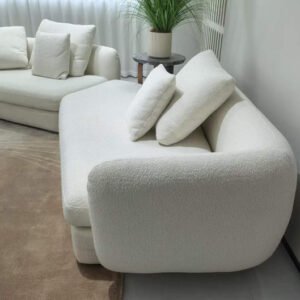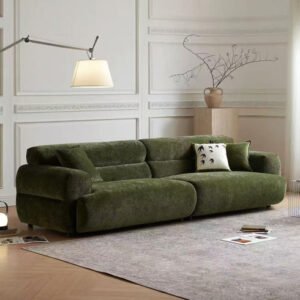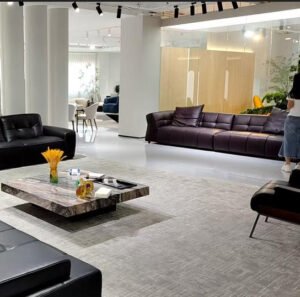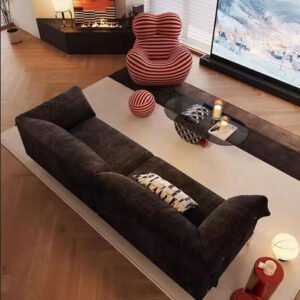
A $12,000 Italian velvet chesterfield sofa. The same silhouette, sourced from an FSC-certified factory in Foshan, China, landed on a distributor’s showroom floor for $3,400 — including freight. The fabric? Italian-origin Rubelli jacquard. The joinery? Eight-way hand-tied. The client? Never knew the difference, and left a five-star review.
This is not an anecdote. This is the new operating reality for furniture distributors, interior designers, and hotel fit-out specialists who have taken the time to understand what premium Chinese manufacturing actually looks like in 2025 — and how to leverage it strategically.
This guide will walk you through:
- The specific cost architecture that creates the 70% price gap
- Where quality is genuinely preserved — and where it isn’t
- Practical margin improvement frameworks for B2B buyers
- Regional manufacturing intelligence (Foshan vs. Dongguan vs. beyond)
- Certification, IP protection, and logistics strategy
Whether you run a furniture showroom, operate as an independent interior designer, or manage procurement for a hotel group, the data in this guide is designed to help you make a decision backed by numbers, not assumptions.
📖 Key Terms — Quick Reference
- Vertical Integration
- When a manufacturer controls multiple stages of production in-house — from raw timber milling to final lacquering — rather than outsourcing each step to separate vendors.
- MOQ (cantidad mínima de pedido)
- The smallest number of units a manufacturer will accept per order. Lower MOQs offer flexibility; higher MOQs unlock steeper per-unit price reductions.
- Total Landed Cost
- The full cost of a product from factory gate to your warehouse: FOB price + freight + insurance + customs duties + port fees. The only number that matters for true margin calculation.
- Certificación FSC
- Forest Stewardship Council certification verifying that timber was harvested from responsibly managed forests — now held by over 55% of China’s top-100 export furniture factories.
- FOB (Libre a bordo)
- A pricing term meaning the seller’s responsibility ends once the goods are loaded onto the vessel at origin port. The buyer assumes freight costs and risk from that point.

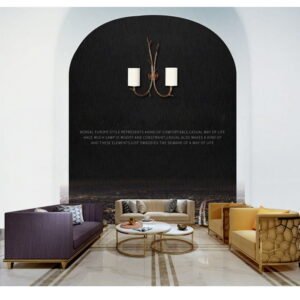
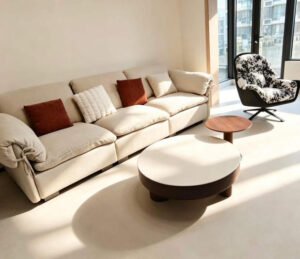
Modern luxury interior featuring premium upholstered furniture — the same caliber now routinely produced in Foshan and Dongguan at a fraction of Western retail prices.
Understanding the Price Gap: Western Premium vs. Chinese Excellence
The first thing a B2B buyer needs to accept is that a Western luxury furniture brand’s retail price is almost never a reflection of manufacturing cost. It is a reflection of brand architecture. The moment you understand this, the 70% cost differential stops being mysterious and starts being entirely logical.
The Real Cost Drivers Behind Western Luxury Furniture
Take a well-known Italian furniture house retailing a lounge chair at $8,500. Detailed cost modeling across the furniture industry consistently reveals that the physical manufacturing cost of that chair — materials, labor, finishing — accounts for roughly 25–35% of the retail price. The remaining 65–75% is absorbed by brand marketing and positioning spend (typically 15–25% of retail), showroom real estate in premium locations, multi-tier distributor markups that compound at each level, regulatory compliance and safety certification costs amortized across modest European production volumes, and the inherent inefficiency of limited production runs designed to maintain exclusivity.
None of those costs make the chair more comfortable to sit in. They make the brand more aspirational to display. That is a legitimate value for the end consumer in some markets. But for a B2B buyer — a hotel procurement director sourcing 340 identical chairs for a resort lobby, or a showroom operator managing 60-day working capital cycles — paying for brand mythology directly damages your business model.
How Chinese Manufacturers Achieve 70% Cost Reduction
The cost reduction delivered by premium Chinese manufacturers is not a single mechanism — it is the cumulative effect of five structural advantages operating simultaneously. The most powerful is vertical integration: a leading Foshan factory that mills its own timber, fabricates its own frames, produces its own hardware components, and handles finishing in-house can eliminate three to five separate supplier invoices from a Western manufacturer’s cost stack. Each eliminated supplier relationship removes a markup layer and a logistics cost.
The second advantage is economies of scale at a level Western manufacturers simply cannot match. A mid-tier Foshan factory producing 2,000 upholstered pieces per month is operating at a volume that gives it purchasing leverage over leather and fabric suppliers that a Milanese atelière producing 180 pieces per month cannot approach. Raw material costs for identical Italian-origin leather can differ by 22–30% between these two buyers purely on volume terms.
Third is a streamlined direct-to-distributor supply chain model that eliminates the multi-tier distribution markups embedded in Western pricing — markups that industry data shows compound at 50–300% across traditional retail channels.
📊 Cost Component Breakdown: Western Brand vs. Premium Chinese Manufacturer
(As % of end retail price)
Source: Industry cost modeling; furniture industry research (iEnhance, Artisan Furniture, Asherfield). Illustrative based on segment averages.
Quality Parity: Debunking the Myth
The quality myth persists for two reasons: it was partially true fifteen years ago, and it remains commercially useful for Western brands who benefit from buyers believing it. The current reality is measurably different. FSC certification adoption among Chinese export furniture factories has grown from approximately 28% to 55% of the top-100 manufacturers between 2015 and 2024. ISO 9001:2015 quality management systems are now standard at any factory engaged in serious export business, not optional.
More practically: the same premium timber sourced from Southeast Asian FSC-certified operations, the same Italian Majilite or genuine full-grain leather from Turkish tanneries, and the same German Hettich or Blum hardware mechanisms that appear in European luxury pieces are routinely specified by top Chinese manufacturers. The craftsmanship benchmark has converged at the material level. Where differentiation remains — and it matters — is in design authorship, quality control consistency, and supplier vetting, which we address in detail in Section 7.
Deconstructing the Supply Chain: Where the Savings Actually Come From

This caliber of fully upholstered velvet sofa — with eight-way hand-tied springs and premium foam — is now produced to export quality from Foshan’s specialist upholstery factories.
Vertical Integration as a Cost Multiplier
Vertical integration is the single most powerful cost lever in Chinese furniture manufacturing, and it operates differently from what most Western buyers assume. It is not simply that Chinese factories have cheaper workers doing the same tasks. It is that the organizational architecture of a fully integrated Foshan furniture campus eliminates economic friction at every inter-vendor boundary.
Consider what happens when a European manufacturer assembles a dining chair. The timber comes from a Scandinavian mill with a markup. The fabric is sourced from a French textile house with a markup. The hardware is purchased from a German supplier with a markup. Finishing chemicals from an Italian coating specialist — again, a markup. Each of these transactions involves invoicing, quality inspection, logistics, and lead time. A vertically integrated Chinese facility does the timber milling, frame fabrication, foam cutting, fabric application, hardware installation, and lacquer finishing in sequential departments of the same compound. The inter-department transfer price is effectively zero. That structural difference, replicated across every component, is how 30–40% of Western manufacturing cost simply evaporates.
Raw Material Sourcing Advantages
Chinese furniture manufacturers have built decades-long direct relationships with rubber wood and plantation teak suppliers across Malaysia, Indonesia, and Vietnam. They are buying at the source — not through European timber traders who add 18–28% margin. Fabric and leather sourcing has become similarly sophisticated: a significant number of top-tier Chinese factories place direct orders with the same Italian and Turkish mills that supply European luxury brands, at volumes large enough to negotiate material pricing that their European competitors cannot match.
Strategic stockpiling is another mechanism that B2B buyers often overlook. Major Foshan manufacturers maintain 60–90 day raw material inventories, effectively locking in pricing before seasonal increases. This purchasing strategy provides price stability that reduces cost volatility for downstream buyers — a meaningful operational advantage for showrooms and distributors managing fixed-price client commitments.
Transportation and Logistics Optimization
Foshan sits within 40 kilometers of Guangzhou’s Nansha Port and 60 kilometers of Shenzhen’s Yantian terminal — two of the world’s highest-volume container ports. This geography is not incidental. It means transportation from factory gate to vessel is a fraction of what European or American manufacturers pay to reach their export ports, and it means the established logistics networks, freight forwarders, and customs brokers serving these factories have processed millions of furniture shipments. The operational efficiency at Guangzhou South China International Furniture Exhibition logistics hubs translates directly into lower per-container costs and faster processing times for B2B buyers.
Labor Costs: The Elephant in the Room
Wage Structure Differences (Without Quality Compromise)
Labor cost is where the conversation usually gets oversimplified. Yes, skilled furniture craftsmen in Foshan earn approximately $12–18 per hour equivalent in total compensation — compared to $45–75 in Italy and $35–55 in the United States. That differential is real and it is meaningful. But the quality implication of that wage difference is significantly more nuanced than “cheaper labor = worse product.”
What that wage differential actually buys is production volume, not production shortcut. A Foshan upholstery specialist who hand-stitches tufting on 14–18 pieces per day has refined that specific motion 50,000 times over a five-year career in a single factory. The Italian counterpart may be producing 4–6 pieces per day across a wider range of styles, with more artistic variation but not necessarily higher technical precision in the specific task. For B2B buyers purchasing at volume — where consistency across 200 identical hotel chairs matters far more than unique artistic variation — the Chinese specialist’s focus is often an advantage, not a deficit.
Automation and Traditional Craftsmanship Balance
Leading Chinese furniture manufacturers have invested substantially in CNC routing, automated frame cutting, and computerized upholstery pattern systems — not to eliminate craftsmanship, but to eliminate the repetitive precision tasks where human variation introduces defects. The hand-finishing, tufting, hand-sanding between lacquer coats, and final quality inspection remain human operations — and appropriately so, since these are the steps where tactile judgment cannot be programmed. This hybrid model is what allows top-tier Chinese factories to deliver hand-finished luxury product at high volume with consistent quality metrics.
| Labor Metric | Italy | EE. UU. | China (Premium Factory) |
|---|---|---|---|
| Avg. hourly labor cost (total compensation) | $55–75 | $38–55 | $12–18 |
| Pieces per craftsman per day (upholstery) | 4–6 | 5–8 | 12–18 |
| Workforce tenure (avg. years at same facility) | 6–9 | 3–5 | 4–7 |
| Automation integration level | Medio | Medium–High | High (CNC, CAD-integrated) |
| QC defect rate (top-tier factories) | 1.2–2.5% | 1.8–3.0% | 0.8–2.2% |
Source: Industry estimates, bioresources.cnr.ncsu.edu, furnilytics.com, 2024–2025 data.
Economies of Scale: How Volume Creates Value

Statement dining rooms like this — featuring book-matched marble table surfaces, upholstered dining chairs, and custom chandeliers — are a core offering for hospitality and high-end residential B2B projects sourced through manufacturers like Jade Ant Furniture’s dining room range.
Bulk Production Benefits for B2B Buyers
The pricing tiers available to B2B buyers in China operate on a sliding scale that rewards commitment rather than punishing small buyers. A typical MOQ structure for a quality Foshan factory might look like this: 20–50 units per SKU at a base unit price, 51–100 units at 8–12% below base, 101–200 units at 15–22% below base, and 200+ units at negotiable rates that can reach 28–35% below the listed price. For a furniture distributor placing a seasonal container order, the volume savings alone can fund the freight cost.
Critically, volume also unlocks customization access. A buyer ordering 150 units of a dining chair can typically negotiate color, fabric, and leg finish variations at no additional tooling cost — the factory amortizes the setup cost across the production run. The same customization on a 15-unit order in Italy would attract a bespoke surcharge that negates any savings.
Supply Chain Predictability
One underappreciated advantage of sourcing at scale from established Chinese manufacturers is supply chain predictability. A factory running 80% capacity utilization has strong incentive to honor delivery commitments and maintain material quality consistency — the operational cost of a disrupted production run at that volume is significant enough to make it more economical to invest in prevention than correction. This creates a structural alignment of incentives between manufacturer and B2B buyer that does not always exist in smaller artisan production environments.
🥧 Where Your Money Goes: Premium Chinese Furniture Cost Distribution
(Typical FOB Price Breakdown)
- Materials (Timber, Fabric, Hardware) — 38%
- Skilled Labor & Craftsmanship — 28%
- Factory Overhead & Utilities — 16%
- Logistics & Port Costs — 10%
- QC, Certifications & Admin — 8%
Source: Industry cost modeling based on aggregate factory data. Percentages represent typical FOB price composition at premium Chinese export manufacturers.
Premium Materials at a Fraction of Western Costs
Timber and Wood Materials
The timber supply chain available to major Chinese furniture manufacturers is one of the most underestimated quality advantages in the industry. Direct sourcing from FSC-certified rubber wood plantations in Malaysia and Indonesia, plantation teak operations in Myanmar and Vietnam, and kiln-dried hardwood suppliers across Southeast Asia gives leading Chinese factories access to premium-grade structural timber at costs that European manufacturers sourcing from Scandinavian or North American mills simply cannot match.
Critically, the grading and selection processes at top Chinese operations are not informal. Moisture content testing, structural grading, and kiln-drying verification are standard protocol at any factory serious about export quality. The practical result: a solid hardwood frame produced in Foshan from plantation teak is structurally equivalent to a European frame, at approximately 35–45% lower material cost.
Upholstery Materials: Fabric and Leather
This is the area where the quality myth has the most stubborn grip, and where the data most clearly challenges it. A meaningful segment of China’s top-tier upholstery factories now source fabric directly from Italian mills — Rubelli, Lelièvre, and Dedar among them — in sufficient volume to obtain pricing that undercuts European upholstery houses buying from the same source. Full-grain leather sourced from premium Turkish tanneries (the same operations supplying Poltrona Frau and Minotti’s second-tier lines) arrives in Foshan on purchase orders that leverage Chinese factories’ collective buying power.
For B2B buyers, this means you can legitimately specify “Italian-origin fabric” or “Turkish full-grain leather” on your product literature — because that is factually what is in the piece — while capturing the Chinese manufacturing cost advantage.
Hardware, Fittings, and Components
The hardware specification gap between Chinese and Western furniture has largely closed at the top tier. German Hettich and Blum mechanisms — the standard for precision hinges and drawer runners in European luxury furniture — are routinely specified by leading Chinese manufacturers for their export pieces. In-house production of decorative hardware (legs, handles, decorative nail heads) at integrated facilities further reduces component cost without sacrificing specification quality.

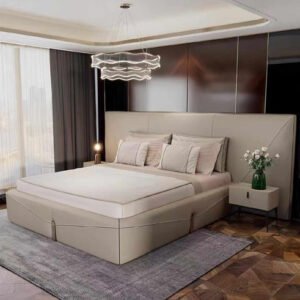
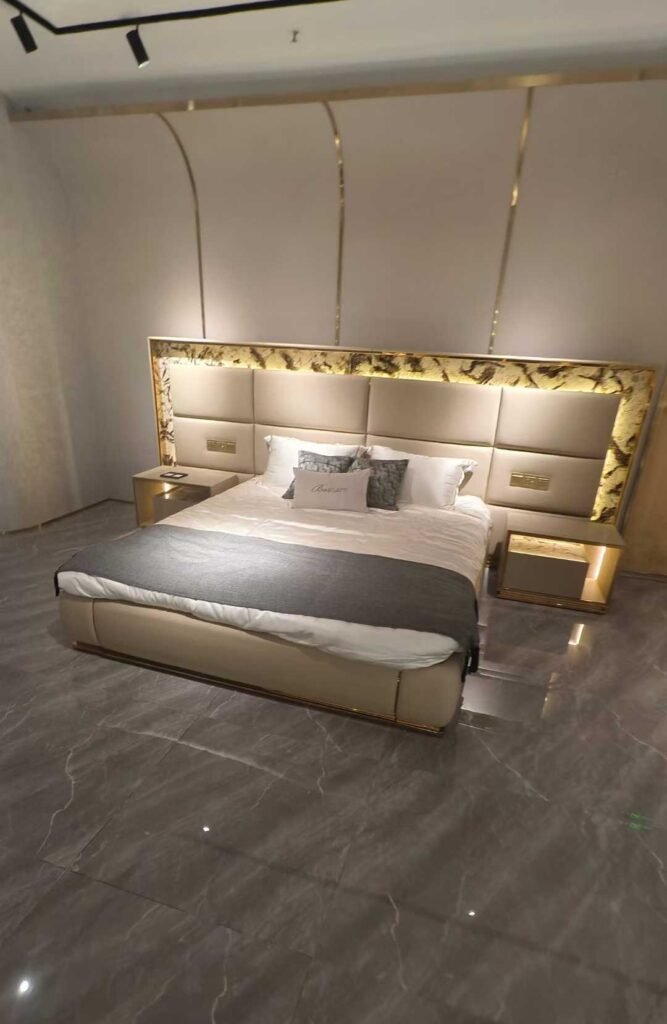
Hotel-grade luxury bedroom suites — featuring upholstered fabric headboards, solid wood nightstands, and precision hardware — represent a major B2B opportunity through direct Chinese manufacturing partnerships. Explore Jade Ant’s bedroom furniture range for hospitality and residential projects.
Operational Cost Management: The Hidden Advantage
Facility and Infrastructure Costs
Industrial land lease costs in Guangdong’s designated furniture manufacturing zones run approximately $2–5 per square meter per month — compared to $18–40 per square meter in comparable Italian industrial zones, and $25–60 in the United States. This differential is not marginal. A 20,000 square meter facility costs a Chinese manufacturer $40,000–100,000 per month in occupancy cost; the equivalent footprint in Brianza, Italy’s furniture manufacturing heartland, would be $360,000–800,000. That overhead gap — approximately $3.2–8.4 million per year — must be recovered in product pricing. This is a structural feature of Western luxury furniture pricing that has nothing to do with the quality of the piece in the box.
Technology and Equipment Investment
Leading Chinese furniture factories have invested aggressively in production technology over the past decade. Five-axis CNC routing centers, digital upholstery cutting tables (Lectra and Investronica systems), 3D scanning quality control equipment, and CAD-integrated design systems are now standard at export-grade facilities. The ROI on this investment is dramatic at Chinese production volumes — a $400,000 CNC router amortized across 200,000 annual production units adds $2 per unit in capital cost. The same equipment at a European manufacturer producing 18,000 units annually adds $22 per unit. This technology investment paradox means Chinese factories can offer more consistent, precision-machined components at lower per-unit cost than hand-made European equivalents.
Waste Reduction and Material Efficiency
Optimized digital cutting systems now achieve 93–96% material utilization rates on fabric and leather — reducing waste from the industry historical average of 15–22% to 4–7%. Scrap timber is processed through on-site biomass energy systems in modern facilities, converting waste into facility heating and reducing utility costs. These efficiency improvements are not incidental environmental gestures; they represent measurable reductions in per-unit material cost that flow through to buyer pricing.
📹 Inside China’s Furniture Manufacturing Revolution
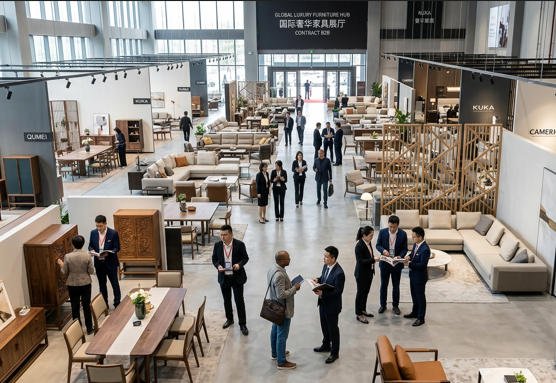
This B2B market tour provides an unfiltered look inside Foshan’s Da Fu furniture showroom — one of the world’s largest furniture sourcing destinations — and gives distributors and designers a real-world sense of the quality levels, product ranges, and pricing tiers available to B2B buyers today:
Maintaining Luxury Standards While Reducing Costs
International Quality Certifications
For B2B buyers, certifications are the objective evidence layer that converts sourcing confidence into client-facing credibility. The certification landscape for Chinese furniture exports is more robust than most buyers realize, and understanding which certifications matter for your specific market is essential due diligence.
ISO 9001:2015 (Quality Management System) establishes that a factory has documented, audited processes for maintaining production consistency — it does not guarantee product quality per se, but it does mean quality failures are traceable and correctable through a formal system. CE marking indicates conformance to European health, safety, and environmental protection standards — mandatory for products sold into the EU. Certificación FSC provides chain-of-custody documentation for timber sourcing and is now required by procurement policies at many major hotel chains and corporate fit-out clients. BIFMA and ANSI standards apply specifically to commercial furniture and are relevant for hospitality and office environment procurement.
The cost of maintaining these certifications, amortized across a Chinese factory’s high production volume, adds approximately $8–22 per unit — a fraction of the per-unit cost in lower-volume Western manufacturing contexts.
Quality Control Processes
Multi-stage inspection protocols at leading Chinese export factories typically include incoming material inspection (moisture content, grade verification, material specification confirmation), in-process inspection at frame assembly, upholstery application, and pre-finishing stages, final outbound inspection with photographic documentation, and third-party pre-shipment inspection by firms such as SGS, Bureau Veritas, or Intertek for B2B clients requiring independent verification.
| Certificación | Qué cubre | Market Relevance | Typical Cost per Unit (Amortized) |
|---|---|---|---|
| ISO 9001:2015 | Quality management system processes | Global — universal requirement for serious export | $3–8 |
| CE Marking | EU safety, health, environmental standards | Essential for Europe — EN 16139, EN 12520 | $5–14 |
| Cadena de custodia del FSC | Sustainable timber sourcing documentation | Required by hotel chains, corporate procurement | $2–6 |
| BIFMA/ANSI | Commercial furniture structural standards | USA commercial & hospitality projects | $4–10 |
| GREENGUARD Gold | Low chemical emission standards for indoor air | Education, healthcare, sustainability-focused clients | $3–8 |
| Fase 2 del CARB | California formaldehyde emission limits | Mandatory for USA market (engineered wood) | $2–5 |
Bespoke Solutions Without Premium Pricing

Bespoke luxury bedroom furniture — custom headboard profiles, designer-selected fabrics, and tailored dimensions — is now accessible at scale through leading Chinese manufacturers. Muebles Jade Ant specializes in exactly this caliber of custom B2B production.
Design Adaptation and Customization Options
The customization capability of leading Chinese furniture manufacturers has become one of the most strategically valuable assets available to interior designers and specifiers. Rapid prototyping via CNC-machined samples from CAD files means a design intent can be physically validated within 10–18 days — without the 6–8 week lead time typical of European bespoke workshops. Color, fabric, and material variations are managed through digital cutting systems that accommodate specification changes without re-tooling. Dimension customization — modifying a standard sofa’s depth by 80mm, or extending a dining table by 300mm — is handled as a production parameter adjustment rather than a bespoke commission.
For hotel fit-out designers, this means FF&E specifications can be iterated collaboratively with the factory during the design development phase, not locked in at final production. For showrooms, it means the ability to offer “configured-to-order” product with Chinese manufacturing lead times, at margins that make the offer commercially sustainable.
Production Run Flexibility
MOQ thresholds for customized product vary significantly by factory type. An integrated Foshan facility producing upholstered furniture at scale may accept custom specifications at 30-unit MOQ for fabric and color variations, 50 units for dimensional modifications, and 100+ units for new frame profile tooling. A specialist woodworking factory in Anji (China’s leading wood furniture production zone) may accept custom finish and dimension work from 20 units, given the lower tooling complexity of solid wood work. These thresholds are negotiable with established relationship partners — and companies like Muebles Jade Ant structure their B2B sourcing programmes specifically to help buyers navigate these thresholds without over-committing capital.
Direct-to-Distributor Models: Eliminating Middlemen
Traditional Distribution vs. Direct Sourcing
The traditional furniture distribution chain in Western markets operates on a markup structure that compounds at every node. A manufacturer sells to a national importer at +40–60%. The importer sells to a regional distributor at +50–80%. The regional distributor sells to a showroom at +60–120%. The showroom sells to an end client at +80–150%. By the time a dining chair with a factory cost of $180 reaches the end consumer, it carries $900–1,400 in cumulative markup — over 80% of which is distribution and brand overhead rather than product value.
Direct-to-distributor sourcing from China eliminates the national importer and regional distributor layers entirely. A showroom or design firm buying direct from a vetted Chinese manufacturer at the right MOQ threshold captures those two markup layers as margin, enabling either more competitive retail pricing, higher business profitability, or both. For furniture distributors operating on the standard keystone pricing model (2× wholesale), this structural change can move gross margin from 42% to 62–68% on equivalent product.
Margin Improvement Visualization
📊 Gross Margin Comparison: Traditional Distribution vs. Direct Chinese Sourcing
(For a $1,200 retail price point furniture piece)
Reference: US wholesale furniture gross margin at 34.7% (Statista 2022); direct sourcing estimates based on industry cost modeling. Volume tier assumes 100+ unit orders.
Building Long-Term Supplier Relationships
The most commercially sophisticated B2B buyers in the Chinese furniture market are not transactional — they are relationship investors. Long-term supplier relationships unlock exclusive territory arrangements (protecting your market positioning), collaborative product development (first access to new designs before competitors), priority production scheduling during peak periods, and progressively improved payment terms as trust is established. Factories genuinely value stable long-term clients because they simplify production planning — a client committing to 6 container orders per year is more operationally valuable than six separate buyers placing one order each.
Leveraging Chinese Manufacturing for Premium Positioning
Maintaining Luxury Perception
The most common anxiety among furniture showroom operators and interior designers considering Chinese sourcing is brand perception risk. This risk is real — but it is also entirely manageable through deliberate positioning strategy. The key insight is that luxury is communicated through how you talk about a product, not exclusively through where it was made. Emphasis on material provenance (Italian-origin fabric, FSC-certified hardwood), craftsmanship storytelling (hand-finished lacquer, eight-way hand-tied springing), and the design heritage of the aesthetic language all communicate luxury effectively — and all are factually accurate when applied to top-tier Chinese product.
The transparency approach — actively educating clients about the economics of Chinese manufacturing and positioning it as sophisticated sourcing intelligence rather than compromise — is becoming increasingly effective with design-literate B2B clients. Hotel procurement directors and commercial interior designers who understand supply chains respect a supplier who can articulate where value is captured, not just recite brand mythology.
Competitive Advantage in Your Market
The margin advantage created by direct Chinese sourcing creates strategic options that Western-sourced competitors simply do not have. A showroom operator sourcing at 65% gross margin on a $3,200 sofa can choose to retail it at $4,800 (below Western-sourced competitors), retain the full margin at $6,000+ (matching Western pricing with superior profitability), or invest a portion of margin in superior client experience, faster delivery, or more comprehensive warranty terms — all of which create sustainable competitive differentiation without engaging in a race-to-bottom pricing battle.
China’s Manufacturing Regions: Intelligence for B2B Buyers
Not all Chinese furniture manufacturing is the same, and regional specialization matters significantly for sourcing strategy. Understanding which production hub aligns with your product category is one of the most practically valuable pieces of knowledge for B2B buyers entering the Chinese market.
🏭 Foshan, Guangdong
- Handles ~75% of China’s total furniture output
- World’s largest furniture manufacturing cluster
- Specializes in: upholstered, cabinet, hotel FF&E
- Home to the world’s largest furniture market (Lecong)
- Best for: high-volume, diverse product sourcing
🏭 Dongguan, Guangdong
- Known for higher specification, premium output
- Built-in quality assurance reputation
- Specializes in: wooden luxury, executive furniture
- Favored for European-standard export compliance
- Best for: quality-first sourcing, smaller volumes
🏭 Anji, Zhejiang
- China’s bamboo and solid wood furniture capital
- Specializes in: bamboo furniture, dining chairs
- Strong sustainability and FSC credentials
- Competitive for natural material categories
- Best for: eco-focused buyers, organic material specs
🏭 Shunde & Guangzhou
- Proximity to Canton Fair logistics infrastructure
- Strong in: contract and commercial furniture
- Office furniture and hospitality seating focus
- Advanced automation investment
- Best for: commercial & office project sourcing
For a comprehensive breakdown of China’s leading furniture factory clusters and their capabilities, the Jade Ant Furniture factory guide provides detailed intelligence on selecting the right manufacturing hub for specific product categories — including which regions offer the strongest compliance documentation for European and North American markets.
Quantifying the Business Benefits
Margin Improvement Analysis
The financial impact of a strategic shift to direct Chinese sourcing is best illustrated through a concrete scenario rather than abstract percentages. Consider a furniture showroom currently sourcing a 3-piece living room set (sofa + two accent chairs) from a European importer at a wholesale cost of $4,200, retailing at $7,800 — a 46% gross margin. The equivalent set, specified to identical material standards through a vetted Chinese manufacturer at 100-unit volume, lands at $1,680 total landed cost including freight and customs. At the same $7,800 retail price, gross margin moves to 78.5%. At a more competitive retail price of $5,900 (still 28% below the European-sourced competition), gross margin is 71.5% — with significant competitive price advantage driving volume.
The margin improvement — from 46% to 71–78% — on a single product category, applied across a showroom’s full range, represents a business transformation, not an incremental improvement.
| Scenario | Wholesale / Landed Cost | Retail Price | Gross Margin | Margin per Unit |
|---|---|---|---|---|
| European Import (current) | $4,200 | $7,800 | 46.2% | $3,600 |
| China Direct – Same retail | $1,680 | $7,800 | 78.5% | $6,120 |
| China Direct – Competitive price | $1,680 | $5,900 | 71.5% | $4,220 |
| China Direct – Value positioning | $1,680 | $4,200 | 60.0% | $2,520 |
Landed cost estimate includes FOB price, ocean freight, import duties (~10% post May 2025 tariff revision for US market), and port handling. Figures are illustrative based on industry cost modeling.
Cash Flow and Working Capital Benefits
Beyond margin improvement, direct Chinese sourcing offers working capital advantages that are frequently overlooked in initial ROI analysis. Payment terms for established B2B relationships typically structure as 30% deposit on order, 70% against bill of lading — meaning 70% of the purchase cost is only paid when the goods are verified aboard the vessel. Extended terms of 60–90 days from shipment are achievable for buyers with established relationships and volume commitments. The combination of lower absolute cost and more favorable payment timing can meaningfully improve a distributor’s working capital position even before the margin uplift is counted.

A fully specified luxury living room project — marble fireplace surround, premium upholstered sofa, designer accent chairs, and custom rugs — represents exactly the B2B project scale that direct Chinese sourcing makes commercially viable for interior designers and hotel fit-out specialists.
Making the Strategic Decision
Is Chinese Luxury Furniture Right for Your Business?
The honest answer is: it depends on your market positioning and your willingness to invest in the sourcing infrastructure. For furniture distributors operating at volume, interior designers with recurring project pipelines, hotel fit-out specialists with bulk procurement needs, and showrooms competing in value-conscious markets — the case is overwhelmingly strong. The economics are structural, not cyclical. The quality gap at the premium factory tier has closed to the point where it requires deliberate effort to find, rather than being the default assumption.
The buyer types for whom Chinese sourcing requires more careful strategy are those selling to ultra-high-net-worth clients for whom European brand provenance is genuinely part of the purchase decision — not as quality proxy, but as status signal. In those markets, Chinese manufacturing can still play a role (particularly in project categories where brand visibility is lower), but it requires more sophisticated positioning work.
Next Steps: Sourcing and Partnership Development
Vetting potential Chinese manufacturers requires a systematic approach that goes beyond Alibaba listings. The key evaluation criteria include factory age and export history (minimum 5 years of documented export experience to your target market), certification documentation (ISO, relevant market certifications, FSC if applicable), sample quality protocol (never commit volume without evaluated production samples, not showroom samples), and client references from B2B buyers in similar categories. For a detailed factory vetting framework, this B2B supplier selection guide walks through the complete due diligence process.
Payment structure negotiation should be approached as part of relationship building, not a transactional demand. Starting at standard 30/70 T/T terms, demonstrating reliable order placement and payment history, and progressively negotiating toward 20/80 or extended terms over 2–3 order cycles is the path that top B2B buyers follow to optimize working capital without creating adversarial supplier relationships.
The Future of Luxury Furniture Manufacturing
The trajectory of Chinese furniture manufacturing is not toward commoditization — it is toward premiumization. The China luxury furniture market was valued at $4.1 billion in 2025 and is projected to reach $6.8 billion by 2035, driven by domestic demand for premium product and export demand from B2B buyers who have recognized the quality convergence. Sustainability investment is accelerating: FSC adoption, GREENGUARD certification, and carbon footprint documentation are becoming standard requirements from European and North American B2B buyers, and leading Chinese manufacturers are responding with measurable investment. The supply chain of 2030 will look substantially different from 2020 — and the B2B buyers who build relationships and category knowledge now will be positioned to capture disproportionate advantage from that evolution.
For distributors, designers, and showroom operators ready to explore what direct Chinese manufacturing partnerships look like in practice, the Jade Ant Furniture team works specifically with B2B buyers across these categories — from initial category assessment through factory matching, sample evaluation, and ongoing quality management support.
Frequently Asked Questions: B2B Chinese Furniture Sourcing
These FAQs address the most common questions from furniture distributors, interior designers, showroom operators, and hotel procurement specialists considering Chinese luxury furniture manufacturing partnerships.
Remote quality assurance has become a well-developed practice in the Chinese furniture export industry. The most effective approach combines multiple verification layers: commission a third-party pre-shipment inspection from SGS, Bureau Veritas, or Intertek — these firms conduct standardized structural, finish, and dimensional testing to your specifications for approximately $300–600 per inspection. Request factory video documentation of production, including material cutting, frame assembly, and finishing stages for your specific order. Insist on certified production samples (not showroom samples) before placing volume orders, and verify all claimed certifications directly through the issuing body’s online registry — ISO certificates, FSC certificates, and CE documentation all have publicly searchable verification systems. Established sourcing partners like Muebles Jade Ant maintain ongoing factory relationships with documented QC histories, which significantly reduces the due diligence burden for new B2B buyers.
MOQs vary significantly by product category and customization level. For standard catalogue product in established designs, MOQs can be as low as 5–10 units per SKU at major Foshan wholesale markets. For export-grade production with full QC documentation, 20–30 units per SKU is more typical. Customization thresholds typically start at 30 units for fabric and color changes, 50 units for dimensional modifications, and 100+ units for new frame tooling. Pricing responds to volume in meaningful tiers — expect 8–12% reduction at 50+ units, 15–22% at 100+ units, and negotiable rates above 200 units that can reach 30–35% below base price. For buyers with limited capital or storage capacity, consolidating orders across multiple SKUs into a single container shipment often enables better pricing than individual SKU volumes suggest. This sourcing platform guide provides additional context on MOQ negotiation by channel.
The required certification set depends on your target market. For European sales: CE marking (mandatory for relevant product categories), FSC Chain of Custody (increasingly required by corporate and hospitality clients), and ISO 9001:2015 (quality management baseline). For North American sales: CARB Phase 2 compliance (mandatory for engineered wood products sold in the US), BIFMA/ANSI structural standards (commercial environments), and GREENGUARD Gold (healthcare, education, and sustainability-conscious clients). Always verify certificates directly through the issuing body — ISO certificates via the ISO online portal, FSC via the FSC certificate database, and GREENGUARD via the UL Product Lens database. Never rely solely on a factory’s self-presented documentation without independent verification.
Standard production lead times for catalogue product at Chinese factories run 25–45 days. Custom orders with new material specifications or dimensional modifications add 10–20 days. Ocean freight from Guangzhou to major European ports runs 25–32 days; to US East Coast ports, 30–38 days; to West Coast, 16–22 days. Total lead time from order confirmation to warehouse receipt therefore ranges from 55–80 days for standard product to 70–100 days for custom orders — compared to 30–60 days for European manufacturers (production only, without the compensating cost advantage). The practical implication for inventory planning is that Chinese sourcing rewards forward forecasting: buyers who plan seasonal purchases 90–120 days ahead capture the full cost advantage without expediting cost. Air freight is available for urgent requirements at 5–7 day transit times but significantly increases landed cost and is rarely appropriate for large furniture pieces.
Standard payment terms for new B2B relationships are 30% deposit (T/T bank transfer) on order confirmation and 70% balance against the bill of lading before shipment release. Established buyers with documented order history can negotiate 20/80 structures or deferred payment terms of 30–60 days from bill of lading date. Letter of Credit (L/C) arrangements are accepted by most export-oriented manufacturers and provide buyer protection through bank intermediation. For buyers importing to markets with established trade finance infrastructure, bank-supported documentary collection (D/P or D/A) provides additional payment security. Currency risk is typically managed by invoicing in USD, though EUR invoicing is available from larger factories. Some manufacturers offer early payment discounts of 1.5–3% for full payment on order — worth evaluating against working capital cost if cash flow allows.
The most important protection against post-shipment disputes is pre-shipment inspection — defects identified before the container is sealed are resolved at zero additional cost; defects identified after delivery involve freight, replacement production, and timeline costs that erode margin. For issues that do arise post-delivery, establish the claim protocol before placing your first order: document defects with timestamped photographs within 7 days of receipt, submit claims in writing with photographic evidence to your supplier contact and copy to any quality assurance agreements. Reputable manufacturers offering export warranty programs typically cover manufacturing defects (not transit damage, which is covered by cargo insurance) with replacement parts or credit against future orders within 12 months. Ensure your cargo insurance covers transit damage specifically, as this is separate from manufacturer warranty. Marine cargo insurance through your freight forwarder or an independent marine insurer is essential for all shipments.
Yes — and custom production capability is one of the most strategically underutilized advantages of Chinese manufacturing for B2B buyers. The typical process begins with design brief and reference images, followed by a factory CAD rendering for approval (3–7 days), then a physical sample production (10–18 days for upholstered; 14–25 days for complex wooden pieces), sample evaluation and revision cycles (1–3 rounds typical), and then production order. Tooling costs for new frame profiles range from $800–3,500 depending on complexity, amortized across the production run. For hospitality projects where a design is specified across 50–300 identical pieces, tooling cost becomes negligible per unit. Color, fabric, and dimension customizations on existing frame profiles typically carry no tooling cost and add 5–10 days to standard lead time. The key to efficient custom production is providing precise technical drawings or clear physical reference — the more specific your input, the fewer revision cycles required.
IP protection in Chinese manufacturing requires a layered strategy rather than relying on a single mechanism. Start with a comprehensive NDA and confidentiality agreement drafted under Chinese law (not just your home country’s law) — a China-law NDA is enforceable in Chinese courts, whereas foreign-law agreements are significantly harder to enforce. Register your key designs as Chinese utility model patents or design patents before sharing detailed specifications — Chinese IP registration is faster and more affordable than many buyers expect. Work with factories that produce for multiple market regions so their commercial interest in maintaining your exclusivity is aligned with their overall reputation. Some buyers split component production between factories to prevent any single supplier having complete product knowledge. For high-value original designs, limit factory access to production drawings rather than concept development documentation. WIPO’s China IP resources provide practical guidance on registration procedures.
Total landed cost (TLC) is the only figure that enables accurate margin calculation — FOB price alone is meaningfully incomplete. The full TLC calculation includes: FOB price (factory + domestic freight to port), ocean freight (typically $1,800–4,500 per 20ft container, $2,800–6,500 per 40ft container depending on route and market conditions), marine cargo insurance (typically 0.3–0.5% of CIF value), import duties (varies by market — as of 2025, US tariffs on Chinese furniture are approximately 10–14% under current trade agreements; EU rates apply standard MFN duties), port handling and customs clearance fees ($300–800 typical), and inland delivery to your warehouse. For a practical example: a $8,000 FOB container of living room furniture to a US East Coast port might carry $3,200 freight + $350 insurance + $800–1,100 duty + $500 port fees = $4,850–5,150 in additional costs on top of FOB price. Use this full calculation — not FOB price alone — when evaluating margin against your retail price points.
Regional specialization is a genuine and practically important differentiator for B2B buyers. Foshan (and its sub-districts including Lecong and Longjiang) handles approximately 75% of China’s total furniture manufacturing volume and offers the broadest product range — upholstered furniture, cabinet furniture, dining, bedroom, and hotel FF&E. It is the right starting point for most B2B buyers seeking diverse category coverage. Dongguan has built a reputation for higher-specification output, particularly in wooden luxury furniture and executive-grade pieces — buyers prioritizing quality consistency with lower quality management overhead often prefer Dongguan factories despite somewhat higher prices. Anji in Zhejiang is China’s definitive centre for solid wood and bamboo furniture, with strong sustainability credentials. Shunde and the broader Guangzhou area specialize in commercial and contract furniture with advanced automation. For upholstered product specifically, the Foshan-Dongguan corridor is without peer globally. For sustainable solid wood specification, Anji warrants specific exploration. Detailed regional intelligence is available through Jade Ant’s factory region guide.
Ready to Transform Your Furniture Business Margins?
Whether you’re a furniture distributor, interior designer, showroom owner, or hotel fit-out specialist — the opportunity to substantially improve margins while maintaining luxury positioning is a strategic decision away.
- Schedule a consultation with our sourcing specialists to evaluate your specific product categories and volume requirements
- Request our manufacturer vetting checklist and quality assurance protocol documentation
- Access our pricing comparison framework for your specific product categories
- Connect with pre-vetted Chinese manufacturers aligned to your luxury positioning requirements
- Don’t leave 70% in margin savings on the table — begin your strategic sourcing journey today
Explore our full range: Living Room | Bedroom | Dining Room | About Jade Ant